
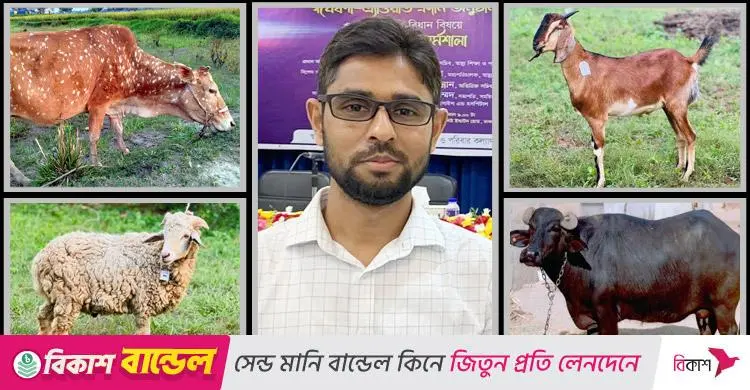
Foot-and-mouth disease (known locally as khura rog) is one of the main viral diseases of livestock in Bangladesh. It reduces an animal's normal capacity and, in dairy animals in particular, sharply cuts milk production, causing farmers big financial losses. It is a name that frightens them. The disease can occur in any season but is comparatively more common in the monsoon. Taking the right steps in time can bring infection largely under control.
Dr Md Golzar Hossain, professor and researcher in the Department of Microbiology and Hygiene at Bangladesh Agricultural University, spoke to Jago News about the disease's symptoms, spread, prevention and what to do. The piece was written by Mohammad Sohel Rana.
What is foot-and-mouth disease
Foot-and-mouth disease (FMD), referred to in the article as "hand, foot and mouth disease", is a severe, highly contagious viral disease of livestock. It mainly affects cattle, pigs, sheep, goats and other cloven-hoofed animals, and causes heavy economic losses in Bangladesh and around the world. The virus is small and non-enveloped, with a genome of positive-sense, single-stranded RNA. It belongs to the family Picornaviridae and the genus Aphthovirus.
A feature of the virus is that it can infect cloven-hoofed animals. It has seven distinct serotypes: O, A, C, SAT 1, SAT 2, SAT 3 and Asia 1. In Bangladesh, outbreaks involve serotypes A, O and Asia 1.
When it strikes
The virus can stay active in the environment for a long time and is seen all year round. It is generally more common in the monsoon and at the start and end of winter. A study in Bangladesh found it was more frequent in the post-monsoon season. This is due to several factors, including rising humidity, waterlogging and changes in animal behaviour.
Symptoms
- Body temperature rises to about 40 degrees Celsius (fever).
- Blisters form on the tongue, palate, lips and gums, the tip of the nose, the base of the hooves, the gap between the hooves, and the teats of milking cows.
- Severely affected cattle drool excessively and stamp their feet. Milk yield falls in dairy animals.
How it spreads
- Through direct contact with infected animals.
- Through indirect contact with secretions and excretions of infected animals (such as semen and milk).
- Through carriers such as people, horses, dogs, cats, birds and vehicles.
- The virus can spread through the air.
- The virus can enter the body through breathing, feed, and skin wounds or mucous membranes.
Prevention and supportive care
Foot-and-mouth disease can be prevented by timely, effective vaccination and by following biosecurity. There is no specific treatment or medicine for infected animals, but some supportive treatment is given so that bacterial infection does not set in on the wounds. The wounded blisters on the mouth, tongue, feet, hooves and teats should be washed with one of the following solutions, mixed with water in the right amount: normal saline, citric acid 1% or potassium permanganate 1%, alum 2%, or methylene blue 1%.
Protecting healthy animals
- Isolate infected animals completely from healthy ones as quickly as possible to stop the spread.
- Stop moving animals from the farm to other places, and ban bringing outside animals onto the farm.
- Disinfect the farm surroundings and animal housing regularly.
- Wash hands and clothes, especially after touching infected animals.
- Vaccinate all healthy animals at risk quickly.
- Inform farmers, livestock keepers and workers about the symptoms, routes of infection and prevention of the disease.
Mistakes that can spread the disease
- Reluctance or irregularity in vaccination against foot-and-mouth disease.
- Failing to isolate infected animals quickly.
- Not keeping the farm and animal housing disinfected.
- Not washing hands and face or changing clothes.
Source: Jagonews24. First published in Bengali on The Agro News.

Comments
(0)