
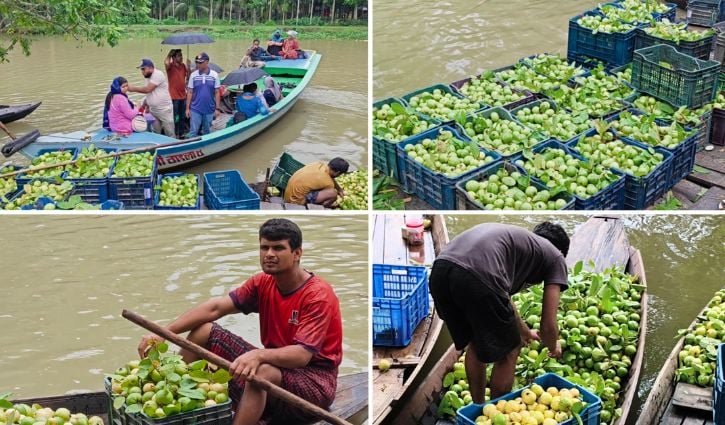
At the height of the guava season, growers from Atghar-Kuriana, Adamkathi, Jindakathi and neighbouring villages in Nesarabad upazila of Pirojpur set out each morning in small dinghies loaded with freshly picked green-and-yellow guava, converging on the Atghar-Kuriana canal, a branch of the Sandhya river. Rows of boats fill the canal; once a price is agreed with a wholesaler the fruit is transferred to plastic trays and covered with banana leaves for the journey. From this, the country's only floating guava market, hundreds of maunds leave daily for Dhaka, Chattogram, Khulna and Barishal, selling at Tk 700-800 a maund.
Soumitra Sarker, deputy director (Khamarbari) of the Department of Agricultural Extension in Pirojpur, said the district grew guava on 710 hectares last year for 7,210 tonnes and on 716 hectares this year for 7,692 tonnes, with more than Tk 18-20 crore of fruit changing hands at the market every season. Nesarabad has the largest area, with orchards also in Nazirpur, Zianagar, Bhandaria and Kaukhali and more than a thousand growers involved. A mini cold store at Atghar-Kuriana, he said, would let growers hold seasonal fruit and secure a fair price.
Md Mahfuzur Rahman, Nesarabad's upazila agriculture officer, said the upazila has 600 hectares under guava, expects 9.5-10 tonnes a hectare this year and good prices; the office gives growers advice and training, and some entrepreneurs market guava jam and jelly. The local fruit is large and sweet and in strong demand; since the Padma Bridge opened, demand has grown further, produce reaches its destination faster and cultivation has spread to neighbouring districts.
Aminul Islam, a wholesaler from Bagerhat, said guava like this grows nowhere else in Bangladesh and sells readily. Local trader Riaz Hossain said bad weather cut the crop a little this year but prices are good. Robin Das, who farms 13 bighas, picks his fruit at dawn every day and rows it to the market.
The market also draws crowds of visitors in season. Rumi Khanam from Dhaka, who left the night before and arrived in the morning, spoke of guava, hog-plum and lemon trees lining the roads and fruit being sold from boats; visitors complain, though, of no hotel, public washrooms, parking or rest house. Upazila nirbahi officer Amit Dutta said government wash-blocks have been built at three guava parks, more are planned at the boat market and elsewhere subject to funds, and a plan is being drawn up for visitors' lodging, food and security.
From a Risingbd report by Nasrullah Al-Kafi. Source: Risingbd
Comments
(0)