
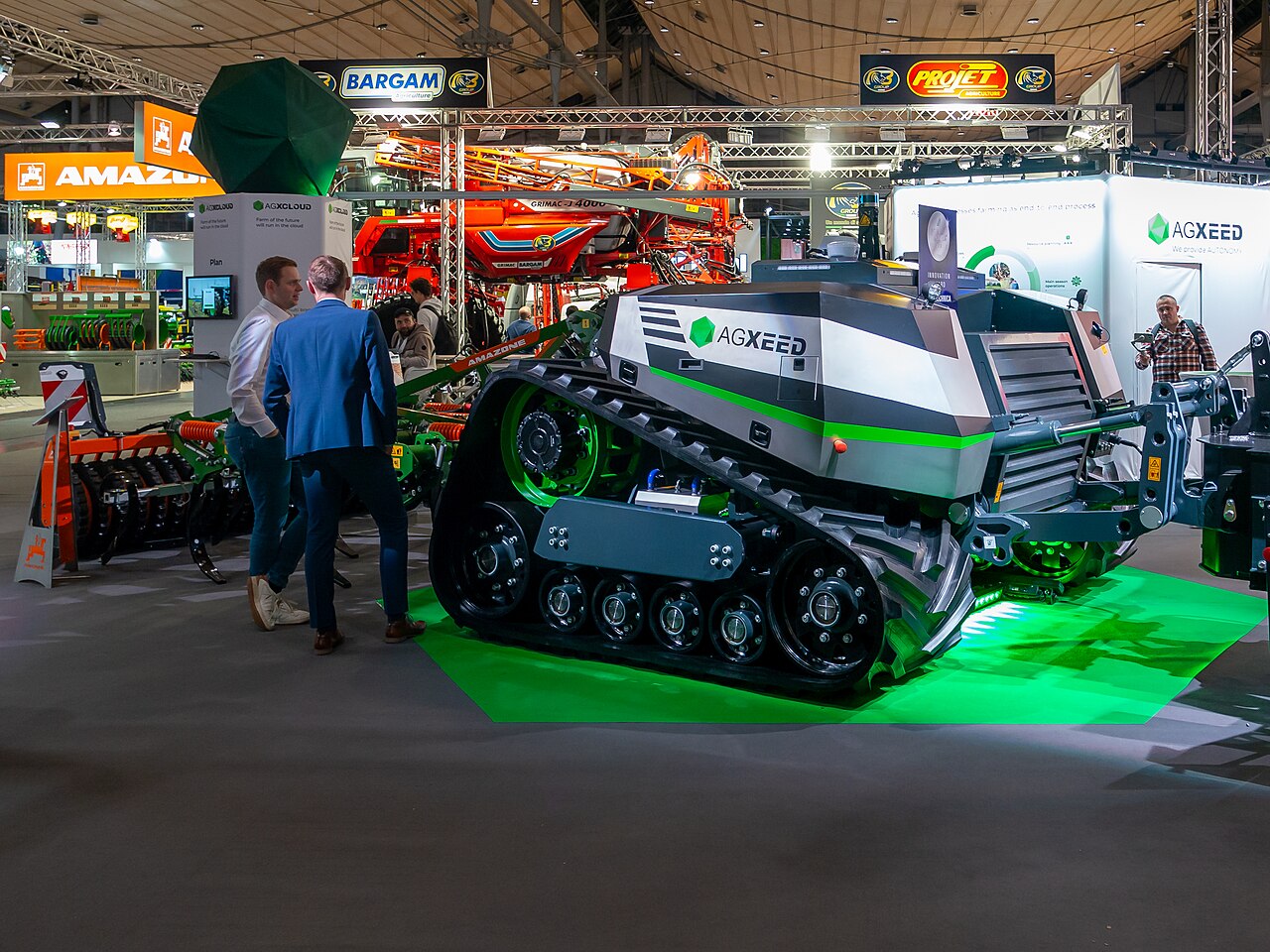
Dutch arable farmer Marijn Vermuë has worked with two kinds of driverless machine and concluded that both are mature enough to justify the investment, though each suits a farm differently, Future Farming reported. In 2025 he used an AgXeed AgBot 5.115T2, a purpose-built, cabless autonomous tracked tractor, for a whole season; in mid-October 2026 he spent a week with GPX Solutions' iQuus retrofit kit fitted to a New Holland T6.180.
The difference is basic. The AgBot is a robot that has no seat for a driver, while the iQuus kit turns an ordinary tractor into one that can work alone but can still be driven by an operator, for example on the road. Vermuë, who farms in Werkendam, stressed that his trial was not a contest with a winner but a weighing of factors that depend on each farm.
He found iQuus "very straightforward" to set up: on 13 October it took under an hour to get the tractor cultivating a field after potatoes for the first time, and under 10 minutes in the next field. Route planning, he said, was as practical as AgXeed's, the two differing the way iOS and Android do. Quick set-up matters to him because several people may use the machine in a season. iQuus asks only for the implement's working width, which saves time, but it cannot yet work headlands on its own; an operator has to drive those.
The sharpest contrast is safety. AgXeed treats the field boundary, the geofence, as absolute: the machine and its implement can never cross it. GPX makes the boundary less rigid, warning that a planned route may be dangerous and leaving the operator to decide. That lets a plough turn over above a ditch, Vermuë said, but a badly planned route could put the tractor into one. GPX's Joanne de Ruiter said a completely restrictive geofence is possible, but customers do not want it.
Transport also differs: the AgBot needs a low-loader to reach the field, while the retrofitted tractor drives there, though the farmer then needs a lift home. On cost, GPX says a system of about €50,000 splits evenly between parts fixed to the tractor and parts that can move to a second prepared tractor. Preparing each tractor costs €25,000 and the movable set €25,000, so two tractors cost €75,000, letting a farmer run light crop care and heavy work such as deep spading autonomously.
Photo: MB-one / Wikimedia Commons (CC BY-SA 4.0)
Source: Future Farming

Comments
(0)