
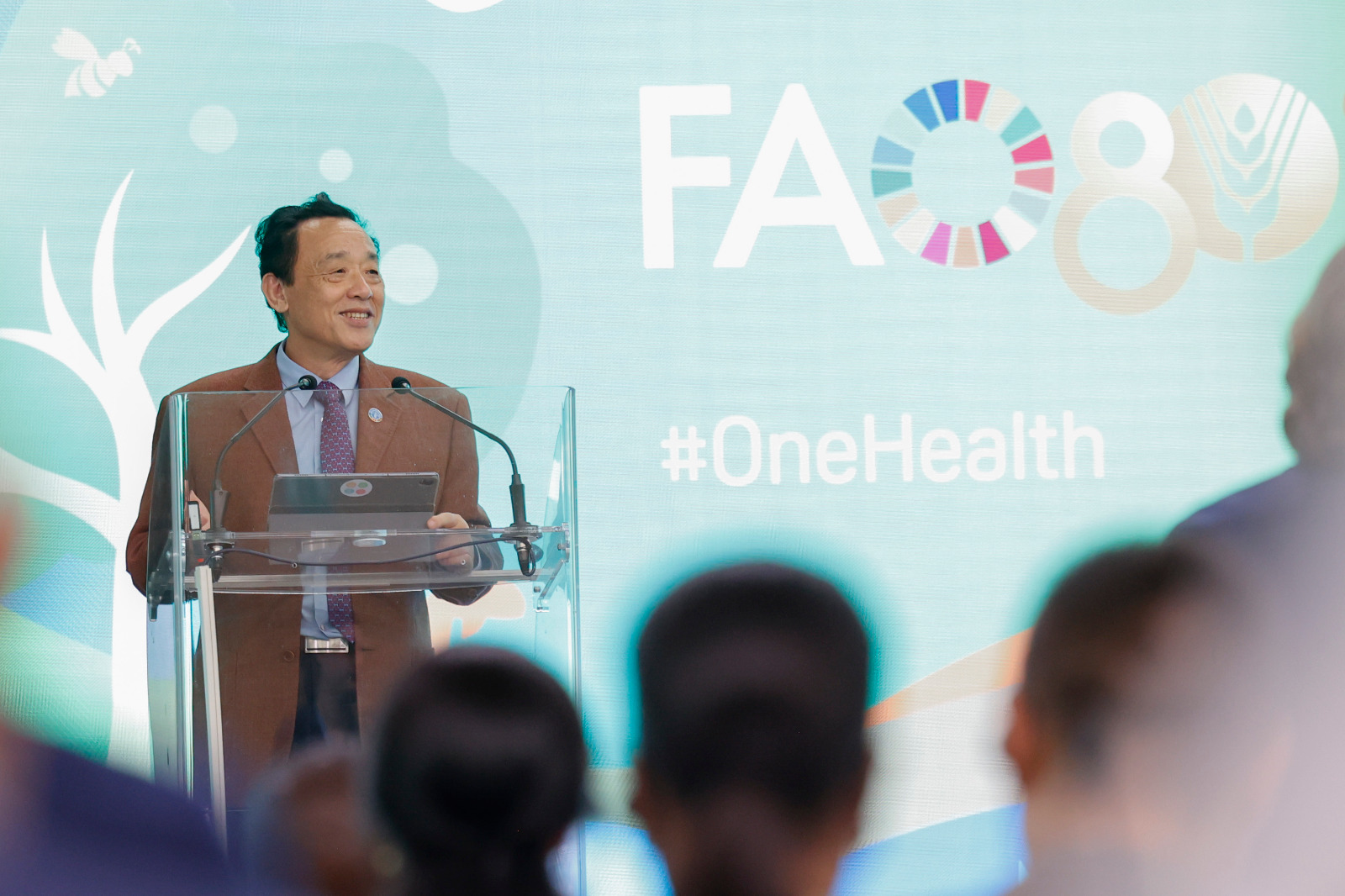
The Food and Agriculture Organization of the United Nations opened its Global Conference for Actions on One Health in Agrifood Systems at its Rome headquarters on 21 September, with Director-General QU Dongyu telling delegates that the health of people, animals, plants and ecosystems cannot be managed apart from farming. "One Health is a farmer's agenda, a scientist's agenda, and a Minister's agenda," he said.
Qu set out the links in farm terms: degraded soil weakens crops and animal feed, poor water quality carries pathogens between animals and people, and pests and diseases destroy an estimated 20 to 40 percent of global crop production every year. Because those threats cut across several ministries, he said, governments, scientists, farmers, Indigenous Peoples, youth and civil society have to work in a coordinated way, and the conference is meant to move countries from dialogue to practical action, priority measures and investment.
Tanzania's Prime Minister Mwigulu Lameck Nchemba attended the opening alongside ministers responsible for agriculture, health, livestock, fisheries and the environment. Serbia's Prime Minister Djuro Macut and Swiss President Guy Parmelin sent video messages. Among the ministers taking part were Abdul Awal Mintoo, Bangladesh's Minister of Environment, Forest and Climate Change; Annie Genevard, France's Minister of Agriculture; Martin Heydon, Ireland's Minister for Agriculture, Food and the Marine; Yu-Kyoung Oh, the Republic of Korea's Minister of Food and Drug Safety, by video; and Mustapha Ferjani, Tunisia's Minister of Public Health. XIA Gang, Deputy Director General of China's National Disease Prevention and Control Administration, also attended.
To back the effort with data, FAO launched the Sustainable Livestock Transformation and One Health Intelligence & Knowledge Hub, a single online gateway that brings livestock statistics, analytical tools and information on FAO's livestock work into one place. Its dashboards, organised by theme and region, cover livestock production, animal health risks, antimicrobial resistance, climate and environmental interactions, and related economic and social questions; a Livestock AI Assistant helps users find their way across the tools. FAO says the hub is meant to strengthen early warning and preparedness and to give policy, investment and planning a firmer evidence base.
On the same day FAO, the World Health Organization, the World Organisation for Animal Health and the Convention on the Conservation of Migratory Species of Wild Animals presented the Global framework to accelerate action on avian influenza, which sets joint goals and areas of cooperation among the four bodies on bird flu in animal and public health and in the protection of wildlife.
The conference runs to 23 September and builds on FAO's work on a One Health in Agrifood Systems Framework, requested by the Organization's Committee on Agriculture in 2024, which is to give countries practical guidance for bringing One Health into their policies, investments and programmes. For livestock and poultry producers in South Asia, where avian influenza and antimicrobial resistance are recurring concerns, the new hub and the four-agency framework are the conference's most concrete outputs so far.
Source: FAONewsRoom

Comments
(0)