
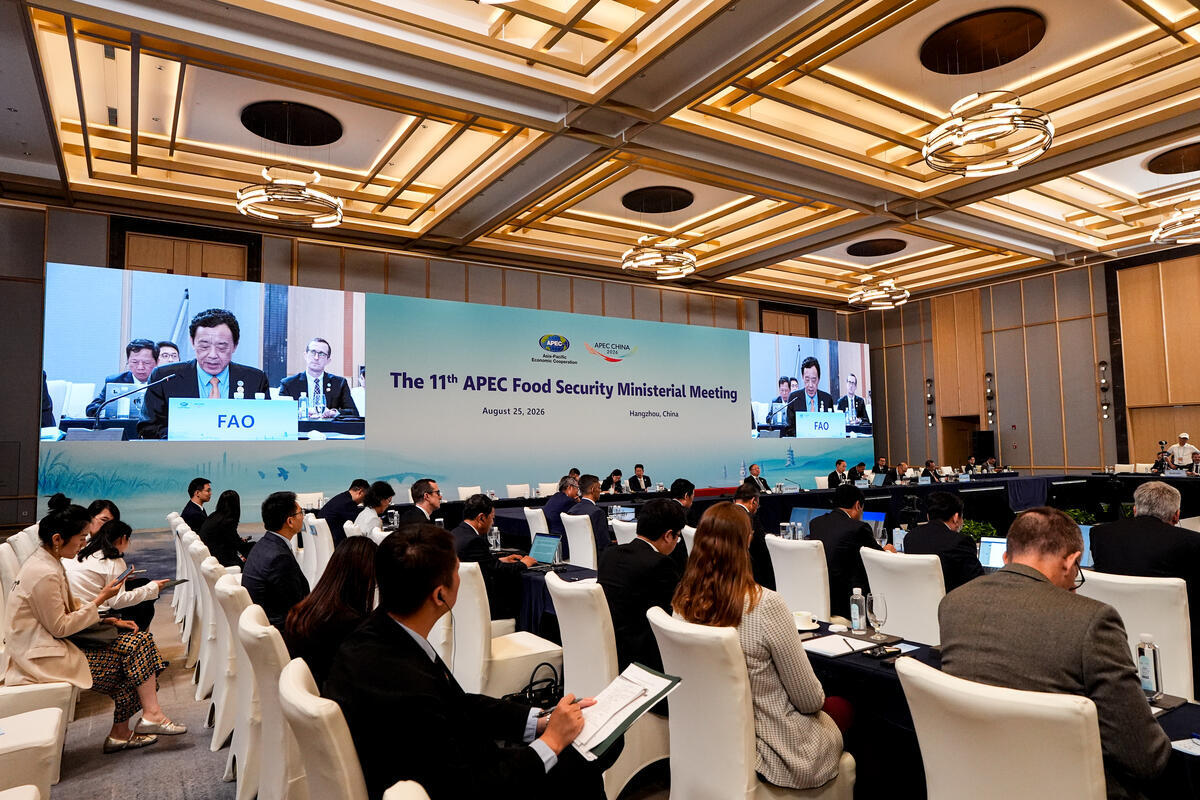
The Asia-Pacific region must put science, technology and artificial intelligence at the centre of transforming its agrifood systems — but on condition that innovation closes rather than widens the divides that already exist, FAO Director-General QU Dongyu told the 11th APEC Food Security Ministerial Meeting in Hangzhou.
"Science, technology and AI must not widen the triple divide — digital divide, rural divide, and gender divide — it must help close them," he said during a panel on technological innovation and digital agriculture.
The region's record is mixed. In 2025 the prevalence of undernourishment in Asia was 25 percent lower than in 2015, yet around 292 million people in Asia still face hunger and nearly one third of the population cannot afford a healthy diet. "Food security is about more than just producing enough food — it is about producing the right food, making it accessible and affordable, and doing so sustainably," the Director-General said.
He set out a plain test for the technology itself. The true measure of digital agriculture, he argued, is not the sophistication of an algorithm but whether innovation delivers for people: letting farmers produce more with less, helping families reach healthier food at prices they can pay, strengthening rural communities against climate shocks and allowing agriculture to prosper without exhausting natural resources.
On AI specifically, Qu called for it to be used as a "force multiplier" that turns large volumes of data into practical decisions — weather forecasting, early warning of pests and diseases, optimising irrigation and inputs, improving supply-chain efficiency and matching supply with demand more closely. His caveat was memorable: "We can make use of AI, but we cannot eat AI."
He also offered his own reading of "SMART" agriculture: s for science driven, m for machine learning, a for AI, r for resilience and t for transformation of the agrifood system. Alongside digital tools he pointed to biotechnology, precision agriculture and smart machinery, and insisted their benefits must reach rural communities as better livelihoods, nutrition and resilience.
Beyond technology, the Director-General called for diversified production, stronger local food systems, improved food safety and greater access to nutritious, affordable food, together with rural revitalisation through infrastructure, digital connectivity, stronger value chains and more opportunity for women and young people. Innovation, he added, should be treated as a regional public good, with economies sharing data, knowledge, technologies, standards and good practice so that solutions reach scale faster.
His remarks came a day after FAO signed a Memorandum of Understanding with Hunan Agricultural University on cooperation in food security, sustainable agricultural development, digital agriculture and South-South and Triangular cooperation.
Source: FAO Newsroom
Comments
(0)