
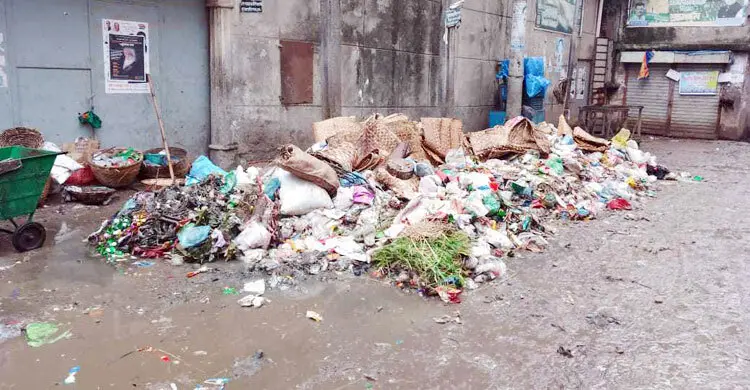
Dhaka South City Corporation (DSCC) mayor Sheikh Fazle Noor Taposh had announced that the waste from sacrificed animals would be removed within 24 hours. But 48 hours after that pledge, the waste still lay piled on streets and lanes across the city, especially in the alleys of Old Dhaka. As it rots, the stench is spreading through the air and badly polluting the environment.
Officials of the DSCC waste management department say they removed the Eid-day waste before the deadline set by the mayor. Many people in Old Dhaka sacrifice their animals on the second or third day of Eid, they say, and waste has built up in only one or two such places. The DSCC would remove it by Wednesday night (19 June).
Eid-ul-Azha was celebrated in the country on 17 June. On 12 June, visiting the National Eidgah grounds, Taposh announced that the waste would be removed within 24 hours. Before Eid, however, he left for the United States with his family, and he monitored the waste removal online from there.
Piles in Old Dhaka wards
The DSCC has 75 wards. Ward 33 is made up of Aga Sadek Road, Bangshal Road, Abdul Hadi Lane, Chankharpul Lane, Shikkatuli Lane and Abul Hasnat Road. At 1pm on Wednesday (19 June), waste from sacrificed animals lay heaped on Aga Sadek Road. Rainwater had washed it across the road, and it was giving off a foul smell as it rotted. People were holding their noses as they passed, but there was little sign of the DSCC removing it. Waste was also seen lying in Shikkatuli Lane.
Mostafa Kamal, a resident of Aga Sadek Road, said the waste in most of Old Dhaka had not been removed as the mayor had announced. The waste on Aga Sadek Road was from the first day of Eid, he said, and the smell was now so bad that people in nearby buildings could not open their doors and windows.
But Awal Hossain, councillor of ward 33, told Jagonews that all the waste in his ward had been removed on the first day. Many people could not find butchers and were sacrificing their animals on the second or third day, he said, although the city corporation had asked people to finish by the second day. Any waste lying anywhere that day would be removed by the afternoon, he said.
Ward 34 covers Siddique Bazar, Haji Osman Gani Road, Nazirabazar Lane, Kazi Abdul Hamid Lane, Kazi Ala Uddin Road and the old Fulbaria railway station area. Waste was seen piled on Kazi Ala Uddin Road and in Siddique Bazar, much of it spreading to the front of nearby homes and shops.
Nazrul Islam, a resident of Kazi Ala Uddin Road, said rubbish was dumped all year round in front of holding No 34 on the road, and it was now piled with sacrificial waste, although the spot is less than 200 metres from Nagar Bhaban, the city corporation's headquarters. Waste was likewise heaped on the road in Siddique Bazar, which borders Nagar Bhaban. People in the neighbourhood were very angry at the corporation's negligence, he said, and this mismanagement had to end.
Sacrificial waste was also seen scattered on the streets of Kazi Zia Uddin Road and Samsabad Lane in ward 32; Kazi Zia Uddin Road, Jindabahar, Moulvi Bazar, Begum Bazar and Armenian Street in ward 31; Orphanage Road in ward 27; Pushparaj Saha Road and Jagannath Saha Road in ward 25; and Shanir Akhra in ward 62.
What the DSCC says
Mohammad Nasim Ahmed, chief waste management officer of the DSCC, told Jagonews that Eid sacrifices in Old Dhaka are something of an exception within Dhaka South, as animals are slaughtered there for up to three days. Many animals were sacrificed on Wednesday (19 June), and their waste would be removed by the afternoon, he said. All the waste from the first and second days of Eid had already been removed.
According to the DSCC public relations department, 10,247 workers worked on removing waste from the cattle markets and the slaughtered animals this year. Although the target for removing the waste was 24 hours, the first day's work was completed in 10 hours and 15 minutes, and by 5pm on the second day waste had been removed from 59 of the 75 wards. In all, 17,692 tonnes of waste had been removed in 3,655 trips by 5pm on Tuesday (18 June).
On Tuesday afternoon, Taposh joined a press conference online through the central control room set up in the Shitalakshya Hall of Nagar Bhaban and spoke to journalists about the overall work of removing the waste generated during Eid-ul-Azha.
Asked about waste left lying in several places, Taposh said animals are slaughtered at different times by different people, so after the corporation has cleaned an area, many people dump the waste of their slaughtered animals in various places. There are some isolated incidents of this kind, he said. Many also mix sacrificial waste with cattle market waste, and some people sacrifice on the second and third days. "But we announce it only once it is 100 per cent clean, and it is not true that the first day's waste was left lying uncleared in several places," he said.
North city ahead
No sacrificial waste was seen in four wards of the Dhaka North City Corporation (DNCC) area — wards 19, 20, 24 and 27. The DNCC waste management department said that on the instructions of mayor Atiqul Islam it had removed sacrificial waste from all wards between 2pm and 8pm on Eid day, within six hours. The waste from the second day of Eid had also been removed, and hardly anyone sacrificed animals on Wednesday (19 June), the third day of Eid.
On Tuesday night, DNCC public relations officer Maqbul Hossain said the work began at 2pm on Eid day and 100 per cent of the waste in all wards was removed by 8pm, within the set six hours. The corporation had likewise removed all the waste from sacrifices on the second day of Eid, he said.
Source: Jagonews24. First published in Bengali on The Agro News.
Comments
(0)