
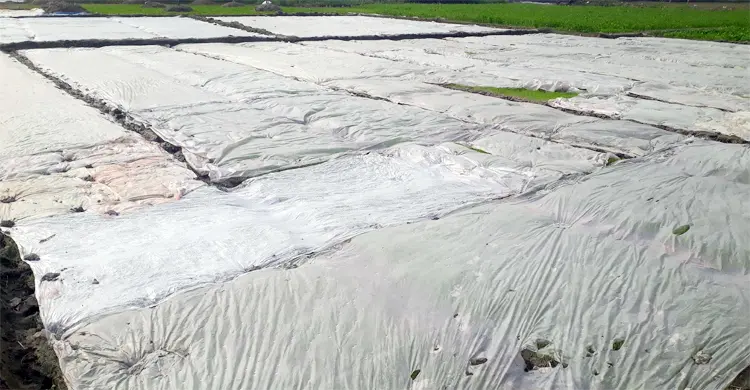
The cold is intensifying in Dinajpur and starting to affect farming. Severe cold and dense fog are turning Iri-Boro seedlings yellow and reddish and ruining them. Farmers are covering potato fields with nets and Iri-Boro seedbeds with polythene.
On Thursday 29 December Dinajpur recorded a temperature of 10.5 degrees Celsius.
According to the agriculture department, this year's target in Dinajpur district is 44,964 hectares of potatoes and 1,71,120 hectares of Iri-Boro. Early potatoes have also been grown on 9,000 hectares, and harvesting and marketing of these have already begun.
According to the Dinajpur Department of Agricultural Extension (DAE), the district's Boro target this season is 1,71,120 hectares, and seedbeds are being prepared on 9,437 hectares to meet it.
Seedlings turning yellow
At Mata Sagar and Krishan Bazar in No 4 Shekhpura union of Dinajpur Sadar upazila, seedlings hit by the severe cold and dense fog were seen turning yellow and reddish and dying.
Farmers say the extreme cold and fog are turning seedbeds yellow, and in some places the seedbeds have shrivelled in the cold.
Md Abu Sayeed, a farmer of Krishan Bazar in Sadar upazila, said: "This time the cold started in Poush itself. The seedbeds are being ruined by the cold. We are spraying them and covering them with polythene but still cannot protect them. The seedbeds are in very bad shape now. If the cold increases in Magh, things could get worse."
At Teghara and Dherapatia in Birol upazila, polythene and nets have been stretched like awnings over potato fields to protect them from the cold. Farmer Maqbul Hossain said farmers will need to be even more careful with potatoes grown for seed if the cold gets worse.
Across Sadar upazila, Iri-Boro seedbeds have been covered with polythene, which farmers say is to protect them from fog.
Mansur Ali, a farmer of Joydebpur village, said he will transplant Iri-Boro seedlings in the coming month of Magh and has sown seed in his seedbed, which has sprouted. But the cold is making the seedlings shrivel, and they cannot grow when the fog is heavy, so he has covered the seedbed with polythene. The seedbed has to be irrigated under the polythene; this makes the seedlings grow fast and keeps pests from attacking, he said.
Officials' advice
Md Nuruzzaman, deputy director of the DAE in Dinajpur, said that at the current level the seedbeds and potatoes should not be damaged. If dense fog sets in and the sun does not come out, the seedbeds must be covered. In the morning the settled fog should be knocked to the ground with a cloth or by dragging a rope. If there is no sun at all, keeping some water in the seedbed will help, he said.
Source: Jagonews24. First published in Bengali on The Agro News.
Comments
(0)