
By Ariful Islam Tamim
Nazirartek in Cox's Bazar is completely different from the country's other beaches. Here one sees fishermen's struggle for a living, the making of dried fish (shutki) and many stories of working life. Work begins on the beach as soon as dawn breaks. The fishermen's day starts with landing fish from the sea, moving it on handcarts, supplying ice and other tasks.
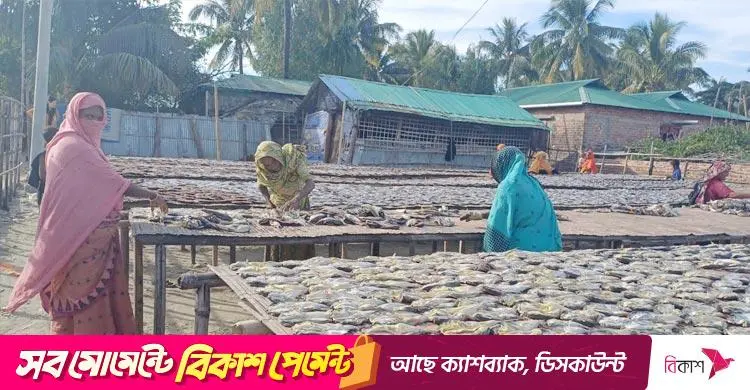
The country's largest dried-fish village, about 7 kilometres from Cox's Bazar town, covers about 100 acres. The smell of dried fish can be noticed from a kilometre before reaching Nazirartek. Dried fish is made along about a kilometre of one side of the road, with fish caught in fishermen's nets hung on bamboo racks to dry.
From the sea to the racks
About 15,000-20,000 fishing families are engaged in fishing and dried-fish processing in the area. Shutki is made from November to March. Every day trawlers and boats full of fish come in from the sea, carrying about 20-25 species, including rupchanda (pomfret), churi (ribbonfish), coral, loitta (Bombay duck) and shrimp. The fish are taken by handcart to the drying village. So that the fish do not spoil, they are stored in ice as soon as they are caught in the deep sea.
The bustle of the fishermen at Nazirartek makes the beach even more alive. Rows of trawlers, golden sunlight on the blue water and wheeling gulls create a special atmosphere. Each trawler goes to the deep sea for anything from two or three days to eight or ten days. Fishing goes on in every season, winter and monsoon, but dried-fish production stops in the monsoon.
In the afternoons the fishermen break into songs and stories, working as they sing in the Chattogram dialect. The shore rings with baul, bhatiali and Chatgaiya folk songs. Local fisherman Shukkur Ali said: "Sometimes we go fishing for two or three days, sometimes for eight to ten. We have to go to the deep sea. Most of the time we catch lakkha, poa, churi, shrimp and other species. After we bring the fish in, they are cleaned and dried. This dried fish is also exported abroad."
Crores of taka a day
"We have to work through many obstacles," Shukkur Ali said. "Shutki is made mainly in the winter season. Every day dried fish worth Tk 2 crore, and sometimes Tk 3-4 crore, is traded here. About 15,000 to 20,000 working fishermen are engaged in fishing and making dried fish. Churi takes two or three days to dry; bigger fish take several more days. Dried-fish production stops in the monsoon, but then we catch fish and sell them."
Shiuli, a woman worker in the dried-fish village, said: "Alongside the men, we work from the morning too. We clean the fish, lay them out on the racks to dry, and keep watch so that insects or crows do not damage them."
The work here plays an important role in the country's economy. Nazirartek does not draw many tourists, but those who come watch the fishermen's lives, the drying process and the busy shore out of curiosity. Nazirartek is a living story soaked in sea waves and human sweat, where the beauty of struggle meets a different taste of life mixed with the smell of dried fish.
The writer is a fourth-year student in the Department of Journalism and Media Studies, Port City International University, Chattogram.
Source: Jagonews24. First published in Bengali on The Agro News.

Comments
(0)