
Scientists at Chiba University in Japan, working with the food manufacturer House Foods Group, have used CRISPR gene editing to knock down the gene behind the sting onions deliver when cut. The work was posted as a preprint on bioRxiv on 21 July 2026 and a peer-reviewed version has since appeared in Frontiers in Plant Science; ISAAA's Crop Biotech Update covered it on 16 September. It is an early proof of concept rather than a finished variety.
The gene codes for lachrymatory factor synthase, or LFS. When an onion is cut, damaged cells release compounds that LFS converts into a volatile gas that irritates the eyes. A New Zealand–Japanese team lowered LFS activity with gene silencing in work published in Nature Biotechnology in 2008, but no commercial low-tear onion followed. The new project instead uses CRISPR-Cas9 to disable the LFS gene directly.
The team, whose authors include Shoya Tamaru and Takahiro Kamoi of House Foods and Tomoko Igawa of Chiba University, worked with onion calli, clumps of undifferentiated tissue grown in culture that can be regenerated into whole plants, and delivered the editing machinery by Agrobacterium-mediated transformation using seven guide RNAs aimed near the start of the gene or its active site.
Of 483 transgenic callus lines screened, 101 carried detectable LFS mutations. From these the team regenerated 71 plants, examined 30 in detail and confirmed 19 as true mutants by next-generation sequencing. Five lines had a mutation frequency above 50 percent. In leaf tissue LFS activity fell to less than 40 percent of unedited controls across all four mutant lines tested, with a similar drop in bulbs and larger reductions in the more heavily mutated lines.
The results came with problems. Many edited plants showed severe growth abnormalities, including stunted bulbs no more than four centimetres across, unusual root and leaf development and excessively bushy growth; none set seed, and several died after transfer from culture to soil. The researchers attribute this mainly to somaclonal variation, changes that build up in cells kept in culture for long periods, rather than to off-target edits, which suggests a shorter culture period or a different pipeline could avoid it.
Because the current lines cannot set seed, a usable variety will need the editing redone with shorter tissue-culture times, or the trait bred into other onion backgrounds once a fertile edited line exists. House Foods' involvement points to commercial interest for home cooks and for processing plants, where cutting onions is a significant source of worker discomfort, but no release timeline has been announced. Regulatory treatment of CRISPR-edited crops differs by country and market acceptance of gene-edited vegetables is largely untested.
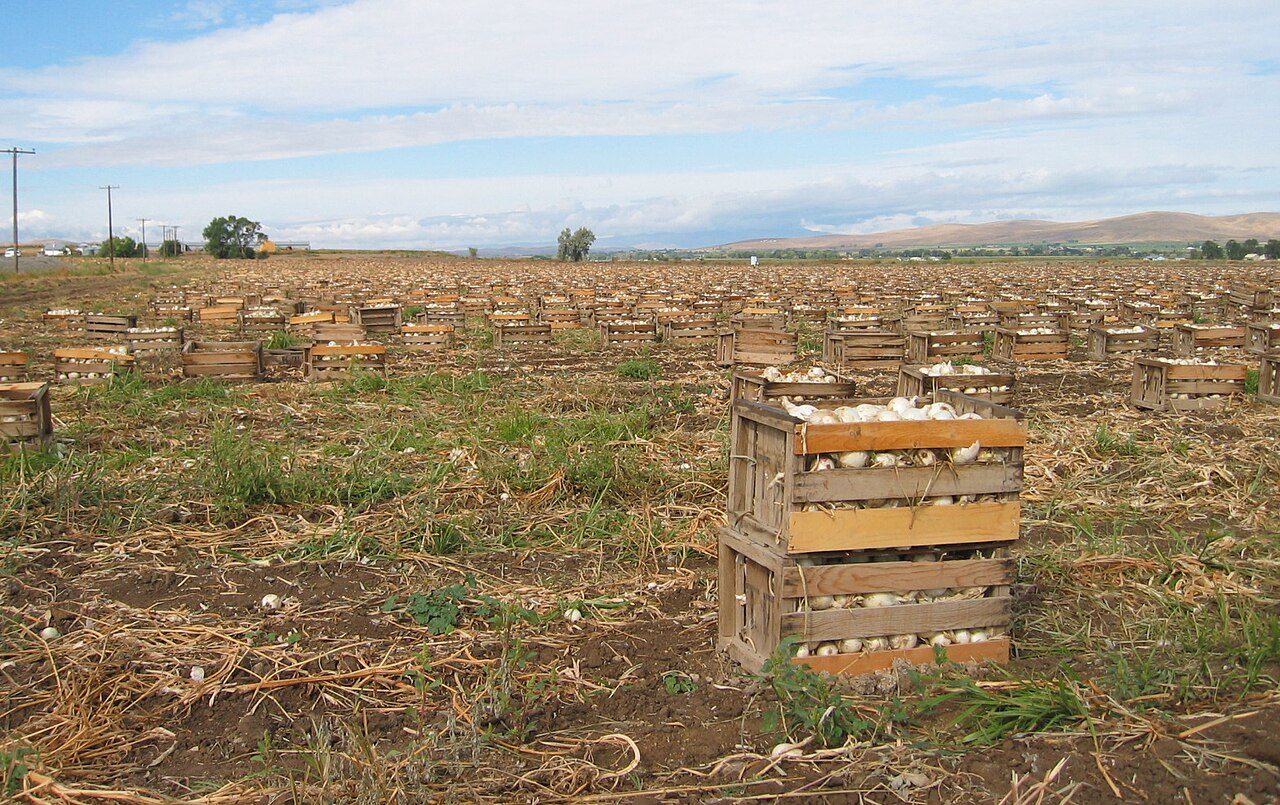
Photo: Bobjgalindo / Wikimedia Commons (CC BY-SA 4.0)
Source: Global Agriculture

Comments
(0)