
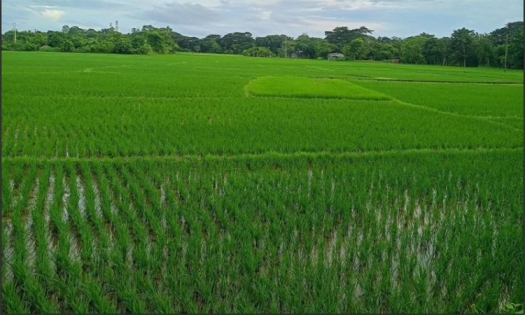
Farmers in Chattogram have all but completed aman transplanting, putting behind them the floods, waterlogged land and ruined seedbeds of the season's start, BSS reports in a special report from Chattogram. Nearly 100 per cent of the target area across the districts of the Chattogram region has been planted, and light Bhadra rain has turned the fields green.
The Department of Agricultural Extension set a target of 179,980 hectares of aman in Chattogram this year and 179,660 hectares have already been planted, about 100 per cent, ahead of schedule. Transplanting is finished in Gumai Beel at Rangunia, the district's largest rice tract, and the fields of Karnaphuli, Patiya, Anwara, Banshkhali, Chandanaish, Satkania and Lohagara in south Chattogram are covered in green; at Patiya farmers are applying the first top-dressing of fertiliser and weeding.
Syed Nur, a farmer at Haildhar in Patiya, said he has planted rice on his usual five kani (two acres). "The monsoon is going very well this year; there is no shortage of water, the land barely dries before it rains again. With the weather good, the transplanted aman has taken well. I expect a good yield," he said.
Mohammad Ali Zinnah, additional director of the DAE for the Chattogram region, told BSS that favourable weather, timely transplanting, adequate fertiliser and seed, and quick rehabilitation support to flood-hit farmers had moved planting along fast, and that farmers faced no serious seedling shortage after the floods. Regional office figures show Cox's Bazar at 18,422 of 18,885 hectares (99 per cent) and Feni at about 66,837 of 66,894 hectares; Noakhali has passed its target and Lakshmipur has reached 117 per cent of its target.
Officials said the expectation of good aman prices, the weather and farmers' interest had brought land outside the plan under aman, while government seedling production and distribution and farmers' own seedbeds averted a seedling crisis. Apru Marma, DAE deputy director for Chattogram district, said the early floods had caused concern, but farmers prepared land quickly once the water receded and, with fertiliser, seed and seedlings assured, transplanting was not disrupted.
A sub-assistant agriculture officer at Satkania said the most positive sign this year is that farmers' interest in aman has not waned; support to flood-affected farmers, seedling and seed supply, and regular field advice brought the target within reach ahead of time.
Source: BSS — Special report, Chattogram

Comments
(0)