
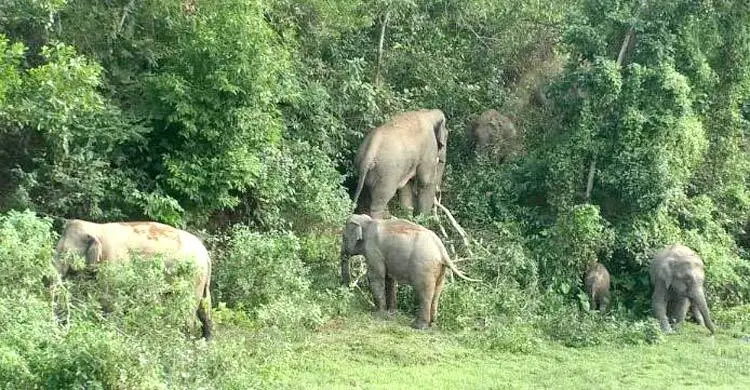
The historic Deyang Hill stretches across a wide area on the south bank of the Karnaphuli river in Chattogram. This ancient hill is a home of wild Asian elephants. Unplanned settlements and industrial construction on the hill have shrunk the elephants' world, and the largest land animal is not tolerating people moving through its corridor.
Experts say it is people who have settled in the elephants' habitat and disrupted their normal life; the elephants did not come to human settlements. The hill has been home to the wild elephants' ancestors, and moving them from here is not easy.
The issue has drawn more attention after three people were recently killed in wild elephant attacks. The Korean Export Processing Zone (KEPZ) authority, built around Deyang Hill, and villagers want the elephants removed from the area. Forest experts, however, say wild elephants cannot simply be moved like that.
Three deaths in September
On 23 September, a man named Md Dulal, 50, was killed in an elephant attack at the Guapanchak cluster village in Bairag union. That same night, in the Bairag area of the union, Rehena Akter, 35, wife of Md Akter, fainted and died after seeing an elephant in front of her house. Earlier, on 11 September, farmer Mohammad Chhoyed, 57, was killed in an elephant attack at Daulatpur in Bara Uthan union of Karnaphuli upazila.
Since these incidents, extreme fear has gripped the villages around Deyang Hill. Herds of elephants raid the villages almost every night in search of food. Villagers try to drive them off with whistles, drums, firecrackers and torches, and there have been protests and human chains.
Local people have given the upazila administration an ultimatum to remove the elephants from Deyang Hill, and the KEPZ authority has made the same demand to the district administration. But the forest department and experts say Deyang Hill is the elephants' ancestral home, and they cannot tolerate settlement in their corridor (the route they move along). Despite people's resistance, the herd is not leaving the area.
A landless people's cluster village has been built at the foot of Deyang Hill at Guapanchak in Anwara's Bairag union, where one person was recently killed in an elephant attack.
'Historically an elephant corridor'
Professor MA Aziz of the zoology department at Jahangirnagar University told Jago News: "From Deyang Hill through Anwara and Banshkhali to the Chunati sanctuary is historically an elephant corridor. The elephants live in these areas according to knowledge passed down from their ancestors. People cannot simply move them out of their habitat whenever they wish."
A meeting was called for 3 October at the Chattogram Deputy Commissioner's office to decide what to do. KEPZ deputy general manager Mushfiqur Rahman told Jago News that they would demand at the meeting that the elephants be removed from the hill.
The KEPZ demand is not new. The organisation had earlier written 22 letters to various government offices seeking to drive out the three wild Asian elephants living on Deyang Hill.
A 2021 letter to the then deputy commissioner said KEPZ is the workplace of about 25,000 workers and employees, including foreign nationals, but that a herd of wild elephants had been raiding the EPZ area for three years. In those three years, elephant attacks had killed 10 people in KEPZ and nearby areas and caused losses of about Tk 25 lakh. The letter said the elephants were raiding the Korean EPZ area every night, and that unless they were removed at once, this international-standard export processing zone would suffer.
The Korean EPZ authority is cutting away a large part of the hill to build facilities. Forest department officials say elephants are losing their habitat as the hill is cut and the forest destroyed.
Villagers allege that wild elephant attacks have killed 15 people and injured more than a hundred in Karnaphuli and Anwara upazilas over the past 12 years. Cases have also been filed with the local police station and the forest department over damage to homes, businesses and crops.
Forest department blames hill-cutting
Rafiqul Islam Chowdhury, divisional officer (wildlife management and nature conservation division) of the Forest Department, told Jago News: "The elephants did not go into people's space; people entered the elephants' home. Of the 2,400 acres allotted to the Korean EPZ authority, 466 acres are reserved forest according to the Calcutta Gazette. A condition of the allotment was that 33 per cent would be kept as forest and for wildlife. But now they are cutting hills and destroying forest to build. Having lost its habitat, the elephant is harming the villagers around."
He said: "If for any reason there is an attempt to remove the elephants from this sanctuary by force, it could backfire. After many such attempts in the past, elephants have attacked people's homes."
A visit on Monday, 30 September, to Guapanchak village in Anwara's Bairag union, KEPZ and the Bairag area found that the spot in the Guapanchak cluster village where a person was killed in the elephant attack on 24 September is a hillock of Deyang Hill itself. Twenty-six families have been resettled in the village, but there is no protection around it.
Villagers' fear
Roksana Akter, daughter of the dead Md Dulal, said: "Having no homestead of our own, we have lived in this cluster village for two years. It is right inside the hills. Everyone is afraid once night falls, expecting an elephant to come. On the 24th, when word came that an elephant was coming, my father went outside with others. Before anyone understood what was happening, the elephant killed him. We live here very unsafely."
Local resident Md Musa said: "The fault is not the elephant's, but people's. As soon as people hear an elephant is coming, they make a commotion and often try to provoke it. Then it gets angry and causes accidents."
There are several paddy fields in Guapanchak village next to Deyang Hill, with elephant footprints clearly visible in them. Farmer Abdur Rahim said: "I farmed this land as a sharecropper. The elephants have ruined everything. They have broken many houses and shops around here, but those affected are not getting proper compensation."
Next to Guapanchak village, the Korean EPZ authority is cutting a large part of the hill to build facilities, and an iron fence has been put up around an area of about one kilometre.
Likewise, several new houses have been built by cutting hills around the Chattogram port ship control office on Deyang Hill. More than a hundred century-old trees were felled before the hills were cut.
Chattogram port estate officer Shihab Uddin said: "I have heard that 60 houses have been built by occupying port land on Deyang Hill."
Forest department divisional officer Rafiqul Islam Chowdhury said: "After 2022 there were hardly any incidents of elephants harming people. So why is it happening suddenly now? Mainly because the elephants' habitat has been damaged by cutting hills and forest to build. That is why the elephants are going into nearby settlements."
KEPZ and response team
Local resident Kazi Abdullah, who works to protect villagers from elephant attacks, said: "The upazila administration said the KEPZ authority would give logistic support to the Elephant Response Team (ERT) formed to protect people from wild elephant attacks. But we see them working only for the security of their own facilities; the villagers are getting no help at all."
Asked about this, KEPZ deputy general manager Mushfiqur Rahman told Jago News: "The land was allotted here for building factories, and that is what we are doing. We are also working to protect our 35,000 workers. We have made every arrangement for the ERT team members."
Aminul Islam Mithu, a journalist who works on wildlife, said: "In 2021 we raised in a High Court writ the need to protect the Karnaphuli, Anwara and Banshkhali elephant corridor. Instead, the China EPZ, the Korean EPZ and new human settlements are being built in this very corridor. We want the new government to raise public awareness scientifically and take steps to conserve the elephant corridor."
The government allotted 2,400 acres of hilly land in Bara Uthan union of Karnaphuli upazila and Bairag union of Anwara upazila to KEPZ, which began operating around 2006-07. Locals said elephants had always moved through Deyang Hill as an ancient corridor, but their movement increased from 2012-13. Towards the end of 2018, the herd began living permanently in the KEPZ area.
Local resident Humayun Kabir said: "Local people do not want to harm the elephants. When they come, they eat the paddy in the fields and the banana plants at homes and go back to the hills. People have been attacked when they came face to face with an elephant. Those killed and injured have not received compensation."
Rafiqul Islam Chowdhury, however, said: "It is not entirely true that there has been no compensation. After verification, we have paid more than about Tk 1 crore in compensation to those affected."
Source: Jagonews24. First published in Bengali on The Agro News.
Comments
(0)