
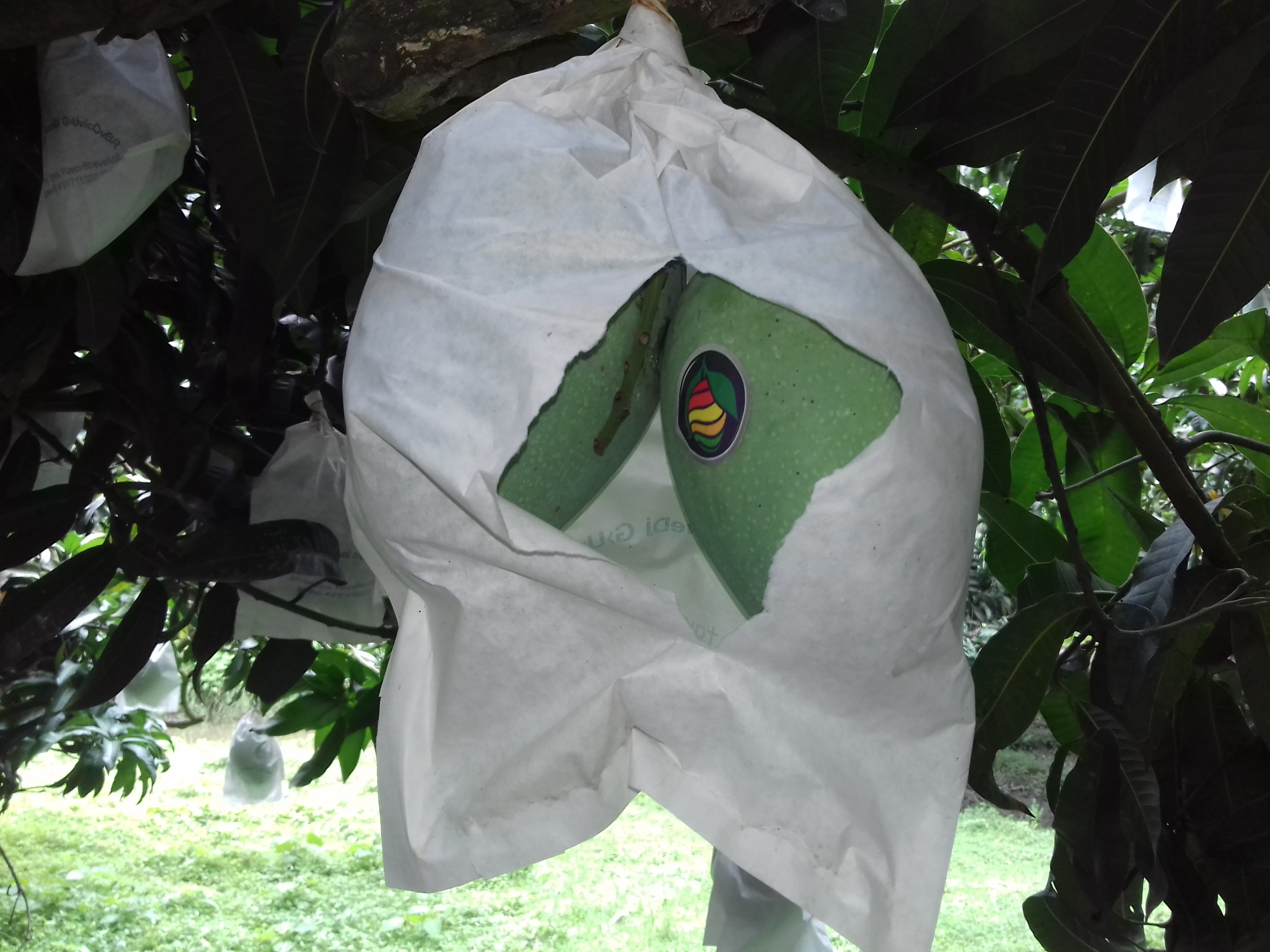
Many mango growers in Chapainawabganj, the north-western district known as Bangladesh's mango capital, said in July 2026 that the paper fruit bags they had fitted over their mangoes to keep pests and disease away had turned from a protection into a burden. In a report published by Jagonews24 on 11 July 2026, growers in Shibganj upazila said bag prices had doubled during the season, that low-quality bags had let much of their fruit rot, and that the Fazli mangoes they were then selling fetched prices which, by their account, did not cover their costs.
Growers say bag prices doubled in 2026
Growers alleged that an artificial shortage had been created that season to double the price of the bags used on mangoes, and that low-quality bags had been supplied to the market at the same time, spoiling a large quantity of fruit. They said their production costs had jumped as a result.
According to the agriculture department and related sources cited in the report, about 30 crore (300 million) mangoes had been bagged in Chapainawabganj in the 2026 season, and growers had spent an estimated Tk 180 crore on the bags alone. The same sources put the potential market value of the mangoes grown on about 37,000 hectares in the district at around Tk 5,000 crore, but said the extra cost of bags and poor materials had left many growers facing losses.
In earlier years, the report said, a fruit bag sold for Tk 3.50. In 2026 demand for bagging rose, a sudden shortage of bags appeared on the market and prices rose several times over. Growers said they had been forced to buy bags of various companies at Tk 6.50 to Tk 7 each.
Growers said that the costs of bags, labour, fertiliser and pesticide had all gone up while mango prices in the market had not met their expectations. They had bagged their fruit to protect it from disease and insects in the hope of better prices, and the extra spending had left them worried about losses.
The growers' arithmetic: half the price of a kilo on bags
By the growers' reckoning, a maund of Fazli mangoes was selling for Tk 1,200 to Tk 1,400 at the time, which they said came to about Tk 26 a kilogram. A kilogram of Fazli usually takes two mangoes, they said, and each mango carries its own bag, so about Tk 13 of every kilogram went on bags alone, more than half the market price, before labour, fertiliser, pesticide, orchard care and transport were added.
Their price per kilogram depends on what a maund means in the district's markets. BSS reported on 16 May 2026 that, although a maund should be 40 kilograms, growers in Chapainawabganj said they had to give 50 to 55 kilograms per maund depending on the market, a long-standing complaint about which the deputy commissioner said he would talk to higher authorities. A grower quoted by BSS also said that mangoes sold at the orchard for Tk 40 a kilogram were reaching Dhaka shops at Tk 80 to Tk 100.
Growers also told Jagonews24 that of every 50 bagged mangoes at least 10 were lost for various reasons, and that the spoiled fruit and the extra care pushed their real production costs higher still, so that many were not getting the profit they had expected from bagging.
Anarul Islam, a grower in Shibganj upazila, said he had bagged about 50 maunds of Fazli mangoes that season, paying about Tk 6.50 for each bag. The fruit was selling for only Tk 1,200 to Tk 1,400 a maund, which he said did not cover his production costs, and about 40 per cent of his bagged mangoes had spoiled.
Atiqur Rahman Sujon, a grower in Shahbajpur union near Sonamasjid, said production costs were rising several times over, from caring for the orchard at the start of the season to buying bags, and that growers were worried about making the profit they had hoped for. He said the bags were used most on the Fazli and Ashwina varieties.
Abdur Rahim, a grower in Hazarbighi village of Shyampur union, said he had bought and fitted about 50,000 bags that season and that all of his mangoes had been bagged. "But the fruit has not turned out well. When you open the bag, rotten mangoes come out. They have rotted so badly that even cattle won't eat them."
Officials and scientists on the shortage and bag quality
Ahsan Habib, member secretary of the Shibganj Upazila Mango Foundation, said there had been a severe shortage of fruit bags that season and that, with supply short of demand, many growers had been forced to use low-quality bags, which made it hard to keep the fruit's quality. In many cases, he said, the bags tore and let water in, and insect attack and spotting followed, so growers did not get the benefit they had paid extra for. He said the crisis had added to growers' difficulties in producing and marketing mangoes, and that the problem would grow when the late Ashwina variety reached the market.
Md Mominul Haque, the Chapainawabganj district marketing officer, said there had been a shortage of fruit bags that season and that many growers had suffered. He said the Department of Agricultural Marketing would take steps the following year to distribute fruit bags to growers, and that a business school of growers had been set up in every union of the district for the purpose, through which growers' problems would be heard and the necessary action taken.
Md Abdul Halim, additional deputy director (crops) at the Chapainawabganj office of the Department of Agricultural Extension (DAE), said there was no alternative to fruit bags for protecting the appearance and quality of mangoes and keeping insects off. Good-quality bags used at the right time greatly reduce spotting, insect attack and disease, he said, and keep the fruit's colour, shape and market value. Poor-quality bags, however, can tear, let water in or block the flow of air and so damage the fruit; quality bags had to be ensured for growers, he said, and attention paid to keeping low-quality bags off the market.
Dr Md Sharaf Uddin, acting chief scientific officer of the Chapainawabganj Regional Horticulture Research Station, told Jagonews24 that the fruit fly does the most damage to Fazli mangoes. "Once this fly attacks an orchard, it finishes off almost all the mangoes there. That is why we advise using fruit bags. Mangoes should not rot inside a fruit bag. If they do, you have to understand that the carbon in that bag was not good, meaning the bag was of low quality."
How fruit bagging spread through the mango belt
Fruit bagging means enclosing each young fruit on the tree in a bag, usually of layered paper, and leaving it there until harvest. The Daily Star reported in July 2022 that when the method was first introduced in 2016 about 60,000 bags were used, and that in 2022 about 12 crore bags were used on mangoes: about 10 crore in Chapainawabganj and the remaining 2 crore in Naogaon, Rajshahi and other leading mango districts. Dr Sharaf Uddin told the paper then that demand for bags was growing by about 1 crore to 1.5 crore a year.
He said then that besides protecting fruit from insects, the bags help shield mangoes from storms, heavy rain and even hailstorms, help keep the fruit dry, and keep it fresh on the tree so that growers can take it to market when they choose. Under conventional practice, he said, a farmer cannot be sure that a mango on the tree will reach the market; with bags, he can be sure it will arrive without unexpected problems in transport.
Cost was already the main limit in 2022. The paper reported that each bag cost Tk 4, plus Tk 1 in labour to fit it, adding about Tk 1,000 to the cost of a 40-kilogram maund, and that a Rajshahi grower expected to sell his bagged mangoes at Tk 3,200 a maund against Tk 1,800 for ordinary fruit. People in the trade told the paper that mainly medium and large growers were using bags, because most small growers could not afford them: the bags have to go on in April and May, just before the paddy harvest, when small farmers are short of cash. Researchers quoted by the paper said bags would be more affordable for small farmers if the 63 per cent import duty on fruit bags were reduced.
The method spread to other districts. Bangladesh Pratidin reported on 17 May 2025 that 50 lakh mangoes had been bagged in Naogaon that season, mainly of the Gourmati, Amrapali, BARI-4 and Banana mango varieties, with growers aiming at export markets. BSS reported on 20 May 2025 that the president of a Rajshahi safe-food producers' society said mango farming with fruit bags had been increasing in recent years, helping to cut pesticide use and prevent fruit fly infestation.
Bagging also changed the market for the late varieties. Bangladesh Pratidin reported in September 2022 that bagged Ashwina mangoes, once sold cheaply for pickles and juice, were staying longer on the trees and selling well at Kansat late in the season. The research station's chief scientific officer at the time told the paper that white bags do not change a mango's colour or taste, while brown bags, which have carbon paper inside, turn the skin brownish; the brown bags protect the fruit from harmful insects, he said, but may reduce its flavour.
What field research says about bagging
Field research supports the growers' reason for bagging. A study by Hossain and colleagues, published in the journal Crop Protection in September 2020, compared ways of managing the oriental fruit fly on mango in Bangladesh during the 2017 season. Bagging mangoes in double-layer brown paper bags forty-two days before harvest gave the best result: fruit infestation fell to zero, marketable yield was significantly higher than under conventional pesticide management, and the marginal benefit-cost ratio was nearly twice that of any other treatment. The authors put the strong return down to high fruit quality and to the bags being usable for two growing seasons. They also tested cloth bags, polythene bags, methyl eugenol traps and protein bait lures.
Studies elsewhere point the same way and show that the bag's material matters. In Spain, Del Pino and colleagues reported in the journal Insects in 2021 that bagging organic mangoes in a yellow satin paper bag or a white muslin cloth bag significantly reduced damage from the mango scale insect; the cloth bag cut the share of unmarketable fruit by up to 93.42 per cent, and bagged fruit were heavier and larger than unbagged fruit.
In India, a study of the Mallika variety at the Horticulture Research Center in Pantnagar, published in Scientific Reports in November 2025, compared bags of several materials, including brown paper, white paper, butter paper and newspaper. Organic, UV- and water-resistant brown paper gave the heaviest fruit and the longest shelf life and reduced post-harvest diseases such as anthracnose, stem-end rot and sooty mould, and bagging returned a 53.18 per cent higher net income than leaving fruit unbagged.
These findings fit what the DAE official and the research station's scientist said in July 2026: a sound, water-resistant bag protects the fruit, while one that tears, lets in water or blocks air does not.
The fruit fly that makes bagging necessary
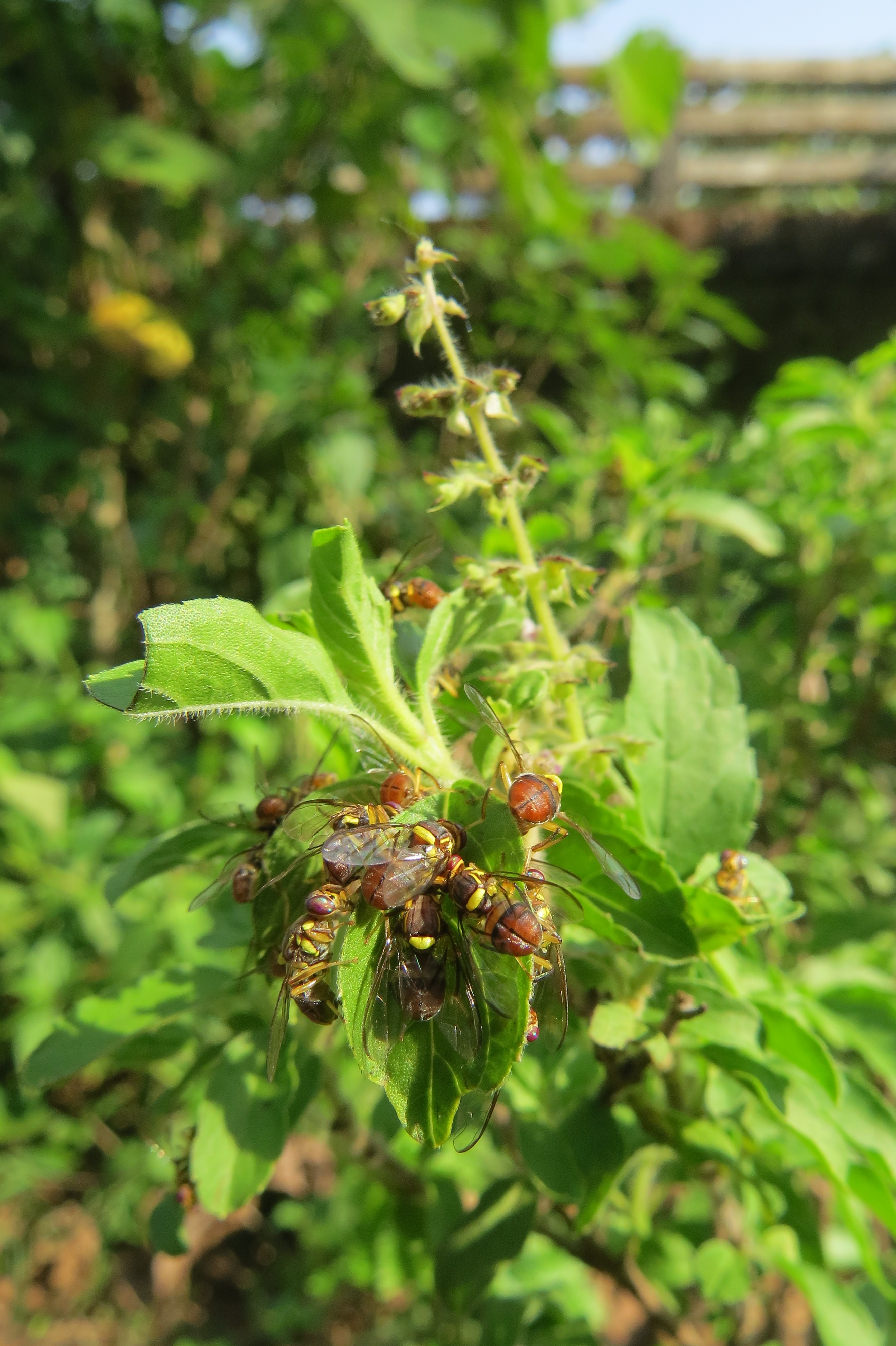
The fly Dr Sharaf Uddin described is the oriental fruit fly, Bactrocera dorsalis, which Hossain and colleagues call a major pest of mango that causes losses of both quantity and quality and creates barriers to export. In a 2015 review in Insects, Vargas and colleagues describe Bactrocera fruit flies as among the most economically important pests in the world, attacking a wide range of fruits and fleshy vegetables across the tropics and subtropics, and note a move away from organophosphate insecticides towards reduced-risk methods.
The female fly punctures the skin of ripening fruit and lays her eggs beneath it; the larvae feed inside the flesh, then leave the fruit and pupate in the soil under the tree. Because the damage begins inside the fruit, a physical barrier has to be in place well before the fly arrives, which is why bagging works when it is done early and with an intact bag, and loses its point when the bag tears or opens.
Besides bags, the non-chemical tools tested in Bangladesh include methyl eugenol traps, which attract male flies, and protein bait lures. Growers who need advice on chemical control should consult their upazila agriculture officer.
Fazli and Ashwina, the late mangoes most often bagged
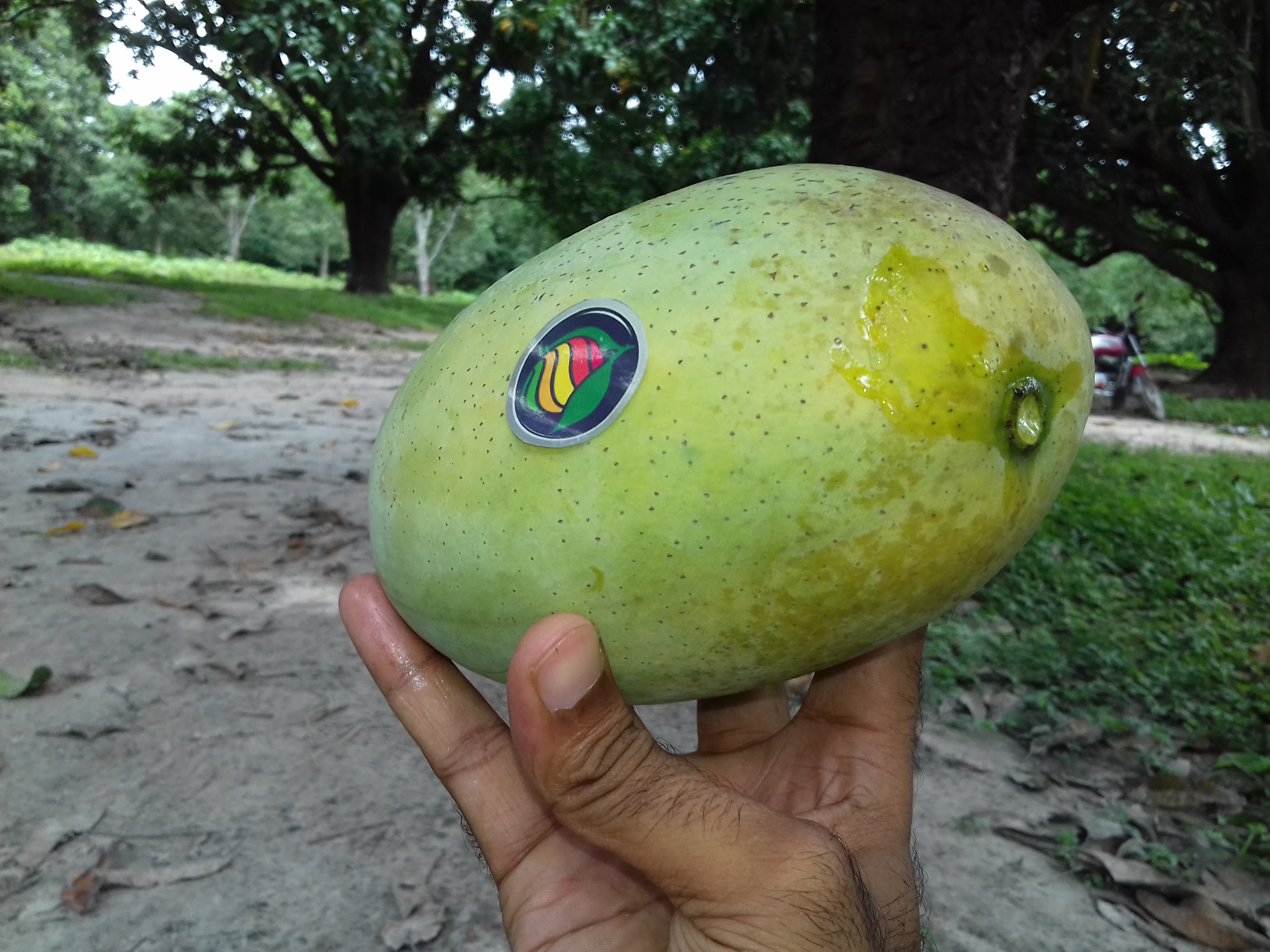
Fazli is a large, late-maturing variety grown mainly in Malda and Murshidabad in India's West Bengal and in Bangladesh's Rajshahi division; a single fruit can weigh up to a kilogram, and it is widely used for jams and pickles as well as eaten fresh. It comes to market after most other varieties, and Ashwina comes later still, so the fruit hangs on the tree into the monsoon, when rain and fruit flies are at their worst.
In 2025 the Rajshahi administration's harvest calendar set 15 June for Fazli and Amrapali, 5 July for BARI-4 and 10 July for Ashwina, BSS reported. In 2026 Chapainawabganj set no calendar at all: the district administration decided at a meeting on 11 May, with growers' agreement, that mangoes could be picked and sold as soon as they ripened on the tree, BSS reported on 16 May 2026.
Fazli, Ashwina, Langra and Khirsapat from Chapainawabganj carry geographical indication (GI) status, The Daily Star reported on 7 July 2026.
Chapainawabganj, the mango capital
Chapainawabganj is the westernmost district of Bangladesh, in Rajshahi division, bordered by Malda and Murshidabad districts of West Bengal in India, by Naogaon to the east and by Rajshahi to the south-east. It has five upazilas: Chapainawabganj Sadar, Shibganj, Bholahat, Gomastapur and Nachole. Shibganj, where the growers in the Jagonews24 report farm, is the westernmost upazila of the country; its 15 unions include Kansat, Shahbajpur and Shyampur, and the Sonamasjid land port and border checkpoint lies on its border.
According to the district office of the DAE, mangoes were grown on 37,487 hectares in Chapainawabganj in 2026, with a production target of 4,58,912 tonnes, 912 tonnes more than the previous year's target of 4,58,000 tonnes, BSS reported on 16 May 2026. In March 2025 the DAE had put the district's orchard area at 37,504 hectares, 100 hectares less than a year earlier, and people in the trade told Bangladesh Pratidin that large orchards were being cut down and sold as housing plots.
Kansat, in Shibganj, is the district's main mango market; officials quoted by The Daily Star in July 2026 called it the largest mango market in the country. BSS reported on 29 June 2026 that trading at Kansat ran from dawn until midnight, and that the DAE's deputy director in the district expected the season's mango trade to exceed Tk 2,500 crore, against a commercial target of Tk 2,400 crore the year before. That estimate is lower than the potential value of about Tk 5,000 crore cited by the sources in the Jagonews24 report.
Rising costs were a complaint before the 2026 harvest began. When the orchards came into bloom in February 2026, orchard owners told Bangladesh Pratidin that fertiliser, pesticide and labour had become more expensive than before and that production costs had risen; they asked for incentives, credit on easy terms and government support in marketing.
Mango in Bangladesh: output, exports and research
Nationally, the DAE recorded 25,08,973 tonnes of mango from 2,05,034 hectares in FY2023-24, after 27,07,459 tonnes in FY2022-23 and 23,50,499 tonnes from 2,02,968 hectares in FY2020-21, The Business Standard reported in April 2025. The Daily Star reported on 7 July 2026, citing the Chapainawabganj research station, that more than 4.5 lakh tonnes of the country's mangoes come from Chapainawabganj and that most of the crop is eaten at home.
Exports have stayed small. According to DAE data reported by The Daily Star, they reached a peak of 3,100 tonnes in FY2023, fell to 1,321 tonnes in FY2024, recovered to 2,194 tonnes in FY2025 and stood at 1,408 tonnes so far in the 2026 season. Officials and experts told the paper that export fruit must meet higher standards for appearance, pest-freedom and food safety, and blamed among other things a shortage of compliant packhouses, weak cold chains, limited use of Good Agricultural Practices, and pest and disease blemishes. The DAE was running an Exportable Mango Production Project in 46 upazilas of 15 districts.
The Chapainawabganj Regional Horticulture Research Station of the Bangladesh Agricultural Research Institute (BARI), also known as the Mango Research Station, is where most of the country's released mango varieties were bred: Bangladesh Pratidin reported in January 2022 that 14 of the 18 BARI mango varieties released until then had come from the station. The station estimates that Bangladesh grows 800 to 850 mango varieties, more than 100 of them commercially, The Daily Star reported in July 2026.
Photo: Fozli.com / Wikimedia Commons (CC BY-SA 4.0). The top picture shows bagged Ashwina mangoes in Bangladesh, as background.
Sources: Jagonews24 ("আম রক্ষার ফ্রুট ব্যাগই এখন চাষির গলার কাঁটা", 11 July 2026), BSS (16 May 2026; 29 June 2026; 20 May 2025), The Daily Star ("25 lakh tonnes of mangoes, and barely 0.1% make it abroad", 7 July 2026), The Daily Star Bangla ("আমে ফ্রুটব্যাগের ব্যবহার বাড়ছে", 4 July 2022), Bangladesh Pratidin (24 February 2026; 9 March 2025; 17 May 2025; 2 September 2022; 2 January 2022), The Business Standard (27 April 2025), Hossain et al., Crop Protection (2020), Del Pino et al., Insects (2021), Kumari et al., Scientific Reports (2025), Vargas et al., Insects (2015), Wikipedia (Chapai Nawabganj District, Shibganj Upazila, Fazli, Bactrocera dorsalis)
Comments
(0)