
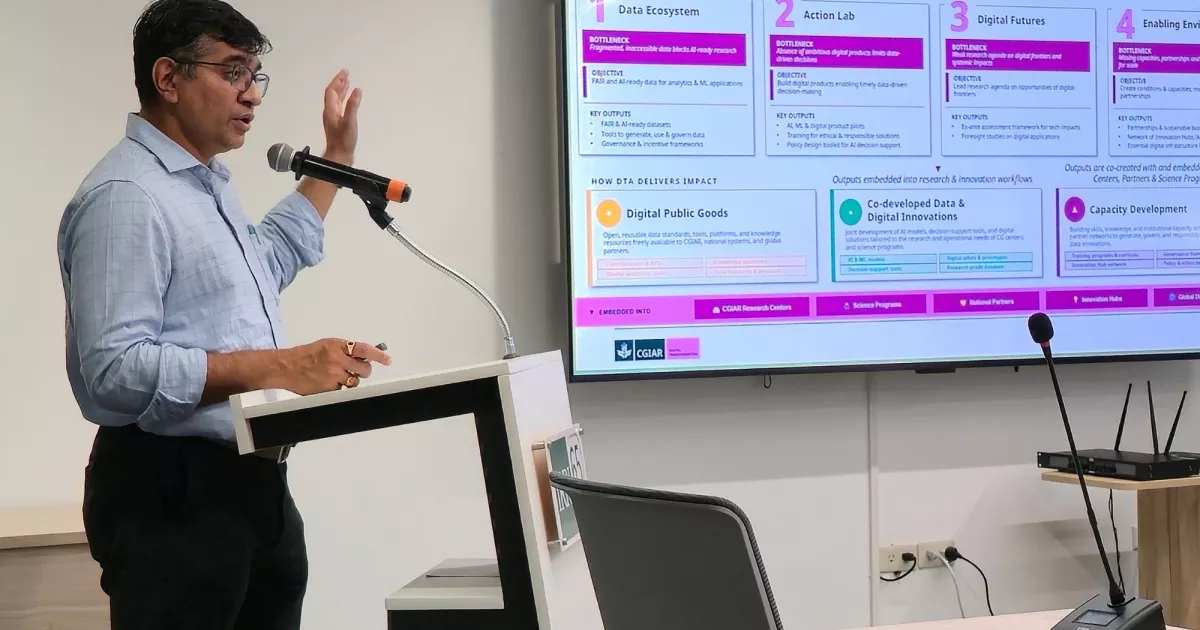
Agricultural research does not need more digital tools so much as a way to connect the ones it already has, argues Ram Kiran Dhulipala, Director of the CGIAR Digital Transformation Accelerator, in a signed column published by CGIAR after visits to ICRISAT and IRRI. The views are the writer's own.
Dhulipala writes that the centres are already building agriculture-specific large language models, imagery-based insurance and lending applications and AI-linked data platforms, but that these efforts are often fragmented. He borrows the "City Map" idea of CGIAR Chief Scientist Sandra Milach: like a city that provides roads, power and water and sets standards for anyone who connects, CGIAR should provide shared digital infrastructure, standards and connectors on which teams build their own tools.
His example is a project with Google.org and Google Research to develop an AI model for digital phenotyping across CGIAR's nine breeding centres, meant to help breeders choose better and release improved varieties faster. The model, he writes, only works with harmonised, interoperable field data, so the Accelerator's job is to make sure data are collected, stored and processed to one standard across 12 priority crops and more than 500 research stations.
He also reports that interest in digital work now comes from every discipline: planning for 2027 drew proposals across all twelve thematic areas the Accelerator has defined, from breeding and seed systems to phenotyping teams using NIR spectroscopy.
His last lesson is about people: transformation cannot be designed centrally and handed to researchers, he writes, but has to be shaped with them. "CGIAR does not need to start its digital transformation. The innovation is already there," he concludes; the task now is to connect it and let it scale.
Photo: CGIAR Digital Transformation Accelerator
Source: CGIAR
Comments
(0)