
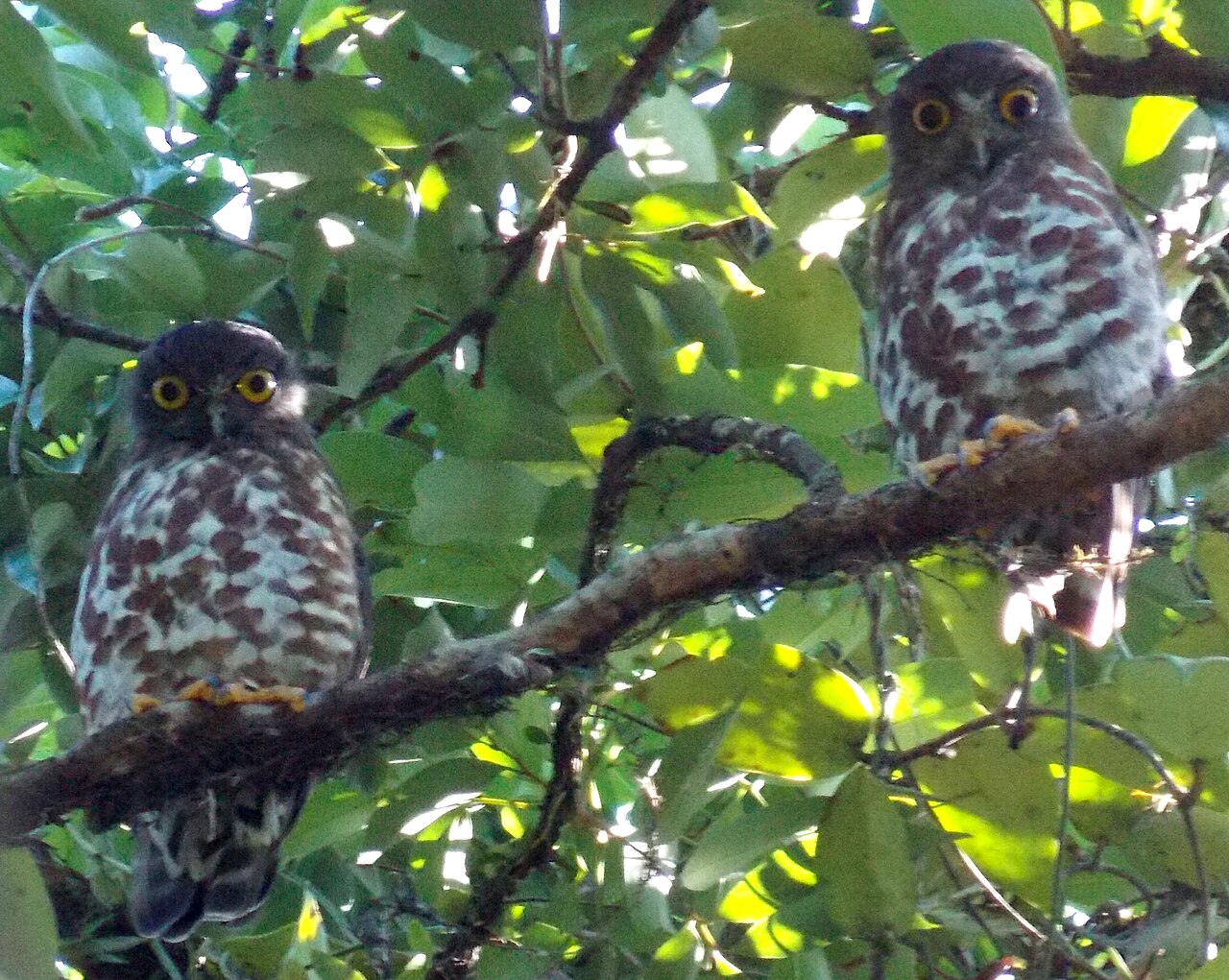
For a long time Tuhin Wadud, a professor of Bengali at Begum Rokeya University in Rangpur, searched the trees in vain for the brown hawk-owl, known in Bengali as khoyra shikre pecha. In a piece for Prothom Alo he recalls that in the end two children he had never met showed him the bird.
It was a March morning in 2021, at about 10 o'clock. As he waited at the university's main gate, two barefoot children took him by the hand to a bakul tree on the campus's Bakul Road. One climbed up and pointed: an owl sat on a branch, rolling its eyes as it watched them. He took its photograph.
One of the children was frightened and asked whether seeing an owl brought harm. The writer told them it did not. Such fears about owls are still common in villages and can put the birds at risk.
He has since seen the species many times, in pairs and alone, by day and by night, perched on large or medium-sized trees. He has watched a pair sitting side by side at Carmichael College and two birds in a tree in a temple courtyard in the centre of Rangpur town. Because it does not hunt by day, it moves little in daylight.
As he describes it, the owl is mainly brown, with a mix of white and brown on the breast and a rather long tail. The bill is a blend of blue and black, the yellow eyes have black pupils and the feet are yellow. Its scientific name is Ninox scutulata.
It is a resident bird of Bangladesh, found in smaller or larger numbers across the country, and is not extinct here. It will stay, he writes, as long as it has food and safe places to live, so protecting trees and natural food sources is everyone's responsibility.
Photo: Mouchumi / Wikimedia Commons (CC BY-SA 3.0)
Source: Prothom Alo

Comments
(0)