
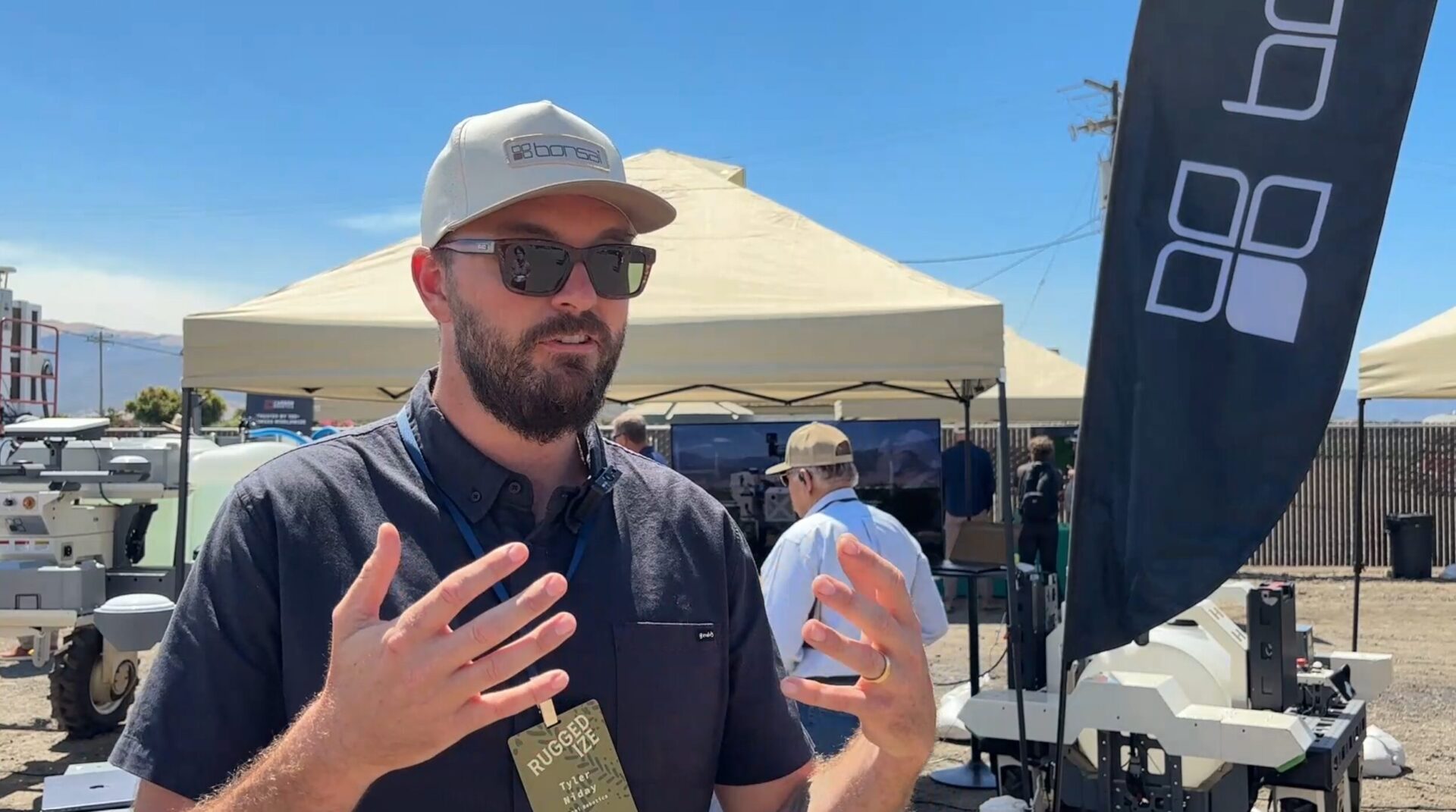
Bonsai Robotics, based in California, is betting that AI can end an old trade-off in farm robotics: build a machine for one crop and one task, or add flexibility and pay for it in cost and complexity. Its autonomy stack converts ordinary 2D camera images into a scaled 3D model of the farm, with an elevation map, a spatial map of the trees and a reading of whether each space holds a tree, bare ground, a person or a machine, so the same system can run in orchards, vineyards, berries and other specialty crops without new code for each one.
“Historically in robotics, you write hundreds of thousands of lines of ‘if-then’ statements, more or less, to get to a solution for one crop,” cofounder and CEO Tyler Niday said at the Ruggedize ag robotics conference at Reservoir Farms in Salinas. Bonsai instead trained a foundation model on about a million acres of specialty-crop data gathered from 400 deployed units, with an automated self-labelling pipeline. It has also trained an Nvidia Cosmos world model on its farm data so it can simulate a new crop, rain or an unexpected obstacle.
The approach does away with lidar and stereo vision for judging distance. A transformer model learns depth from past data, which Niday says pays off in dust: a lidar goes blind, while the learned model keeps inferring what lies ahead.
Bonsai began in almond orchards, including 30-year-old orchards in the Australian outback with no GPS signal, dust and sand hills, and has since widened its reach to strawberries, vineyards, apples, table grapes and citrus, the crops with the heaviest labour needs. After acquiring Farm-ng it builds its own machines as well as retrofitting existing equipment; revenue splits roughly half and half. The new, larger Amiga Max, a hybrid-electric platform shown as a strawberry sprayer, burns about three gallons of diesel a day instead of 30.
The company has sold more than 400 units in total, about 75 of them OEM retrofits and the rest Amiga machines, and has sold out of the Amiga Max for this year. Niday said flexibility is what makes the economics work. He pointed to the OMC AR-500, an orchard shuttle for hauling almonds that costs around $200,000 and sat parked for most of the year; turning it into a tractor that can do several jobs is a large part of why growers buy the autonomy kit.
Niday also credited Reservoir Farms with shortening the path to market. When he started Bonsai it took him seven months to find an orchard willing to let him test; at Reservoir, he said, the decision-making growers of the Salinas Valley came to watch a demo within days, and the same happened with grape growers in Napa.
Five years ago, Niday said, he would have called robotic harvesting unsolvable; with end-to-end models he now believes it can be done. For specialty-crop growers, a single vision system that carries over from one crop to the next promises lower autonomy costs than machines built for a single job.
Source: AgFunderNews
Comments
(0)