
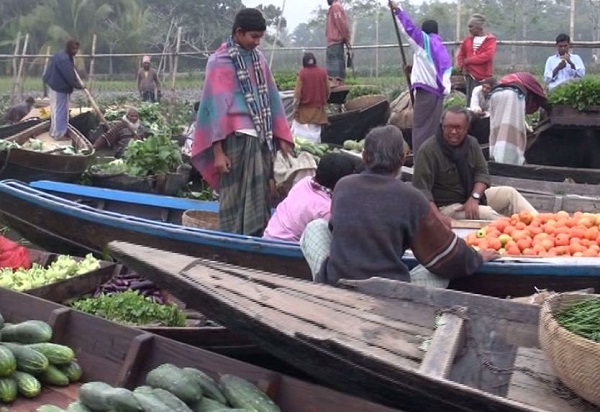
In Nazirpur, Pirojpur, in the south of the country, lies the Boithakata floating market. The traditional market of moving boats on the Belua river sits for four or five hours from dawn each day and is the trading centre for several thousand farming families surrounded by rivers.
A market with no buildings
The route runs from Jhalakathi by road via the Bekutia ferry to Nazirpur, then 30 kilometres to the Taltala ferry, then along the Gaokhali canal. Here the southern Kocha and Kaliganga rivers take the name Belua. The market is entirely natural, with no permanent structures. Farmers and traders arrive by boat early in the morning, and a fair of farmers and wholesalers gathers around everything from vegetable seedlings to other farm produce.
Whatever the sales, farmers here do not complain much; as elsewhere, only wholesalers talk of losses.
More varied than famous markets
The market is more varied than the floating markets of Ratchaburi in Thailand, the Solomon Islands or Can Tho in Vietnam. There are folk tales about its name: some say a small river was once dug with oars (boitha) and later widened into a big river.
A growth centre
Pirojpur journalist Moniruzzaman Nasim Ali said it has become a sizeable growth centre, and if the government takes it up, both agriculture and local people will benefit. For thousands of farmers, this old floating market is the only trading centre, and it could become part of world heritage as agro-tourism.
Source: Shykh Seraj, Hridoye Mati O Manush. First published in Bengali on The Agro News.


Comments
(0)