
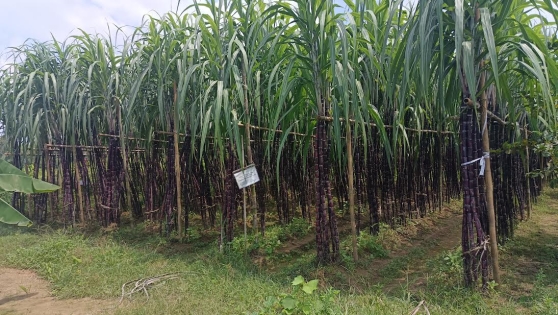
At a time when losses, raw-material shortages at sugar mills and thin margins have driven many farmers away from sugarcane, a dark-stemmed variety known as Philippine black sugarcane — or Black Ruby — is raising new hopes, according to a BSS special report from Gazipur. The Bangladesh Sugarcrop Research Institute (BSRI) has formally approved and released it as BSRI Akh 49, and its cultivation in Gazipur is proving a marked success.
The research and development division of Bashundhara Agro Chemical Industries Limited (BACIL) began growing the variety experimentally in January 2025 on 20 decimals of its 10-acre research plot at Sakashwar Madhyapara in Kaliakair upazila, alongside other crops. Field trials show that with scientific management and proper care the cane can yield twice as much at lower cost. Faisal Ahmed, who leads the field research, told BSS the success owes much to a new planting method that departs from the conventional two-to-three-foot spacing.
Department of Agricultural Extension figures for fiscal 2026-27 put Gazipur's total sugarcane area at 1,603 hectares — 1,220 in Kapasia, 189 in Sreepur, 100 in Gazipur Sadar, 60 in Kaliganj and 34 in Kaliakair. By variety, Ishwardi-16 leads on 542 hectares; the popular chewing canes BSRI Akh 41 (Amrit) cover 384 hectares, BSRI Akh 42 (Rangbilash) 329 and BSRI Akh 47 150, with local Tenai on 80, local types on 38, BSRI Akh 46 on 27, Chimail on 22, BSRI Akh 37 on 20 and Ishwardi-36 on 11 hectares.
With its deep purple-black colour, very juicy stalks and suitability for chewing, BSRI Akh 49 has drawn keen interest from growers and consumers alike. Gazipur has long grown cane for gur and for chewing, and the new variety is expected to command a premium in that market, transforming the fortunes of local cane growers.
Based on BSS's special report from Gazipur. Source: BSS
Comments
(0)