
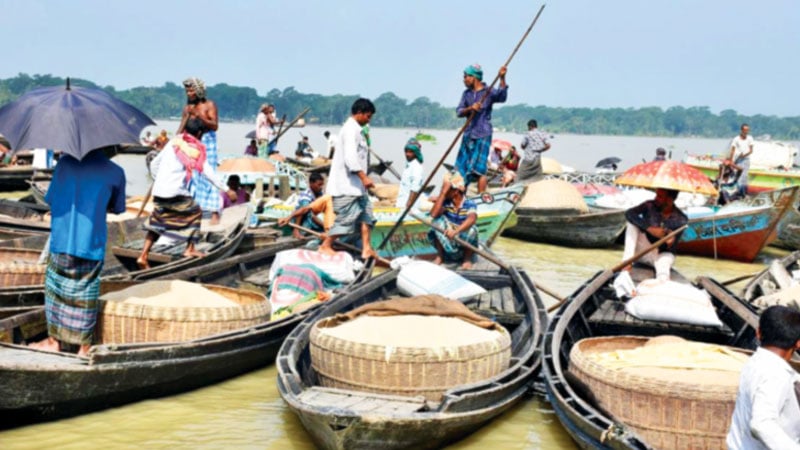
As day breaks at Banaripara in Barishal, hundreds of dinghies and trawlers gather on the Sandhya river. On one boat paddy is being haggled over; on the next, rice is being measured. Bargaining, hauling sacks and cash deals all happen on boats floating mid-river.
Local elders say this floating trade in paddy and rice on the Sandhya is about 200 years old. The riverbanks were once lined with paddy and rice warehouses and mills. Engine-driven trawlers have since replaced sailing boats, but the custom of trading boat to boat has not changed.
Banaripara's name is tied to Balam rice - fine, long and fragrant - once prized across the country. Alongside Balam, many varieties of paddy and rice change hands at the market.
Central to the market are the kutials, who buy paddy and turn it into rice. Paddy bought from the boats is first soaked in water, boiled at dawn in special vessels over large ovens, dried in strong sun for two or three days and then milled. The bustle of kutials once filled every household in Banaripara; much of it has faded.
Traders come by river from Barguna, Patuakhali, Bhola, Pirojpur and other southern districts. Jamal Uddin, a trader from Barguna who brought a boatload of paddy, said the market pays a fair price for paddy and good rice can be bought comparatively cheaply for the journey home; for the ease of river transport and the trust between traders he has come for decades.
The main market sits on Saturdays and Tuesdays, and some trading carries over on Sundays and Wednesdays, which locals call the "gala haat".
Reported by Samakal, Barishal.
Source: Samakal

Comments
(0)