
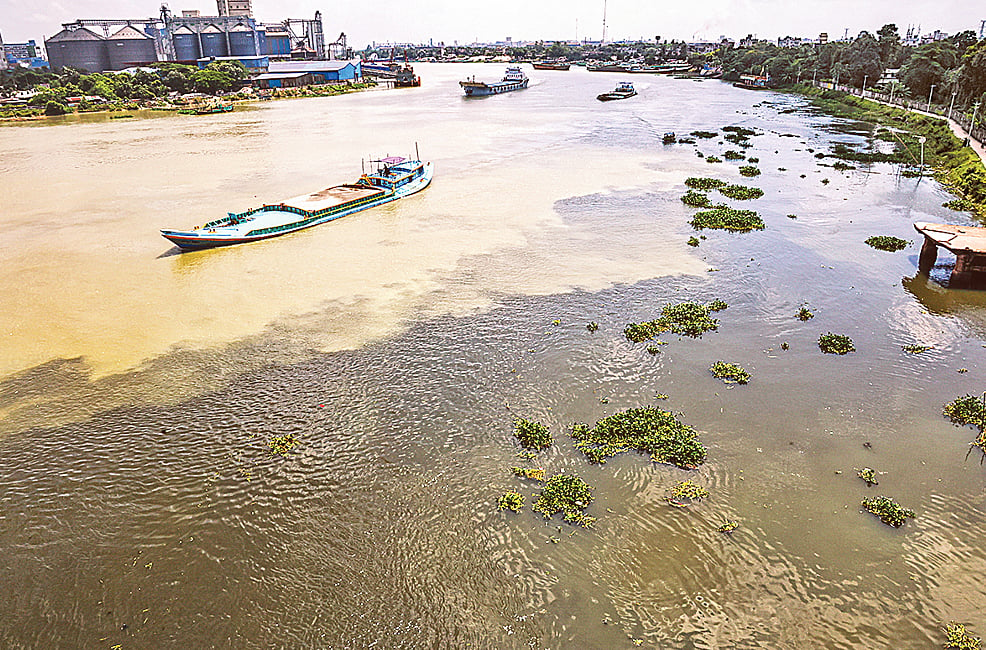
On World Rivers Day researchers in Bangladesh warned that encroachment and pollution are turning the country's rivers into a threat not only to aquatic life but to human health, as industrial waste, oil from vessels and land grabs take their toll.
Dilbar Hossain, in his sixties, has fished the Dhaleshwari since childhood from Charkundania village. He once caught fish worth Tk 10,000-15,000 in a single night, he said, listing boal, air, shol, rui, katla, prawn and jatka among the catch. "Now there are no fish. Every fish is scarce," he said. In the dry season, he added, foul water flowing in from the Buriganga kills fish that then float to the surface.
The National River Conservation Commission counts 1,008 rivers in the country. Its 2019 report said 7,000 factories in 11 industrial zones in and around Dhaka had no waste treatment, and that about 60,000 cubic metres of textile, dyeing, printing and pharmaceutical waste enter Dhaka's canals and rivers every day. It also noted tannery effluent with high levels of chromium in the Dhaleshwari.
Md Khaliquzzaman, associate professor of public health and informatics at Bangladesh Medical University, said his team had found chromium in river water. Former commission chairman Manzur Ahmed Chowdhury said polluted water causes diarrhoea, cholera, dysentery, typhoid and hepatitis, and that the risk grows as rivers degrade.
A study by seven researchers from Bangladesh, Australia and China, published in 2023, tested 15 widely eaten fish from the Meghna, including tilapia, koi, rui, katla, pabda and coral. Iron, zinc, copper, mercury and nickel exceeded limits approved by the World Health Organization. The report notes, however, that no study has yet linked eating fish from polluted rivers to a specific illness.
Mental health is part of the picture too. A 2019 survey of 611 households in Rajbari and Tangail by researchers from Rajshahi University and Islamic University found depression, anxiety and stress far higher among the 509 families that had lost land to river erosion.
The livelihoods of fishers and river-dependent farmers rest directly on these rivers. The report is by Shishir Moral of Prothom Alo.
Source: Prothom Alo


Comments
(0)