
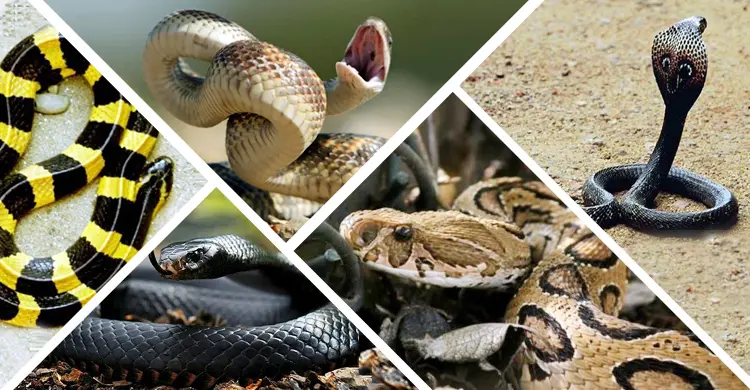
Snakes become far more of a menace in the monsoon. They are seen less often near homes at other times of year, but in the rainy season, with water all around, they turn up far more often. That is why news of deaths from snakebite is so common at this time.
In every flood season, in the three months of May, June and July, the number of snakebites and deaths rises. A nationwide snakebite survey by the Non-Communicable Disease Control programme (NCDC) found that 4,03,317 people in the country are bitten by snakes every year and 7,511 of them die. Each snakebite costs the victim about Tk 2,000 in treatment.
Not every snake is venomous, however, so not every snakebite kills. Some 80 species of snake live across the country, and most deaths are caused by the bites of only seven or eight highly venomous species. Many other species actually keep their distance from people.
Know these venomous snakes
Russell's viper (chandraboda): Also called uluboda, this is the most venomous of the snakes found in Bangladesh. About a hundred years ago it had almost disappeared from the country, with not a single one seen for several decades in a row. But for the past 10 to 12 years, bites from this snake have been recorded again.
King cobra (shankhachur): Also called raj gokhra and padma gokhra, this deadly snake is much longer than other cobras. Its hood does not carry the spectacle-like ring of other cobras. It is found mostly in Bangladesh, Bhutan, Burma, Cambodia, China, India, Indonesia, Nepal, the Philippines, Singapore and Thailand, and prefers dense forest and hill areas.
Krait (keute or shankhini): Also called shankhini and shakini, this snake is seen in Sreemangal. There are eight species of krait in the world, five of which are found in Bangladesh. Kraits are also known locally as keute. They live in dry places around homes or in firewood.
Naja naja: Although its scientific name is Naja naja, this is a cobra (gokhra). It is a land snake that raises a hood, and its hood carries two spectacle-like rings. It lives mainly in the western part of the country, towards the Rajshahi region.
Naja kaouthia: Also a cobra, known locally as jati sap or jat sap, and also called jaura. It lives mainly in the east of the country, in Sylhet and Noakhali. It causes the largest share of snakebites in the country. This snake raises a hood.
Black krait: Also a krait, this snake is found in large numbers in Bangladesh, mostly in the hill areas of Chattogram and Sylhet, Noakhali and the Sundarbans region.
Source: Jagonews24. First published in Bengali on The Agro News.
Comments
(0)