
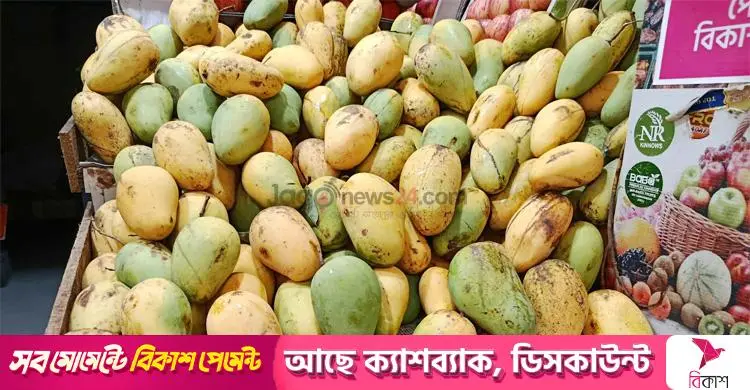
Madhumas (Jyoishtha) ended two months ago, yet mangoes are still on sale. Supply is not large, but what is available at the end of the season can be called sufficient. Prices, however, are now double or more what they were a few weeks ago.
Visits to several areas and fruit markets in the capital found mangoes still on sale at neighbourhood fruit shops, and trade continues in the big markets. Ashwina, Gourmoti, Katimon and several other varieties are available, though at somewhat higher prices. At retail, a kilo of mangoes now costs Tk 120 to 200.
From two months to five
In Bangladesh the peak mango season is considered to run from June to July (from a little before Jyoishtha to mid-Asharh). But mangoes are now on the market for five months, from May to September. Only a few years ago, once the Amrapali supply ended, mangoes were scarcely seen; now they are available even in Bhadro.
The mango season can now be divided into three: early, mid-season and late varieties. Early varieties ripen from the start of May to mid-June. Notable among them are Gopalbhog, Gobindabhog, Brindaboni, Gulabkhas, Ranipasand, Himsagar, Khirsapat and BARI-1.
Mid-season mangoes begin ripening from mid-June, including Langra, Haribhanga, Lakshmanbhog, Khudikhirsha, BARI-2, Bombai and Surjapuri.
Late varieties ripen from July to the first week of September, including Fazli, Amrapali, Mohanbhog, Ashwina, Gourmoti, BARI-3 and BARI-4.
Production of late varieties was once low in Bangladesh but has risen considerably, lengthening the season.
Mohammad Arifur Rahman, project director of the DAE's "Exportable Mango Production Project", has long worked on the country's mangoes. He told Jago News: "Production is highest in June and July. But now the mango season runs until August, and supply is quite good at this time too. Altogether, a variety of mangoes can now be found in the market throughout a long five-month season."
About 30 varieties grown in different regions of Bangladesh reach the market commercially. Half of them are improved varieties, which are popular and produce more. Around 20 varieties are now quite successful commercially and are available in markets across the country through the season.
Buyers and sellers
Buyers say supply in late August is comparatively higher this year than in previous years. Prices are a little higher, but the mangoes now available taste and smell good.
Sellers say mangoes are still arriving in Dhaka's markets from Rajshahi, Chapainawabganj and Naogaon. Sales are good despite the season drawing to a close, though wholesale supply is falling day by day. They mainly buy from Badamtoli, Dhaka's wholesale fruit market.
At a market in Badda, a seller named Bijoy said: "BARI-3, BARI-4, BARI-11, BARI-12 and Gourmoti mangoes are in good demand. They are very sweet."
Salam Hossain, a fruit trader in Rampura, told Jago News: "Most people can properly recognise only two or three varieties: Fazli, Langra and Ashwina. Before, other varieties were hardly found in the market." He said: "A few years ago there were no mangoes in the market at this time in August. When Amrapali finished, the season was over. But now BARI mangoes are everywhere, and they will be available for about another month."
Farhad Hossain, who was buying mangoes at the same market, told Jago News: "The children love mangoes. I used to buy Amrapali, but I can't get it now. For the past few days I've been buying Gourmoti. It's a very good, juicy mango. But the price is rising day by day."
Production and exports
Final figures for this year's production are not yet available. The target this season is about 2.7 million tonnes (27 lakh tonnes) from 205,034 hectares. Last season the country produced 2,508,973 tonnes.
Bangladesh currently ranks seventh in the world in mango production, and its mangoes are exported to various countries. Work is under way to export 4,000 tonnes this year. Mangoes are mainly exported to India, Nepal, Sri Lanka, the Philippines, Saudi Arabia, Kuwait, Qatar, the United Kingdom, Italy, Germany, France, Sweden and Canada.
Source: Jagonews24. First published in Bengali on The Agro News.

Comments
(0)