
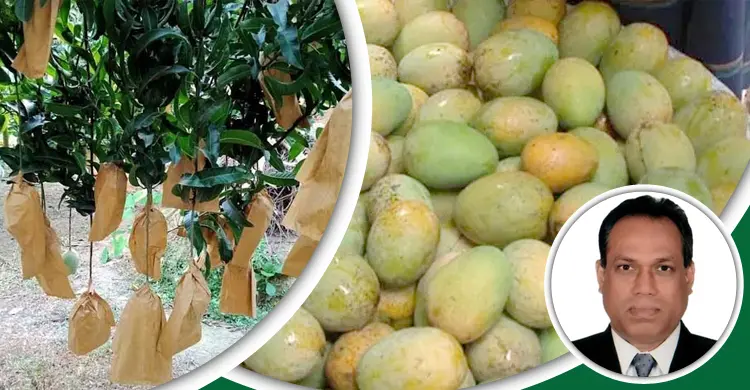
Mangoes carry great economic importance. They are popular with consumers for their good taste and wide range of varieties, and the fruit is rich in vitamins A and C. Mango wood is used for making house windows and for religious purposes.
According to the Bangladesh Bureau of Statistics (BBS), the country produced 1,222,000 tonnes of mangoes in the 2019-20 fiscal year. Mango orchards cover 235,000 acres, and each tree yields an average of 77 kg of fruit.
Exports still small
Bangladesh exported 310 tonnes of mangoes in 2018-19, 283 tonnes in 2019-20, 1,632 tonnes in 2020-21 and 1,757 tonnes in the 2021-22 fiscal year. Although Bangladesh ranks seventh in mango production, it is not among the top exporters. There is potential to export more than a lakh tonnes.
By the Department of Agricultural Extension's (DAE) count, however, national mango production is around 24 lakh tonnes. Mango trade worth about Tk 14,000 crore takes place every year, a huge market built on production, marketing, packaging and transport. The trade begins in April when green mangoes reach the market and continues until the sale of Ashwina mangoes ends in September.
Mehedi Masud, director of the DAE project on nutrition improvement through year-round fruit production, said: "Mango production in the country is rising faster than that of any other fruit every year. This has created the opportunity to export mangoes after meeting domestic demand." (Prothom Alo)
A DAE project for export-quality fruit
Notable mango-growing areas include Satkhira, Naogaon, Rajshahi, Chapainawabganj, Meherpur and the three hill districts. This year, under the DAE's export-quality mango production project, entrepreneurs have for the first time been given temporary incentives to grow mangoes aimed at export markets. The project initially selected 930 entrepreneurs, and the authorities say the number will rise to 8,400 within the next four years.
The selected farmers are growing mangoes under special management because the fruit is bound for other countries. They have already received pesticides, fertiliser, fruit bags and other inputs, along with special training, as export mangoes need particular care. The fruit fly is the mango's main enemy; to keep it out, the fruit must be bagged once it is 45 to 50 days old. Mangoes must also be picked only after a set period following pesticide use. Not only the 930 farmers' orchards will export, however: mangoes from outside this group are also exported when they meet the standards.
Local agriculturists consider Bangladeshi mangoes good in taste, aroma and nutrition, and there is demand for them abroad. Bangladesh has a large market overseas, yet the volume exported is very small. Last fiscal year most mangoes went to the United Kingdom, Saudi Arabia, Italy, Qatar and Kuwait.
A review of the fruit market by the UN Food and Agriculture Organization (FAO) says India and Pakistan are among the largest mango exporters. Mexico exported the most, 468,000 tonnes, and Thailand about 340,000 tonnes. The director of the DAE's export-quality mango production project said the target this year is more than double last year's, at 4,000 tonnes, and farmers have been given the training and support they need.
Barriers identified
The DAE has identified several barriers to mango exports:
- Quality, safe mangoes are not produced.
- Importers' conditions on post-harvest handling are not met.
- There is a lack of coordination among farmers, extension officers, researchers and exporters in production and marketing.
- After harvest, mangoes are not sorted, graded and packed to keep their quality, or carried in cooling vans.
According to growers and exporters, packing for export depends on Shyampur in Dhaka, where the DAE runs export packing facilities at the Central Packing House. The packing house is far from the mango-growing districts, and growers in various upazilas and districts say the quality cannot be maintained when mangoes are brought so far. Local growers say it is essential to build a packing house in each of the main mango-growing districts. Other problems are delays in obtaining the plant quarantine or phytosanitary certificate needed to send mangoes abroad, and high air freight charges, which are much higher here than in competing countries such as India, Pakistan and Thailand.
Bagging mangoes on the tree produces safe, poison-free, exportable fruit, and the method has become known in the field as a simple and low-cost technology. The writer hopes production of safe, poison-free and healthy mangoes will grow, and that growers will follow these practices closely to ensure good-quality fruit.
The writer is a lead agriculturist based in Dhaka.
Source: Jagonews24. First published in Bengali on The Agro News.
Comments
(0)