
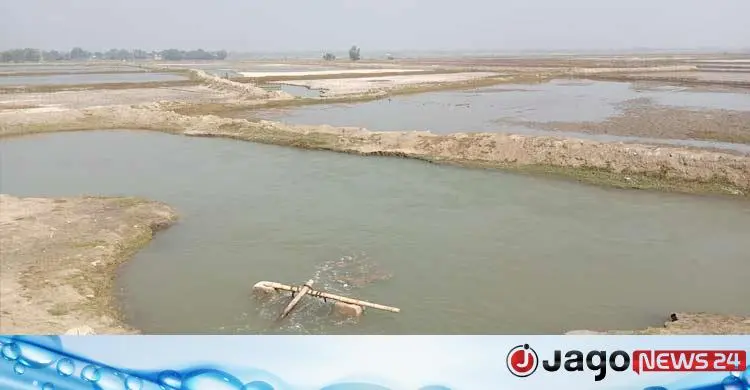
The old curse of salinity has returned to Assasuni, a coastal upazila of Satkhira. Influential people in the Tentulia and Pratapnagar areas of the upazila are accused of using a sluice gate to bring in salt water, putting boro paddy on several hundred bigha of land at risk.
Local farmers say influential shrimp enclosure owners are misusing a gate built to drain monsoon water, letting salt water into the beel. About 800 bigha of land is directly at risk, of which 80 to 100 bigha has been planted with paddy this season. If the water spreads further, it is feared that large areas of farmland, trees, the fresh water in ponds and local biodiversity will suffer serious damage.
Farmers collected signatures and lodged a complaint with the union parishad. They allege that when they tried to go together to block the water, they had to back off in the face of threats. Tension is running high in the area.
The upazila administration says that if it receives a written complaint it will investigate and take legal action to stop the illegal intake of salt water. The Water Development Board has also said it will take the necessary control measures if misuse of the sluice gate is proved.
Farm families fear damage on many fronts
Farmers in Pratapnagar and Tentulia are deeply anxious. They fear that if the water reaches the paddy fields, not only will this season's crop be lost, but soil fertility will fall and farming will suffer for several seasons to come, leaving thousands of people who depend on farming struggling to support their families.
Local farmer Mizanur Rahman said: "We bought seed, fertiliser and pesticide on borrowed money. If salt water gets in now and ruins the paddy, how will we repay the loans? It will be hard even to keep the family going."
Another farmer, Anadi Sarkar, said: "This land used to be salty. With great effort we brought the salt in the soil down, and for two or three years we had been getting good yields. If salt water gets in again, the land will go back to how it was. Then forget paddy, not even grass will grow."
Farmer Rafiqul Islam said those who used to farm fish in the beel had said they would not do so any more, but many had not kept their word. Many farmers had planned to farm fish after harvesting their paddy. "But if the water gets in before the paddy ripens, we lose both ways. The crop will go, and the land will be ruined too."
Local people say salt water in the beel would spoil the fresh water in the area's ponds, making it unfit for household use and creating a shortage of safe water for livestock. Fruit and timber trees would also be at risk of drying up, with a long-term negative effect on farm production, the rural economy and livelihoods.
From a green revolution back to salinity
After cyclones Amphan and Yaas, it took Pratapnagar union a long time to recover from the severe effects of salinity. Through local efforts to control the sluice gates and conserve fresh water, paddy and vegetable farming were restored on thousands of bigha over the past two years, which residents had been calling a green revolution.
That achievement is now under threat from the new intrusion of salt water. A group led by Shahadat Hossain is accused of letting salt water into the southern beel through the sluice gate in the Kheyaghat area of ward 5 of Pratapnagar union. This has created a risk of about 80 bigha of paddy going under water, as well as of permanent waterlogging.
Pratapnagar resident Huzaifa Al-Amin told Jagonews24 that for several days influential enclosure owners had been using the sluice gate, built to drain monsoon water, to take salt water from the river into the beel. The salt water has not yet reached the paddy fields directly, he said.
"There is about 800 bigha of land here. Of that, 80 to 100 bigha has been planted with boro paddy this season. If the water keeps rising like this, the paddy fields will be damaged in a short time," he said.
He added that farmers had collected signatures and submitted a written complaint to the chairman of Pratapnagar union parishad, but it is alleged that the farmers were threatened today, soon afterwards. The farmers had decided to go together to block the water, but because of the threats nobody dared to go out.
Local people say the sluice gate now being used to take in salt water was built mainly to drain excess water in the monsoon. Farmers say that using the drainage system in reverse to let in salt water threatens not only this season's paddy but future farming and the environment of the whole area.
A many-sided crisis for the environment and food security
Agriculture experts say that once salinity rises on the coast, soil fertility falls, farming is disrupted for several seasons and groundwater also becomes saline, putting future crops at risk as well as the current paddy.
Agriculturist Saiful Islam, deputy director of the Department of Agricultural Extension (DAE) in Satkhira, said crop production is low in coastal areas. After embankments were built, farmers in some areas began growing salt-tolerant paddy varieties. "But once again some people are trying to bring salt water into cropland in the name of fish farming. If paddy farming stops, there will be a big shortfall in local food production," he said.
What local representatives and officials say
Pratapnagar union parishad chairman Abu Daud Dhali told Jagonews24: "I have already informed the upazila administration, the Water Development Board and the agriculture officials. If necessary I will also inform the deputy commissioner in writing. We are arranging an emergency meeting at the union parishad with farmers' representatives and others concerned."
Abdur Rahman Tazkia, executive engineer of Division 2 of the Bangladesh Water Development Board (BWDB) in Satkhira, told Jagonews24 that the sluice gate used to control water flow in the Pratapnagar and Tentulia areas was built mainly to drain excess water in the monsoon.
"Water management is an integrated matter involving the interests of agriculture, fisheries and local people. So we will work with the upazila administration and the agriculture department to find a solution that keeps paddy farming from being harmed and stops misuse of the infrastructure. If anyone has been operating the gate illegally, legal action will also be considered," he said.
Assasuni upazila nirbahi officer (UNO) Saiduzzaman Himu told Jagonews24: "We are aware of the matter. If we receive a written complaint, an investigation team will be formed immediately. The real situation will be checked on the ground with representatives of the agriculture department, the Water Development Board and the local administration. If there is proof that the sluice gate is being misused to take in salt water illegally, legal action will be taken against those involved."
Source: Jagonews24. First published in Bengali on The Agro News.

Comments
(0)