
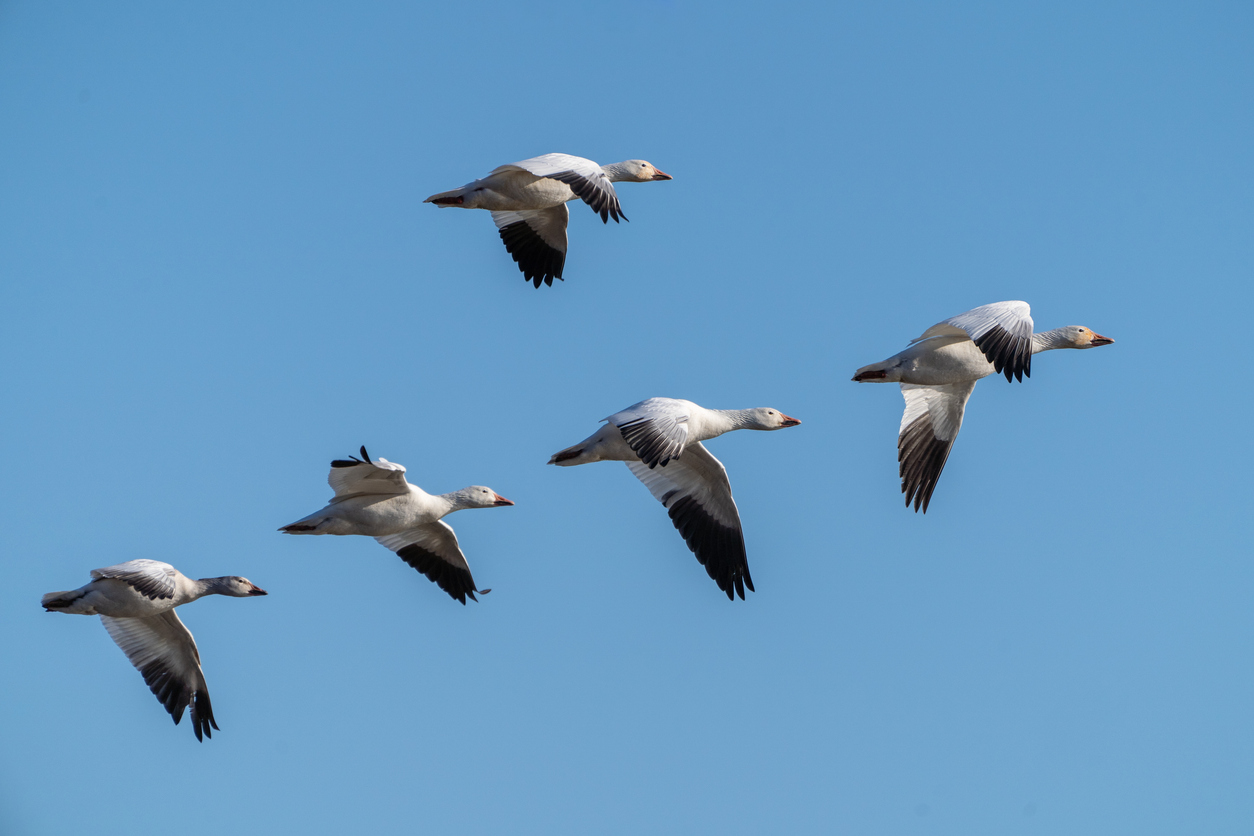
Alveo Technologies, which makes rapid on-farm pathogen tests, has partnered with AgriNerds, a specialist in tracking wild waterfowl, to build an early warning system for avian influenza on poultry farms. The idea is to tell a producer when wild-bird activity around a farm has raised the risk of infection, and to confirm or rule out the virus on site within 45 minutes instead of waiting two to three days for a laboratory PCR result.
AgriNerds’ Waterfowl Alert Network uses radar, satellite imagery, radio telemetry on wild birds and other data to predict waterfowl abundance near individual poultry facilities and grades the risk as low, moderate or high. It now issues daily predictions for more than 160,000 commercial poultry sites across the United States, and its data is used by more than 1,500 farms in 25 states, said founder Maurice Pitesky, an associate professor at the UC Davis school of veterinary medicine. “The farm doesn’t change location, but the risk does change,” he said, since weather, crops, water and habitat shift from year to year.
Alveo’s handheld platform uses molecular amplification, the same chemistry as a laboratory test, in a rugged device the size of a phone. Company president Erik Tyrrell-Knott said it distinguishes the H5 and H7 subtypes with 96 to 99 per cent accuracy, close to PCR, whereas lateral-flow strip tests miss the virus 30 to 40 per cent of the time. The tests are already sold in several countries, have USDA approval for experimental use and are expected to win full US approval in the fourth quarter of this year as the first on-farm molecular bird flu test.
Today, Tyrrell-Knott said, a farmer who sees egg production fall or birds turn lethargic must either spend heavily on biosecurity while “flying blind” or carry on as normal for days awaiting results. Under the new system, a vet would be alerted in real time to a red day and step up testing, and geotagged results would feed back into AgriNerds’ model to sharpen later forecasts.
Infected flocks still have to be destroyed, but early detection changes what happens around them. Farms can restrict movements of staff, feed and waste trucks, and adjust ventilation to limit the spread of contaminated material; about 30 per cent of infections move farm to farm through people, vehicles, equipment or the air, Tyrrell-Knott said. Pitesky added that a positive on-farm result, combined with wind data, would allow AgriNerds to warn farms downwind of where infected feather dander might travel.
In the longer term, Tyrrell-Knott believes fast, trusted tests could let large complexes cull only the affected barn. “You could start to partially depopulate some of these complexes when you’ve got 13 barns with two million birds on a complex, instead of having to cull all the birds,” he said.
For poultry producers, the partnership describes a shift from reacting to outbreaks to testing on the days when the risk is known to be high, which could save both birds and money if it works as claimed.
Source: AgFunderNews
Comments
(0)