
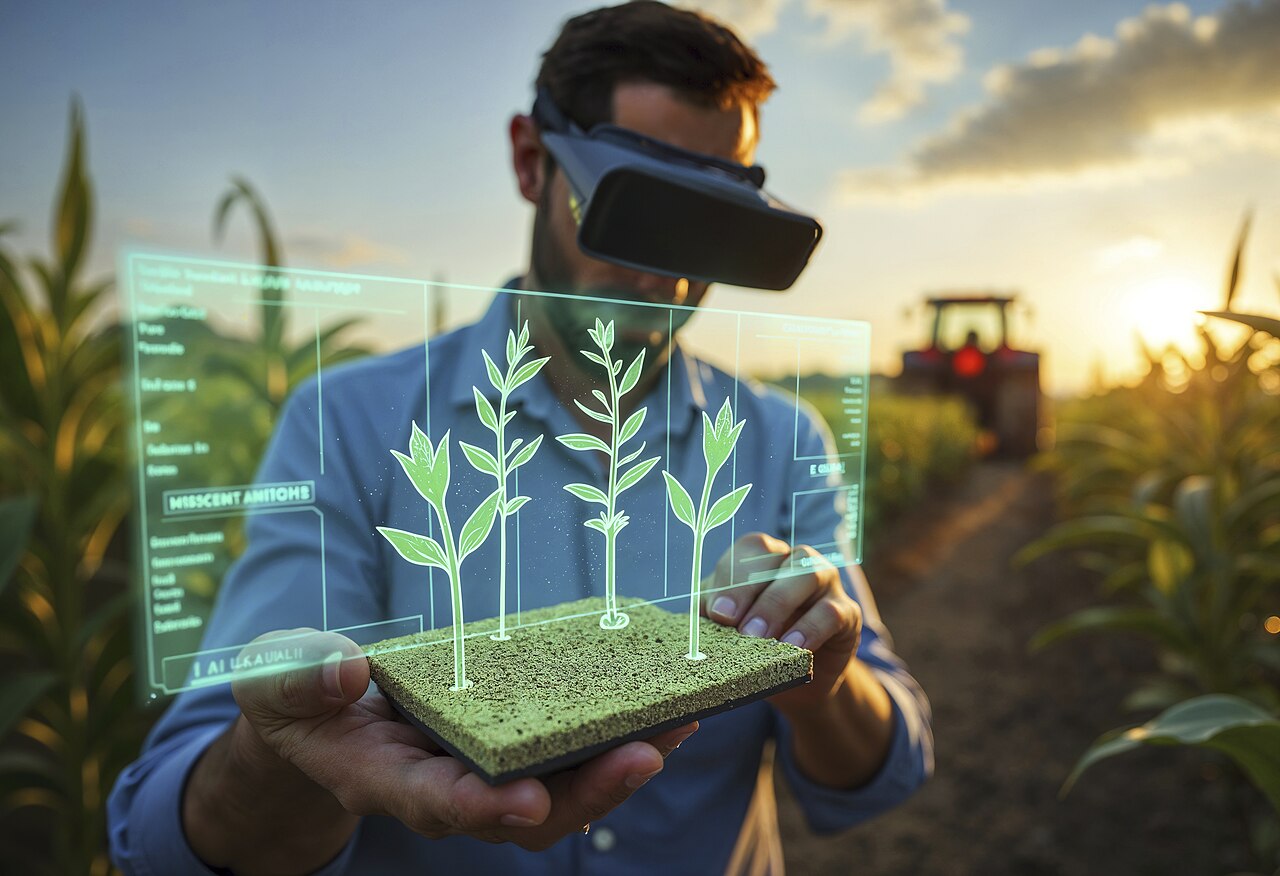
Out of every hundred working people in Bangladesh, roughly forty-five still earn their living from farming. The Bangladesh Bureau of Statistics' Labour Force Survey 2022 put agriculture's share of employment at 45.33 per cent. Yet by the same bureau's provisional estimate, crops, livestock, forestry and fisheries together contributed only 11.55 per cent of gross domestic product in the 2023-24 fiscal year. Why so much labour yields so little income is a question with many answers, but one of the biggest is productivity. And the idea most often put forward for raising that productivity now goes by a single word: agrotech.
Agrotech, or agricultural technology, means using modern tools and innovation to improve farming. A small device that measures conditions in the soil, a drone that looks down on a field, a combine harvester that cuts rice, an advice service on a mobile phone, a website that sells produce straight to buyers: all of these count. The aim is the same throughout: to bring in more harvest, at the right time, with less cost and less waste, and to raise the farmer's income in the process. Many believe it could open a new era not only for farmers but for the whole agricultural industry.
Bangladesh is an agricultural country, and farming is one of the pillars of its economy. But the sector is under pressure. The same land has to produce more every year, because the population grows while the farmland does not. Heavy use of chemicals and water strains the environment. And as young people leave villages for jobs in cities or abroad, labour is hard to find at planting and harvest time. Agricultural technology can play an important part in meeting these problems. Used well, it lets farmers raise output, cut costs and build a more sustainable way of farming.
Why farming needs technology more than ever
Around the world, agrotech matters more each year because it offers new answers to old farming problems. Farmers once made their decisions on experience and judgement: when to irrigate, how much fertiliser to use, when to spray. Experience is precious, but when the weather no longer behaves as it used to, judgement alone is not enough. Timely technology gives the farmer extra information with which to look after a crop more precisely.
For Bangladesh the need is sharper still. A farmer's land here is usually small and split into several plots. Most families have no savings to absorb one bad season. Floods, drought, salinity, untimely rain and hailstorms come round again and again. So in this country the value of any farm technology is measured by a plain test: does it lower the farmer's risk, and does it put a little more money in his or her pocket? Technology that passes both tests is the kind that stays in the field.
News from the field, in the field: sensors, data and productivity
The first big advantage of agrotech is knowing the land well. Small sensors placed in the soil can measure moisture, temperature, acidity or nutrient levels and send the readings on. Combine that with data from weather stations, satellite images and drone photographs, and it becomes clear which part of a field is weak, where water is running short, and where pests have started to attack. The farmer can then act at the right moment, and the result shows up in the yield.
Take fertiliser. Spreading it evenly over a whole field wastes money where the soil already holds enough nutrients and leaves a shortfall where it does not. With soil test results and field data in hand, fertiliser can go where it is needed. The same is true of irrigation. In the dry-season boro rice crop, irrigation is one of a farmer's largest costs, especially with pumps running on diesel or electricity. Irrigating according to soil moisture saves both water and fuel.
In this way Bangladesh's farmers can use agrotech to grow more and spend less. Sensors, drones and automated equipment make it possible to irrigate, fertilise and apply pesticide at the right time. Yields rise, and production costs come down considerably.
Timing is the harvest: the right job at the right moment
There is an old saying in farming that a stitch in time saves nine. Preparing seedbeds, transplanting, weeding, irrigating, fertilising, spraying and harvesting all have their proper moment. Miss it, and the same effort brings a smaller return. With automated machines, drones and sensors, the farmer can catch that moment. Technology helps decide which day the field needs water, which week a spray will work, and, from the weather forecast, when it is safe to harvest.
The clearest example comes at harvest time in the haor wetlands of the north-east. At the start of the Bengali month of Baishakh, farmers race to bring in their boro rice before flash floods pour down from the hills. When labour is scarce, ripe rice risks being drowned in the field. To ease that crisis, the government in June 2020 launched a project for agricultural mechanisation through integrated management. Under it, combine harvesters, reapers, rice transplanters, power threshers and seeders have been supplied with a 70 per cent subsidy in the haor and southern coastal areas and a 50 per cent subsidy elsewhere. Newspapers have also reported an Anti-Corruption Commission investigation into how the project was run, but the spread of machines in the fields is plain to see.
The scale is considerable. According to an assessment published by the CGIAR research partnership, the programme distributed more than 35,000 subsidised machines worth 1,595 crore taka, and combine harvesters made up 84 per cent of that value. The same assessment suggests there is room to ask how far the benefit reaches smaller, cheaper machines and small farmers when most of the subsidy goes to large machines. Bringing in machines matters, in other words, but so does watching whose hands they end up in.
Agrotech thus makes farm work more effective through modern machinery, drones and other technology. Jobs get done faster, on time, and with less waste.
Farming that spares the environment
Another major side of agricultural technology is protecting the environment. If the amount of pesticide a crop needs can be measured precisely, excess chemicals no longer end up in the soil, canals or ponds. Beneficial insects, fish and human health are all protected. Water-saving irrigation eases pressure on groundwater, a serious worry in the north and north-west of the country. Organic manure and fertiliser applied according to measured soil health keep land fertile over the long run.
Environmentally friendly methods can be both sustainable and profitable for the farmer, because money is not spent on chemicals the crop does not need, and healthy soil gives a good yield the following season too. With the help of technology, it is possible to reduce harm to the environment and build a farming system that lasts.
What the farmer gains
Agrotech is not only about machines and software; it changes the farmer's daily life. Putting together the experience of those who use it and the observations of researchers, several benefits stand out:
- More output at less cost: sensors and automated systems keep watch on the crop so that action comes at the right moment, and inputs go where they are needed and nowhere else.
- Decisions based on data: mobile apps, drones and satellite images tell the farmer about crop condition, prices and market demand.
- Access to markets: online platforms let farmers sell directly, reaching buyers beyond the local market.
- Training and knowledge: apps and software put accurate information within reach and teach farmers how to use it.
- Time and labour saved: irrigation, fertilising and harvesting are done quickly and accurately, and the hardest physical work is reduced.
None of these benefits is a revolution by itself, but added together they change a farm's accounts. A few per cent more yield, a few per cent lower cost and a slightly better price at market: those three together decide whether a farmer ends the year in profit or in loss.
Advice in the palm of the hand: phone calls, apps and weather alerts
Data-driven decisions make many people think of expensive equipment. But in Bangladesh the most widespread form of agricultural technology is the ordinary mobile phone. By calling 16123, the Krishi Call Centre run by the Department of Agricultural Extension, a farmer can get advice on crops, fisheries and livestock. According to the Agriculture Information Service, agriculture officers based at Khamarbari in Dhaka answer the calls. The service was launched as a partnership between government agencies, the telecommunications regulator, the development organisation Practical Action and the mobile phone operators.
For identifying crop diseases there is a mobile app called Krishoker Janala, or the farmer's window. According to reporting in the Dhaka Tribune and published research, it holds pictures and remedies for more than a thousand problems across 120 crops, and it works without an internet connection. A farmer can match a leaf spot or an insect against its pictures and identify the problem without travelling to a distant agriculture office.
To manage weather risk, the Department of Agricultural Extension runs the Bangladesh Agro-Meteorological Information Service, known as BAMIS. Drawing on data from the Bangladesh Meteorological Department and the Bangladesh Water Development Board, the portal publishes farm weather advisories for all 64 districts twice a week. Advice such as holding off fertiliser before rain, or cutting ripe rice early when a storm is forecast, feeds straight into decisions in the field.
According to a World Bank project completion report, these vetted advisories reach around 30,000 lead farmers through the Department of Agricultural Extension, and spread from them to neighbouring villages. Between 2019 and April 2025 the BAMIS portal recorded 9.5 million views, and the advice is now also available through a mobile app. A farmer who once relied on the radio weather bulletin can now receive farm advice prepared for his or her own district.
What these services share is this: through technology, farmers can now learn what they need to know about their land, their crops and their markets with far less effort than before, and use it to make sound decisions.
Reaching the buyer directly
One long-standing complaint of Bangladeshi farmers is that they grow the crop while most of the profit goes to middlemen. Agrotech has opened a path here too. Through online platforms and social media, a farmer or a group of farmers can sell directly to buyers. Mangoes, lychees, vegetables and free-range chickens now travel from many districts straight to customers in the cities.
If quality and supply chains can be assured, this path can extend beyond local markets to international ones. Export buyers want to know where and how a product was grown. A digital record of the field, the inputs used and the harvest date answers that question. A stronger link to the market brings the farmer a better price, and that raises income.
Training: a skill that matters more than the machine
Having technology is not enough; one has to know how to use it. Agrotech has therefore opened new doors for farmer training. New techniques can be learned from videos, apps and online courses. Research institutes such as the Bangladesh Agricultural Research Institute (BARI) and the Bangladesh Rice Research Institute (BRRI) publish information about the varieties and methods they develop. In the field, sub-assistant agriculture officers help farmers put new technology to work, hands on.
However advanced a drone or a combine harvester may be, it sits idle unless there are skilled people to operate it, maintain it and understand the information it produces. This is creating new work for rural young people: renting out machines, repairing them, offering drone spraying services. In many areas farmers hire these services instead of buying machines themselves, a realistic route for owners of small plots.
Counting the cost and the hours
Using automated machines, drones and sensors, farmers can work quickly and accurately, saving both time and money. A field that once took many labourers several days to harvest can now be cut by machine in far less time, with threshing, cleaning and bagging done in the same pass.
Saving time has another benefit that does not show up at once in the accounts. If rice can be cut and brought home quickly, the land can be prepared early for the next crop. When mustard, potatoes or pulses are sown without delay after the aman harvest, the same field has a better chance of yielding an extra crop in the year. So the gain from machines is not confined to one season; it runs through the whole year's cropping cycle.
Technology lets irrigation, fertilising and other tasks be done fast and precisely. That saves the farmer a great deal of time and reduces physical labour. The time saved can go to another crop, to livestock or to other work that brings in income. So the same household can produce more in a year.
Tomorrow's fields: from smart farms to biotechnology
Experts are optimistic about the future of agricultural technology. As technology advances, the face of farming is changing, and in the years ahead it will bring farmers more benefits and more opportunities. Several trends are already clear.
The first is smart farming and automation. A smart farm is one where sensors, machines and software work together. When the soil dries, a pump switches itself on; when a poultry shed grows too warm, the fans start turning. As such systems spread, farm work will become faster, and farmers will get bigger harvests for less time and labour.
The second is the wider use of drones. Surveying land, monitoring crops and spraying pesticide or fertiliser will all become quicker. Images taken from above show the health of a crop accurately, so farmers can solve problems fast. Compared with walking through muddy fields with a sprayer, it also reduces the farmer's own exposure to chemicals.
The third is biotechnology and genetic engineering. These tools will be used more widely to raise productivity, making possible new varieties that yield more and resist disease. Bangladesh has already brought Bt brinjal, resistant to the fruit and shoot borer, into its fields. Combining conventional breeding with modern biotechnology, the Bangladesh Rice Research Institute has also developed rice varieties that tolerate submergence and salinity, which are helping farmers in flood-prone and coastal areas.
The fourth is the development of environmentally friendly technology. Sustainable technology and green methods in farming will keep improving, so that agriculture stays safe for the environment and profitable in the long term.
The fifth is farm data analytics. By analysing years of accumulated data on weather, soil, yields and prices, farmers will be able to make better decisions about the condition and productivity of their own land. Artificial intelligence can also forecast harvests from this data. That will further raise the chances of higher output and lower costs.
The obstacles still to clear
Alongside the promise, the realities must be kept in mind. The first obstacle is price. It is hard for a smallholder to buy expensive machines or sensors, so subsidies, low-interest farm credit and machine-hire services need to reach further. The second is training: farmers do not trust technology they do not understand. The third is connectivity. Without fast internet and reliable electricity in the villages, many digital services cannot work fully.
There is also the matter of trust. A farmer who has farmed one way for many years needs time to adopt something new, especially when a single wrong decision can put a whole season's income at risk. Demonstration plots, the success of a neighbouring farmer and the steady presence of a field worker are therefore the most effective ways of spreading technology. With training, affordable equipment and connectivity in the countryside, agrotech can be the difference between a farm that merely survives and one that prospers.
Small farms, large change
Taken together, agrotech is bringing major change to farming and opening new horizons for Bangladesh's agriculture. It helps farmers run their work more efficiently, make the right decisions at the right time and earn more. Its benefits do not stay in one farmer's home; they spread into the country's food security and its economy.
In a country where nearly half of all working people are tied to agriculture, even a small rise in farm productivity leaves its mark on millions of families. Those who work in the sector expect modern technology to spread much further in the years ahead. The question is how quickly, and how fairly, it reaches small and marginal farmers. If that can be ensured, technology will make Bangladesh's agriculture stronger and more sustainable.
Photo: Technology at work in agriculture, Ahman10 / Wikimedia Commons (CC BY 3.0)
Comments
(0)