
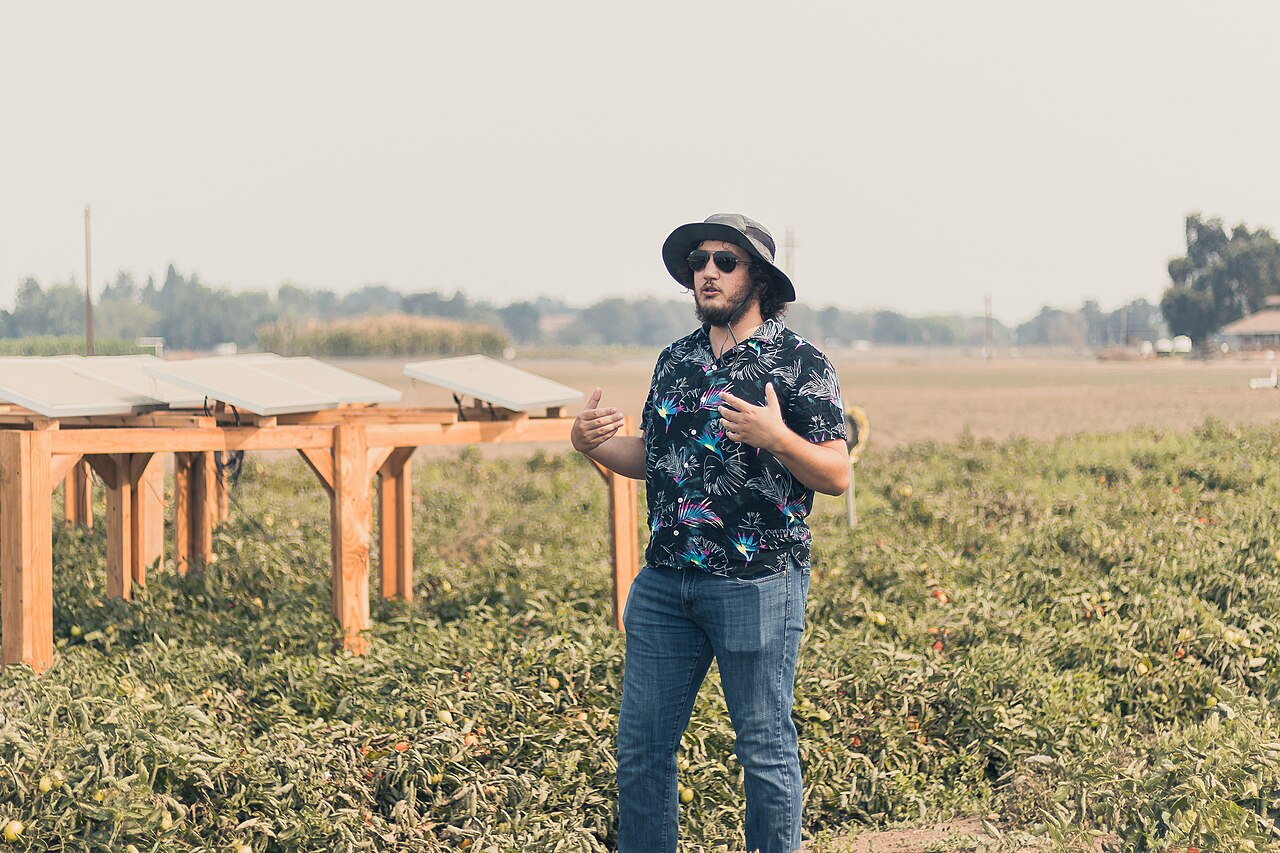
In Murcia, in south-eastern Spain, solar panels now shade bell peppers, wine grapes and dragon fruit, part of a wider test of whether farming and solar energy can share the same land instead of competing for it. The practice is called agrivoltaics, or agri-PV.
"Agrivoltaics is the integration of food production with renewable energy production," said Silvia Tomasi, a senior researcher at Eurac Research, with panels installed above, between or at the edges of crops. A 2023 study estimated that Europe could generate 25 times its current electricity demand this way. In southern Italy, Amazon and Apple have signed to buy power from agrivoltaic projects with a combined capacity of over 150 megawatts, and Italy has secured 1.7 billion euros in state aid for the approach, while the EU-funded AGRISOL project plans to invest 1.9 million euros in projects in Italy and Spain.
Rules increasingly require farming to stay central. In France, projects must keep at least 90 percent of crop output compared with local reference yields; in Italy, at least 70 percent of the area must remain in agriculture. Pilar Flores, who coordinates an EU-funded agrivoltaics project at the Murcian Institute for Agricultural and Environmental Research and Development (IMIDA), said what is needed is a classification that keeps "minimal loss" of arable land at its core.
Shade from the panels can cut evaporation, keep soil moist, protect crops from hail and give workers and grazing animals relief, and farmers can use or sell the power or rent the space above their fields. But Flores warned the benefits are not automatic: in Murcia her team found water-stressed peppers grew better under panels than well-watered ones. "You have to analyse each case and each location," she said.
Not every farmer is convinced. Fabrizio Garbarino, president of the Italian farmers' union Associazione Rurale Italiana, said agrivoltaics take advantage of the crisis in Italian farming instead of tackling farmland abandonment, with developers, including for data centres, pressing farmers for land. A 2025 study co-authored by Tomasi found the gains can favour large farmers, landowners and investors over small farmers, and a review by the Italian newspaper Today.it found about 86 percent of roughly 775 million euros of public funding for agrivoltaics went to large projects.
The report was written by Ansley Evans, Lottie Watters and Stefania D'Ignoti.
Photo: UC Davis College of Engineering / Wikimedia Commons (CC BY 2.0)
Source: Euronews

Comments
(0)