
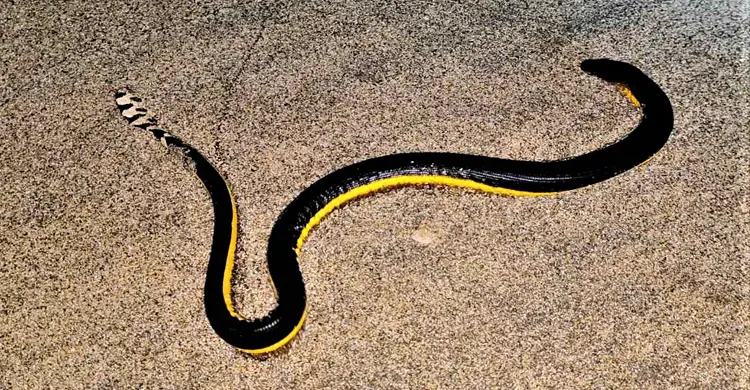
The yellow-bellied sea snake, known in Bengali as holde peti and described as a deadly venomous snake of the Arabian Sea, is now moving along the Cox's Bazar beach. One was seen at the town's Samitipara beach point on the night of Friday, 11 August.
Earlier, in June, a yellow-bellied snake was seen at the town's Sugandha point beach. It is believed that yellow-bellied snakes have become more common on the Cox's Bazar beach recently.
The snake has caused panic at Digha beach in West Bengal, India, for about three weeks. Digha lies directly opposite the Cox's Bazar coast across the Bay of Bengal. As India has no antivenom for this snake, a special alert has been issued there.
Sighting at Samitipara
Mahbub, supervisor of the Cox's Bazar district administration's beach workers, said he saw a yellow-bellied snake while on duty at the Samitipara beach point at around 11.30pm on Friday. He then saw the snake head back towards the sea, and he took video footage and some photos of it.
According to sources, the yellow-bellied snake is one of the world's eight most dangerous sea snakes, and the death rate from its bite is 80 per cent.
Doctor's warning
Dr Shahjahan Nazir, assistant professor in the department of infectious diseases and tropical medicine at Cox's Bazar Medical College, said no deaths from this snake have been reported in Cox's Bazar, but a fisherman was reported killed at Dublar Char beach about six months ago. The fisherman had kicked the snake, thinking it was dead, and it attacked him.
He said the yellow-bellied snake is found in the Bay of Bengal and on the Cox's Bazar beach. Its bite paralyses the body, and the kidneys and heart are affected and gradually stop working. The colour of the urine may also change. So fishermen and others concerned need to be careful about this snake, he said.
About the species
According to experts, the yellow-bellied sea snake is the most commonly seen sea snake in the world. It is a highly venomous species belonging to the Hydrophiinae (sea snake) subfamily.
Its scientific name is Pelamis platurus. With a distinctive two-coloured pattern, it is found in tropical and subtropical waters of the Indian and Pacific oceans, including the coasts of Africa, Asia, Australia, Mexico, Baja California and Central America.
An adult yellow-bellied snake is on average 3 feet long. It has smooth scales and a smoothly shaped body, a yellow underside and a bluish-black back. Its tail is flat like a boat's oar with a yellow fin, letting it swim freely in the sea. On the IUCN Red List it is listed as Least Concern.
Professor Dr Monjurul Kibria of Chittagong University's zoology department said yellow-bellied snakes are carnivorous and eat only fish. They can stay underwater for up to three hours at a stretch and spend their entire life cycle in the sea.
"While diving and swimming, this species can take in up to 33 per cent of its oxygen needs through its skin. It is a highly venomous species, so caution is essential with this snake," the professor said.
Source: Jagonews24. First published in Bengali on The Agro News.
Comments
(0)