
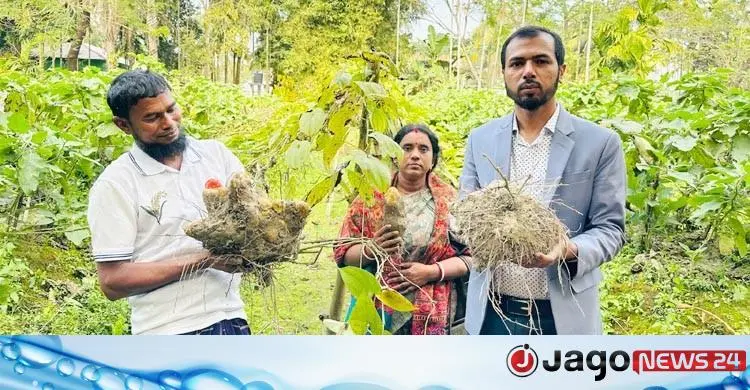
Dr Shamim Ahmed, Md Bahauddin Sek and Md Nazmul Huda
Char Fasson upazila in Bhola district is one of the country's largest coastal areas dominated by chars. Being close to where the Meghna river meets the Bay of Bengal, its landscape is distinctive, with vast chars, river-borne silt soil and a clear tidal influence. This location gives agriculture promise, but salinity, waterlogging, river erosion and natural disasters are major challenges for farmers. As a result, it is hard to secure lasting profit from conventional crops in many parts of Char Fasson. Against this background, greater yam (mete alu) cultivation in the Abuganj block of Aslampur union is pointing to a new opportunity.
Planned cultivation of greater yam began here in 2020 through the Char Fasson upazila agriculture office. At first only a few farmers tried the crop on a trial basis, but it has since spread widely. Greater yam is now grown on about 275 hectares in Abuganj block, a sign of significant change in the char farming system.
Thanks to the silt soil, raised land and good drainage of the chars, the crop yields well here. Relatively low risk, quick returns and good market prices are winning farmers' trust, especially those who used to lose money on rice or other crops. With local demand, its value as a safe, nutritious vegetable and its profitability, greater yam has great commercial potential in the area.
A native tuber with growing demand
Greater yam (Dioscorea alata) is a native tuber vegetable whose history is closely bound up with traditional rural life. In the past it was mostly grown, largely neglected, on fences or trees around homesteads or on fallow land to meet household needs, and production and marketing were limited. Over time, eating habits have changed and interest in tubers has grown because they are safe and nutritious, so both demand and price have risen. Today it is a familiar, sought-after, high-value vegetable not only in villages but in city markets too. In some parts of Africa it is eaten as a staple. It goes by different names in different regions, such as maitta alu, gachh alu, macha alu, chupri alu, mom alu and pyachra alu.
Nutritionally it is very important. Its high carbohydrate content makes it a main source of energy, and its dietary fibre aids digestion. Vitamins B and C help skin health and immunity, and vitamin E, iron and zinc reduce hair loss. It also contains minerals such as potassium and calcium, which play an important role in controlling blood pressure and strengthening bones. Being low in fat, it is considered a healthy food for all ages, and its low sodium and other minerals help control blood pressure. For these reasons interest in eating it is growing.
Planting and fertiliser
Well-drained high, medium-high and medium-low land is best. Greater yam is planted in pits or mounds (mada). The soil in the pits should be ploughed repeatedly until friable, and it helps to put some ash at the bottom. Then fill the pit with the soil mixed with an equal amount of organic fertiliser or vermicompost. Plant the seed or tuber 4 fingers below the surface with the sprouting end facing up. About 1.0–1.5 tonnes of bulbils are needed per hectare, and each seed bulbil should ideally weigh 200–250 grams; 25–30 bulbils are needed per decimal of land. Bulbils are best planted between February and April, at a spacing of 4–5 feet between lines and 3–4 feet between mounds. The underground yams can usually be harvested within 8–9 months of planting and can weigh around 4–10 kg.
Heavy use of organic fertiliser gives bigger yams and higher yields. Per hectare, apply 2.5 tonnes of organic fertiliser or vermicompost, 195 kg urea, 150 kg DAP or TSP, 250 kg MoP, 50 kg gypsum and 5 kg zinc. Mix all the organic fertiliser, TSP, gypsum and zinc well into the soil at the final ploughing. Apply half the urea and half the MoP at the first weeding and the rest a month later at the second weeding; alternatively, apply 50 grams of urea and 50 grams of potash 2–3 fingers deep in the soil around each plant 2–3 times at monthly intervals after planting.
Irrigation, support and pests
If the soil lacks moisture after the shoots emerge, the seedlings can die, and even in the early growth stage a lack of moisture dries out the vine tips. Irrigate before the soil around the base dries out, though no irrigation is needed in the rainy season. Keep the field and mounds weed-free from emergence onwards. After emergence, drive a long bamboo pole in at the base of each plant and tie brushwood or bamboo twigs to its top so the vine can rest on them.
Greater yam suffers hardly any disease or pest attack, though sucking insects sometimes appear, for which cypermethrin or Sevin can be applied. Waterlogging at the base and foot rot can cause heavy yield losses. Caterpillars eat large holes in the leaves, and a kind of beetle bores into them and eventually eats almost all the green tissue, leaving only the veins. In such cases approved pesticides should be applied at the right dose on the advice of the agriculture department. Snails sometimes cause damage too, but they are easily dealt with by killing them by hand.
The sorjan method
Commercial greater yam grown on trellises by the sorjan method is bringing revolutionary change to farming in Char Fasson upazila. In Abuganj block it is grown mainly this way, a technique very well suited to the chars. The land is first ploughed well and raised into long beds, with channels in the middle and on both sides so excess water drains away easily and does not waterlog. Because water tends to stand in the chars in the rainy season, the method is very effective. Its biggest advantage is that once the trellis is built, cucumber, chilli and bean can be grown on the same land as intercrops. This makes maximum use of the land and diversifies farmers' income; if one crop earns less, another makes up the shortfall, reducing the farmer's risk.
Harvest, costs and returns
When the leaves of the yam plants turn yellow, it is time to prepare for harvest. The authors state here that greater yam takes 8 to 10 months to harvest. With good management, yields of 25–30 tonnes a hectare or more are possible. At present 355 farmers grow greater yam on 275 hectares in Bhola, particularly in Char Fasson upazila.
The article gives this per-hectare cost and income account:
- Land preparation and sorjan beds: Tk 80,000
- Seed, 1.5 tonnes: Tk 60,000
- Organic fertiliser: Tk 30,000
- Chemical fertiliser: Tk 20,000
- Pesticides: Tk 10,000
- Irrigation: Tk 20,000
- Labour and care: Tk 40,000
- Land lease value and other costs: Tk 100,000
- Total cost: Tk 360,000
- Sale value of 25 tonnes: Tk 750,000
- Net profit: Tk 390,000
For the cost of one trellis, farmers harvest three vegetables a year.
Farmers' experience
Abdul Hashem, a farmer in Abuganj block, is a real example of success in commercial greater yam farming. "Earlier we did not make much profit growing rice," he said. "Now, growing greater yam, I have realised this crop is very good for our area. Costs are low, the yield is good and we get a good price in the market. With other crops on the same land, we earn extra income." He started on 20 decimals, and having profited, now grows greater yam commercially by the sorjan method on 280 decimals, turning his fortunes around.
Md Helal, another farmer from the same area, said: "The soil in the chars is very fertile. Greater yam is relatively safe, and even if water stands, the damage is small. I started on 15 decimals, and after good results I have now grown it on 80 decimals."
The experience of these two farmers shows that greater yam is an effective and profitable crop for coastal areas like Char Fasson. With the right methods, hard work and market demand, it is gradually becoming an important driver of economic change in the area. Farmers expect that if cultivation spreads further, the living standards and financial security of Char Fasson's farmers will rise further. Char farmers are steadily building trust in the crop, which can improve both the local economy and rural livelihoods in the long run.
To expand cultivation, the agriculture department is working tirelessly for Char Fasson's farmers through farmer training, close field monitoring, the use of high-yielding seed, modern technology, crop care and proper market links. It is also working to reduce risk through intercropping, maintain soil fertility and increase export opportunities.
Overall, greater yam has opened a new horizon for future farming in Char Fasson. It is not only a cash crop but can be seen as an important means of improving char farmers' lives, raising incomes and ensuring food security. With proper planning, training, farmers' interest and marketing, Char Fasson upazila could become one of the country's model areas for greater yam production and commerce.
The writers are Dr Shamim Ahmed, district training officer; Md Bahauddin Sek, additional deputy director (PP); and Md Nazmul Huda, upazila agriculture officer, Char Fasson, Department of Agricultural Extension (DAE), Bhola.
Source: Jagonews24. First published in Bengali on The Agro News.
Comments
(0)