
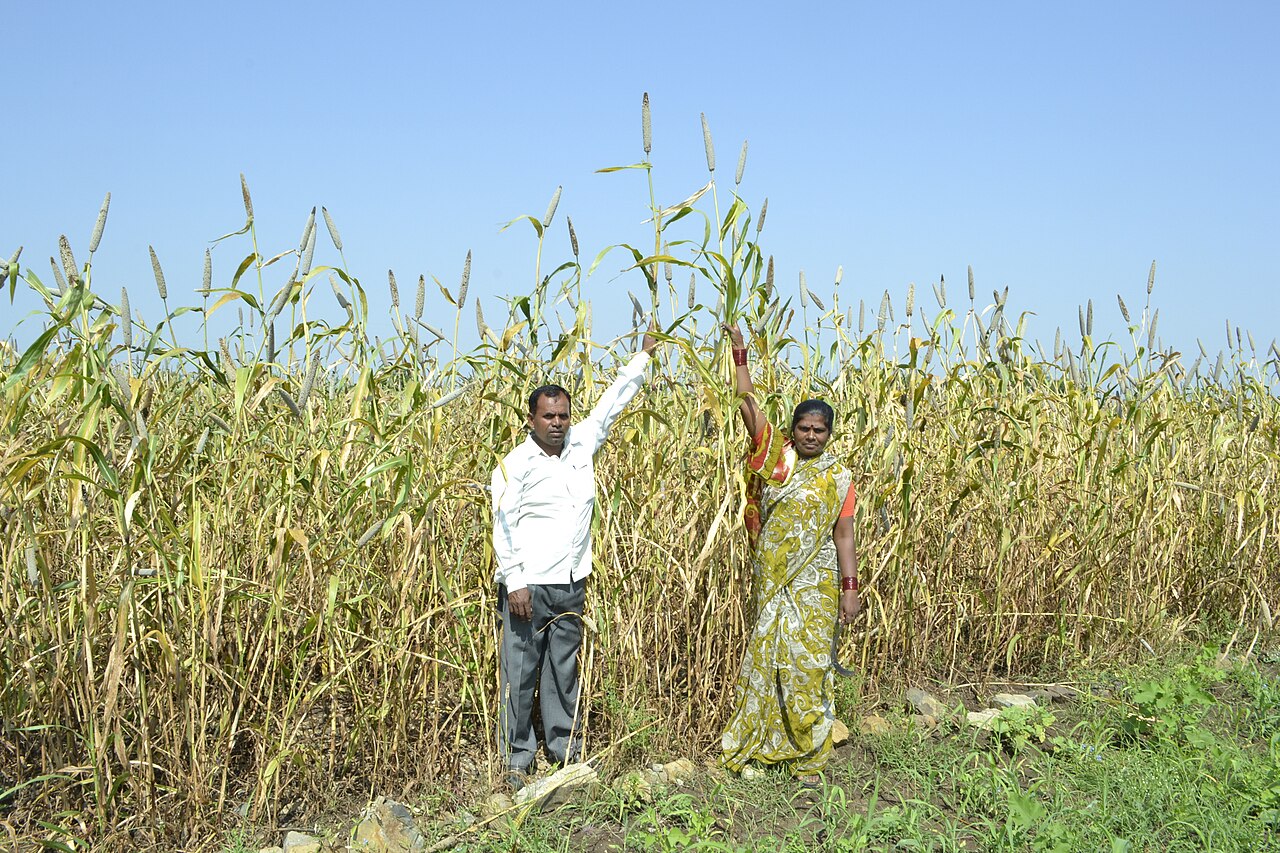
The Watershed Organisation Trust (WOTR), with support from the Walmart Foundation, has launched the second phase of its Project on Resilient Incomes for Smallholder Farmers through an Ecosystems Approach (ProRISE-II) in drought-prone and semi-arid parts of Maharashtra and Karnataka, Krishi Jagran reported on 31 October.
ProRISE-II will work with 35,000 farming households through 40 farmer producer organisations (FPOs) in five districts. It combines climate-resilient farming, soil and water management, micro-irrigation, access to bio-inputs, stronger FPO leadership, governance and business skills, aggregation, value addition, market access and digital tools, and will gather evidence on gender-responsive governance and agroecological practice.
The first phase supported more than 11,800 farmers in 11 FPOs in the Solapur, Dharashiv and Jalna districts of Maharashtra. The FPOs reached a combined business turnover of ₹44.86 crore, and 12 groups pursued Participatory Guarantee System certification for residue-free farming. Over three years, participating farmers reported average net income from crop sales rising from ₹1,57,046 to ₹2,37,184, against a rise from ₹1,37,392 to ₹1,90,078 among comparison households. Of sampled project farmers, 76% reported adopting improved varieties or climate-resilient practices and 55% reported cutting pesticide and chemical spraying. The FPOs now work with 32 buyers and a branded portfolio of 52 products.
"Smallholder farmers are navigating increasingly unpredictable climate conditions while working to build more secure and sustainable livelihoods," said Nishant Gupta of the Walmart Foundation's social and environment team. WOTR said women need a meaningful role in FPO leadership and decision-making, alongside better markets, viable businesses and care of natural resources.
By the end of the project WOTR aims to have 30 FPOs in the two states running as climate-resilient, market-oriented, professionally managed enterprises, and to share what it learns as models for other climate-vulnerable regions of India.
Photo: लोकपर्याय (Lokparyay), Vaijapur / Wikimedia Commons (CC BY-SA 4.0)
Source: Krishi Jagran

Comments
(0)