
By Sanjana Rahman Juthi
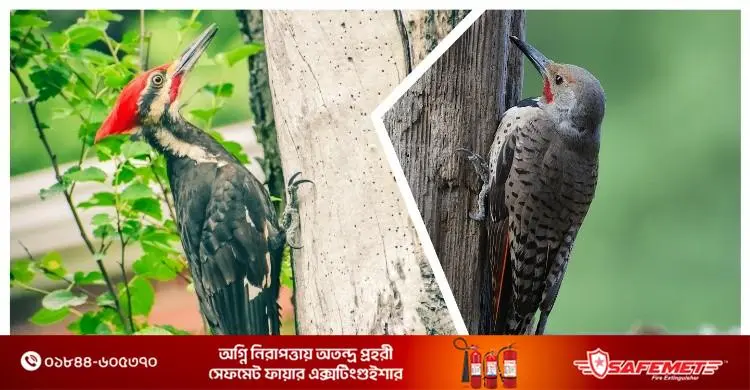
Our natural world holds many remarkable birds that do hard work with ease. The woodpecker is one of them. It can peck more than a hundred times a minute, and strikes trees roughly 8,000 to 10,000 or more times a day. Yet even pecking at wood with all its strength does not harm its brain. One of the main reasons for this is its tongue, which is incredibly long, sometimes almost twice the length of its beak.
A tongue that works like a seat belt
The most striking fact is that the woodpecker's tongue is coiled around the back of the brain. It wraps round the back of the head and comes forward again. This tongue works like a seat belt for the bird's head. When a woodpecker strikes a tree, a reverse reaction starts inside its head; the tongue absorbs that reaction and reduces the pressure on the brain while it pecks.
One of the main reasons woodpeckers peck wood is to find food. They live on insects inside trees. That is why the woodpecker is called the doctor of trees: it eats the insects living inside the tree, which helps the tree live longer.
When looking for food, woodpeckers make small pecks in a tree. If one makes a large hole, it is building a home. Interestingly, they do not stay in one nest for more than a season; each season they build a new one.
Species in Bangladesh
Other birds live in the old tree holes. Several species of woodpecker are found in Bangladesh, among them the Bangla woodpecker, the great woodpecker, the Metetupi woodpecker, the Himalayan woodpecker and the Holdechandi woodpecker. The species vary in size. Colourful bodies, long strong beaks and the build of their feet give woodpeckers their distinctive character.
The sound of woodpeckers pecking is rarely heard amid the noise of the city, but the bird is well known in rural areas. Sadly, with the number of trees falling in villages as in cities, the bird is now on the path to extinction. We must plant trees now to conserve woodpeckers and other bird species. Only then will birds survive, and nature with them.
Source: Jagonews24. First published in Bengali on The Agro News.


Comments
(0)