
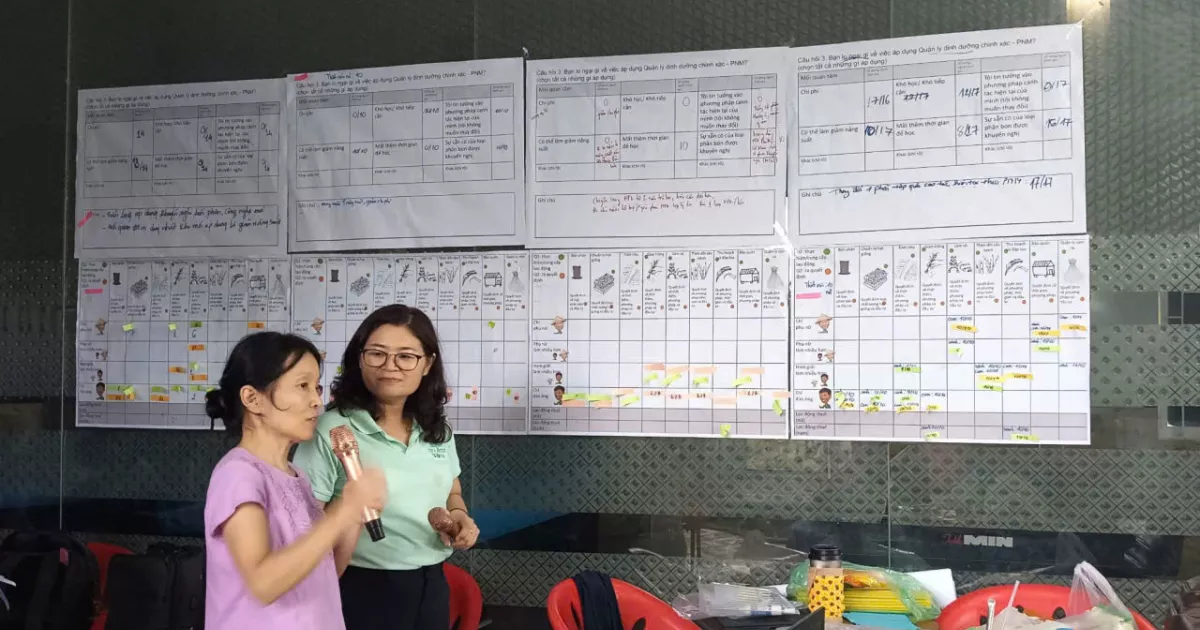
More than 70 farmers, agricultural experts and government extension officers met at the Kien Thanh Cooperative in Vi Thanh 1 Commune, Can Tho, on 18 August to redesign how precision nutrient management is taught in the Mekong Delta — and specifically, to whom.
Precision nutrient management means putting the right type and amount of fertiliser in the right place at the right time by the right method. It is a central part of Vietnam's One Million Hectares of High-Quality and Low-Emission Rice programme, because it cuts waste and lowers greenhouse gas emissions at the same time. It has been promoted through extension services, cooperatives and the fertiliser and seed companies — channels that are, as the International Rice Research Institute (IRRI) and the International Potato Center (CIP) put it, mainly male-dominated.
That matters because of who decides. Participant voting at the workshop indicated that women manage household finances in 80 per cent of the households represented, and group discussions found that fertiliser decisions usually involve both husband and wife. Training that invites one household representative — in practice the husband — leaves the person holding the money outside the room.
Getting women into the discussion took a change of venue. Inviting them to an unfamiliar setting did not work; the workshop was therefore held inside the cooperative itself, where women could talk in small groups and then present their conclusions to everyone.
"Understanding household dynamics, including the allocation of tasks, decision-making authority, and everyday operational challenges, can help researchers design inclusive support programs," said Dinh Thi Kim Dung, head of partnerships and engagement at IRRI's Vietnam office. Nozomi Kawarazuka, a gender specialist at CIP, added that discussion of fertiliser tends to stay on rates and timing, when the equally important questions are who does the work, who influences the decision and what would make each of them change practice.
Farmers made the same argument in their own terms. Pham Van Son, a member of the cooperative, said precision techniques have to suit the specific field to work, and backed direct dialogue about what the change would do to cost and yield. Pham Thi Nhu Phuong, a local farmer, proposed that community meetings and research activities invite both spouses as a matter of course. Truong Ngoc Minh, vice chairwoman of the Vi Thanh 1 Commune Women's Union, said rural women's role in production and household finance makes direct access to technical knowledge a practical necessity rather than a courtesy.
Le Thanh Tung, vice chairman and secretary-general of the Vietnam Rice Association, closed by arguing that a farmer-centred model of this kind is what makes the one-million-hectare programme reach everyone it is meant to reach.
Source: CGIAR

Comments
(0)