
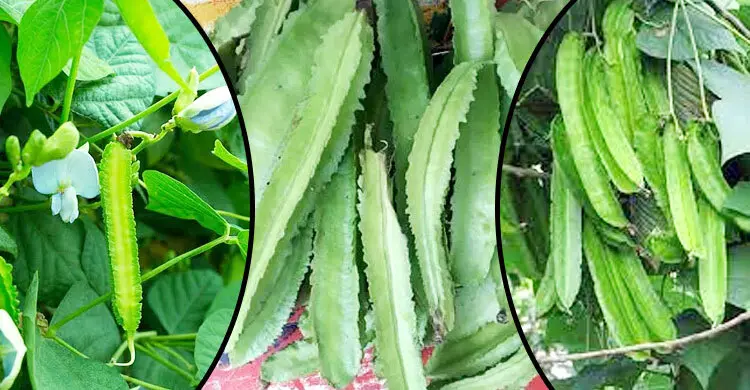
Like yardlong bean and country bean, kamranga shim (winged bean) is a climbing plant. Its flowers, pods, vines, leaves and roots are all edible. The vegetable is best suited to higher altitudes (1,500-2,500 feet above sea level), so it is grown most in the country's hill districts, though it is also grown on a limited scale in the north. As it needs little water, it is more common in relatively dry areas. It is mainly grown on a small scale in and around homesteads; commercial cultivation, as with other vegetables, is not common.
Varieties
There has been little effort to develop kamranga shim varieties in this country, but the Bangladesh Agricultural Research Institute (BARI) has released one variety, BARI Kamranga Shim-1. The local varieties are mainly light-sensitive, so the vegetable is grown in late autumn, winter and spring when days are short. Many species of bean are found abroad, and some foreign varieties flower and fruit even in long days, that is, in summer and the monsoon.
How to grow it
Seeds are sown in rows, as with yardlong bean or country bean. The soil in each row should be dug 20-25cm deep to make pits. For a higher yield, it is good to mix plenty of organic fertiliser into the pits. Kamranga shim does not need very fertile land; it grows well even in poor sandy or clay soil and does not need much fertiliser. It is best grown on high land with good drainage. Applying about 1,500 grams of fertiliser, 500 grams each of urea, TSP and MOP, to pits 30-45cm wide and 2.54cm long during land preparation gives a good yield. About 3 weeks after the seedlings emerge, a further 500 grams of urea should be top-dressed in 2-3 instalments at 20-day intervals. It yields well where it gets enough light and air. It can also be grown in open partial shade, but the crop does poorly in heavy shade. This nutritious bean is suitable for growing at every home and on rooftops.
Sowing the seed
The seed coat is very hard, so germination is low. It is best to soak the seeds in water for 20-30 hours before sowing. Seeds are usually sown 8-10 inches apart at a depth of 1 inch, with 3-4 feet between rows. The seeds sprout within 5-7 days of sowing and grow quickly. After 4-5 weeks of growth, once the days shorten in favourable weather, the plants begin to flower. Kamranga shim can also be grown from roots: roots of mature plants can be collected at the end of the season and planted in early and late autumn in place of seed. In the homestead, the vines are trained up stakes 1.5-2.0cm long or onto a small trellis. It can be grown very easily by standing up sticks or bamboo twigs as supports.
Care
If the soil is very dry after sowing, germination may be delayed, so light irrigation can be given every 2-3 days when the soil lacks moisture. When the seedlings are a foot tall, the tips should be pinched off; this increases branching and brings more flowers and pods. Stakes 2.4-3.0cm long must be given as supports for the climbing plants. Tying together the tops of the stakes of two neighbouring rows helps the growing vines climb neatly from both sides. Alternatively, a narrow trellis can be provided. When the soil at the base lacks moisture, light irrigation should be given from time to time, but water must not stand at the base. The land must always be kept free of weeds, and the soil loosened when it crusts.
Yield
About 40-60 young pods can be picked from each plant, weighing about 4-5kg. Planting 20-30 plants on a small plot can meet a family's need of about 100-125kg of vegetables in a season. The leaves, flowers, pods, seeds and roots are all highly nutritious and fit to eat, and as the plant also has medicinal properties, everyone benefits from it.
Source: Jagonews24. First published in Bengali on The Agro News.

Comments
(0)