
Alongside various attempts at wildlife trafficking in Bangladesh, there are complaints of wild animals being held illegally at resorts, parks and mini zoos. But by following the rules and laws, some wild animals can be kept legally in Bangladesh.
Recently the Forest Department rescued 14 wild animals, including crocodiles, monkeys, monitor lizards, fishing cats, jungle cats and snakes, from a resort in Bagerhat and released them at the Karamjal Wildlife Breeding Centre in the Sundarbans.
The Forest Department alleges that the resort had illegally held these Sundarbans animals of various species for a long time to attract visitors.
Earlier, at the start of last month, the department rescued 26 wild animals of 10 species from several eco-parks in Khulna, Jashore, Satkhira and Bagerhat.
Four wild animals Bangladeshis can keep
Forest Department officials say people in Bangladesh can keep a few kinds of wild animal with permission.
Molla Rezaul Karim, conservator of forests for the wildlife and nature conservation circle, said: "We give permission to keep four animals: elephants, deer, crocodiles and peacocks. Keeping any other wild animal in a cage or in captivity is completely illegal."
Beyond these, pet bird farms and snake farms can be set up with permission, and officials are also encouraging peacock farms among pet birds. The Bangladesh government has rules for keeping all these animals and birds.
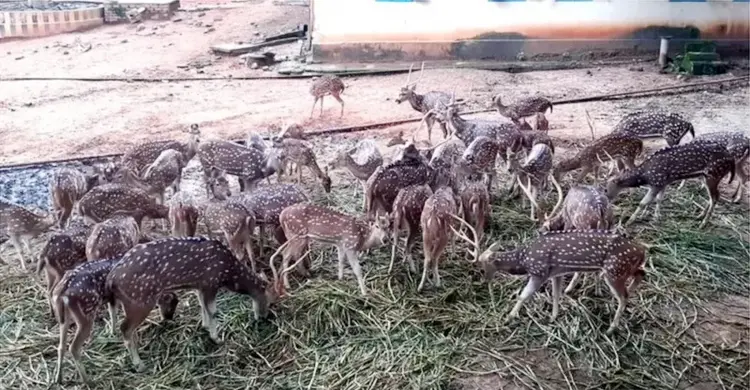
Keeping elephants and deer
Deer and elephants can be kept as farms with Forest Department permission. Ten deer or one elephant counts as a farm. Deer or elephants may be kept as a hobby or for sale alive, but deer may not be slaughtered to eat or sell the meat.
Under the Deer and Elephant Rearing Rules 2017, keeping deer or elephants without a licence is a punishable offence, carrying one year in prison or a fine of Tk 50,000.
The licence fee for such a farm is Tk 20,000 in city corporation areas and Tk 10,000 outside them. A possession fee of Tk 1,000 must be paid for each deer.
The licence application goes to the forest officer of the area where the farm will be set up. The farm owner must have the land as his own, rented, or on long-term possession of government land.
Each deer needs at least 100 square feet of space and a shed 10 feet high, with grain feed, mineral salt and safe drinking water. The farm must have a 10-foot-high security fence all round.
Farms must be at least 30 km from forests where deer occur naturally. Hobby keepers with more than 10 deer must apply as farmers.
If the number of deer or elephants grows, they need to be sold, or the possession certificate is cancelled, they may be sold, exchanged or donated with the forest officer's written permission, but the recipient must also have a licence or permission to keep them.
Conservator Molla Rezaul Karim said deer cannot be slaughtered for meat or to sell meat or hides. Even when a deer dies, its hide, head or bones cannot be given away or sold; they must be handed to the Forest Department.
When an elephant or deer gives birth or dies, the relevant Forest Department office must be informed within 15 days with a certificate issued by a veterinary surgeon. An elephant calf must be ear-tagged within 90 days. The rules provide for prison and fines for breaches.
How crocodiles can be kept
The Forest Department licenses crocodile farming in Bangladesh on condition of export. The government issued the Crocodile Rearing Rules 2019 under sections 52 and 24 of the Wildlife (Conservation and Security) Act 2012, under which a crocodile farm can be set up with a Forest Department licence.
The licence is obtained from the forest officer of the area where the farm will be. The fee is Tk 1 lakh in city corporation areas and Tk 50,000 outside them.
The owner must obtain an annual possession certificate for each crocodile, with a possession fee of Tk 1,000 per crocodile.
Crocodiles for rearing must be imported; they may not be caught or collected from the wild under any circumstances.
A crocodile farm needs at least five acres of flood-free land at least 100 km from the Sundarbans, with round-the-clock electricity and easy transport links.
The farm must have safe infrastructure, a security fence, waste treatment and feed production, and storage for processing crocodile products. Staff must be trained, and each crocodile must be microchipped in the presence of a forest officer.
Once farm crocodiles are fit for export, the owner must apply to the forest officer to collect and export crocodiles or crocodile products through skilled and experienced people. All records of increases and decreases, imports and exports must be kept in a register.
Peacocks and pet birds
The peacock has been officially declared extinct in Bangladesh. As a result, peacocks and other foreign pet bird breeds can be imported to rear or sell.
Under the Pet Bird Management Rules 2020, farms for these birds, including peacocks, can be set up with permission from the local forest officer. The licence fee for a pet bird farm is Tk 10,000.
However, catching and taming or rearing any native bird, including mynas, parakeets and doves, is completely illegal and a punishable offence.
Pet birds must be ringed on the leg and may never be released into the wild.
Snake farms for export
Snake farms can be set up and run with Forest Department permission, subject to conditions. A snake farm needs at least two acres of own land, or land leased for at least 33 years, and it must be flood-free.
The farm must be at least two kilometres from any government forest area and 500 metres from human settlement. No snake farm may be within one square kilometre of an industrial plant, and round-the-clock electricity is required.
The licence fee is Tk 1 lakh in city corporation areas and Tk 50,000 outside them. All structures must be concrete buildings, with an eight-foot-high brick wall and a three-foot-high barbed-wire fence all round.
The farm must employ a person with at least five years' experience in running a snake farm, rearing snakes and collecting venom, and an expert in forestry or zoology.
Snakes must be collected from farms, farmland, wetlands, fallow land and village woodland. Written permission with full details must be obtained from the local forest officer before collecting, and a detailed report submitted afterwards. Snakes may not be collected from any protected forest in Bangladesh.
A farm must start with 200 snakes, and every snake bred must carry a tag supplied by the Forest Department.
All farm activity must be monitored by CCTV, with at least three months of footage kept, and all records of numbers, sales, imports and exports must be kept.
Venom must be collected and stored by skilled, trained people, and everything recorded in a register. To export venom or snakeskin, an application must be made to the forest officer with a CITES certificate.
What the Forest Department is doing
Beyond the animals the authorities allow to be kept, many other wild animals are often seen caged. Monkeys are most commonly kept to perform shows, and there are complaints of mini zoos holding pythons, porcupines, various birds, jungle cats, otters and other animals.
Conservator Molla Rezaul Karim said keeping or rearing any wild animal other than those permitted is a punishable offence, carrying prison and fines.
"We carry out regular drives. Whenever we get any information, we raid the place. We try to rescue wildlife and bring offenders to justice in every single case," he said.
He said they have rescued more than 40,000 wild animals in the past two to three years, and legal action has been taken against 1,300 people accused of involvement in such offences.
Citing BBC Bangla.
Source: Jagonews24. First published in Bengali on The Agro News.
Comments
(0)