
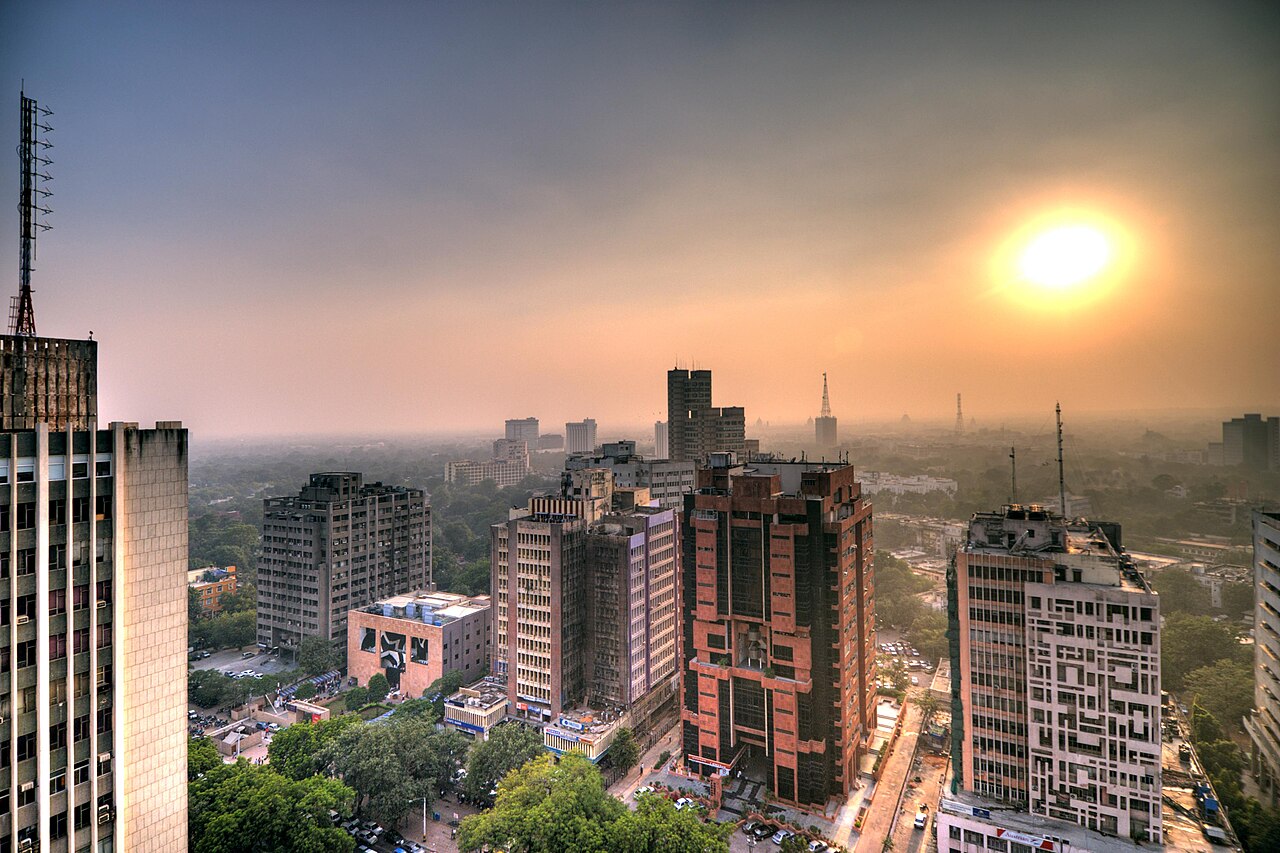
Every year before winter, India's capital Delhi chokes in toxic smog, and this year its air quality index has again passed 400. To cut the pollution, the Delhi government tried cloud seeding, or artificial rain, on the model of the United Arab Emirates, but the trial it ran with IIT Kanpur in October 2025 failed to bring a single drop of rain to Delhi. An analysis in the Kolkata paper Ei Samay looks at why.
Cloud seeding cannot create clouds out of a clear sky. Special aircraft spread fine particles of silver iodide, sodium chloride or potassium chloride into existing clouds; water droplets or ice crystals form around them, grow heavy and fall as rain. The UAE, which gets very little natural rainfall, has invested in cloud seeding for decades to ease water shortages and recharge groundwater. A January 2021 report in The National and research in the journal Environmental Pollution found that although dust storms raise pollution in Dubai and Abu Dhabi, rain brings the suspended particles down. The research found no conclusive proof, however, that cloud seeding alone cleaned Dubai's air.
On 28 October 2025, in a joint pilot project of the Delhi government and IIT Kanpur, an aircraft made two passes over Burari, Karol Bagh and Mayur Vihar spraying the chemicals. No rain fell in Delhi; only 0.1 millimetres was recorded in neighbouring Noida and 0.2 millimetres in Greater Noida, and a second attempt planned for 29 October was postponed because the weather was unsuitable. Manindra Agrawal, director of IIT Kanpur, said the clouds that day held only 15 to 20 per cent moisture, nowhere near enough for artificial rain.
When Delhi's pollution peaks, the weather itself is wrong for cloud seeding. In winter the wind is very light, and a temperature inversion traps pollutants near the ground; moisture and suitable clouds are scarce as well. Researchers at IIT Delhi who analysed data from 2011 to 2021 found that conditions suitable for cloud seeding rarely occur in Delhi's winter, with brief openings only when western disturbances bring moisture into north-west India.
The IIT Delhi research also found that heavy rain washes PM2.5 and PM10 particles out of the air better than light rain, yet pollution returns to its earlier level within one to five days, because vehicles, factories, construction dust, waste and crop-stubble burning keep adding to it. A 2022 study in the International Journal of Environmental Science and Technology questioned whether the chemical particles released during cloud seeding in the UAE might actually add to the particles in the air.
The analysis concludes that technology is no substitute for unfavourable weather: with enough cloud and moisture, artificial rain can at best bring brief relief. Keeping Delhi's air clean in the long run means tightly controlling the sources: vehicle exhaust, construction dust, industrial pollution and stubble burning.
This report is based on an analysis by Ayantika Saha of Ei Samay.
Photo: wili hybrid / Wikimedia Commons (CC BY-SA 3.0)
Source: Ei Samay


Comments
(0)