
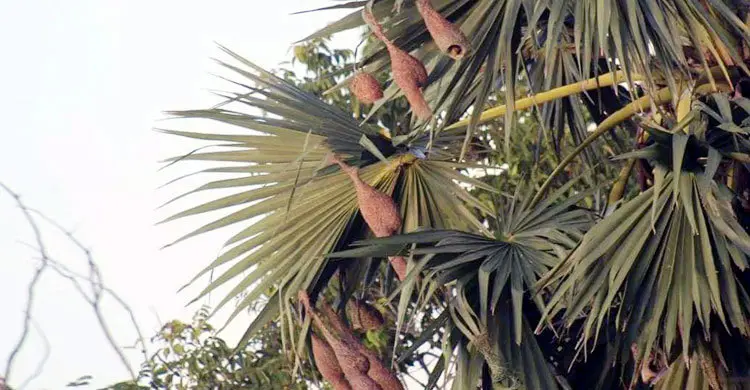
With the passage of time, the finely crafted nests of the weaver bird (babui), woven from palm leaves, are disappearing. Because of environmental degradation, the nests have nearly vanished, although only about 14 to 15 years ago they could be seen on palm trees in fields and villages everywhere.
The weaver bird's nest is not only a work of art; it also used to inspire people to be self-reliant. In the words of the poet Rajanikanta Sen: 'The sparrow calls to the weaver bird and says, / You live in a hut and boast of your craft. / I live in great comfort on top of a mansion, / While you suffer so much in sun, rain and storm.'
Strong, finely woven nests
In the remote villages of the district, the sight of weaver birds and their small, beautiful nests being built is no longer seen as it once was. The weaver bird's weaving is so precise that the nest is hard to tear even when pulled. It takes 10 to 12 days to build 100 to 120 nests on each palm tree. Weaver birds build their nests high on palm trees with straw, twigs, palm leaves, tamarisk, kash grass and creepers.
The nests are as strong as they are attractive; even a violent storm does not bring them down. After building a nest, the male weaver bird goes to other nests in search of a mate. Once he likes a mate, to win the female, the male makes himself attractive by bathing in the water of canals, beels and ponds and dancing from branch to branch.
The bird is known the world over for living in the beautiful nests it weaves. One of its notable traits, the report says, is that it catches fireflies and keeps them in the nest to light it up at night, releasing them in the morning. Outside the breeding season, both male and female weaver birds have coppery-black streaks on their backs, with no streaks underneath. The bill is fully conical and the tail square. In the breeding season the male turns dark brown; at other times both male and female are brown, like the feathers on their backs.
Canada-based businessman and social worker Afsar Hossain Chowdhury told Jago News: "As a child I used to see many weaver bird nests on the palm trees standing in rows on both sides of the road. But now weaver bird nests are no longer seen; they are about to disappear. In our whole area they have built nests on just one palm tree. We wake in the morning to their chirping."
District livestock officer Abu Al Mansur told Jago News: "Many animals are disappearing because of hostile weather and the environment. Countless species of animals, birds and insects have vanished from our environment, and many are on the way to extinction."
Source: Jagonews24. First published in Bengali on The Agro News.
Comments
(0)