
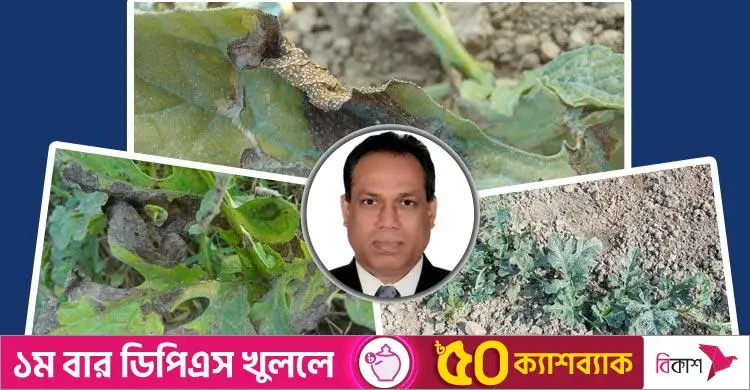
One of the notable diseases of watermelon is downy mildew (DM), caused by the fungus-like oomycete Pseudoperonospora cubensis. Its symptoms appear on the leaves, where lesions begin as chlorotic (yellow) areas and turn into necrotic (brown or black) patches surrounded by a chlorotic halo.
Farmers, be alert about your watermelon fields now. Inspect and monitor your fields regularly, and take the necessary measures as soon as any spots are seen on the leaves of the crop. Contact the office of your upazila agriculture officer.
Symptoms
- The disease first appears on older leaves.
- White, yellowish to brown patch-like spots appear on infected leaves.
- It gradually spreads to other leaves.
Integrated control
- If possible, collect and destroy the infected parts of the plant.
- Keep the field clean and ensure good drainage.
- Do not collect seed from an infected field.
- Do not harm the environment and public health by using pesticides indiscriminately.
- Take action as soon as symptoms first appear.
- Use balanced fertiliser.
- Grow disease-resistant varieties, such as those developed by BARI or other improved varieties.
- Control alternative hosts.
- Keep the field free of weeds.
Chemical control
- Spray Agben (carbendazim) at 1 ml per litre and Arlin at 1 g per litre every 10 days, or
- Spray Mona (azoxystrobin + cyproconazole group) fungicide as directed every 10 days, and the spots will go.
- Do not eat or sell the fruit within 15 days of spraying.
Source: Jagonews24. First published in Bengali on The Agro News.

Comments
(0)