
The much-loved rhymester Lutfor Rahman Riton asks in a moving rhyme: "Has anyone seen a two-legged sarameya? It barks, demanding the killing of dogs."
The word sarameya means hare, deer, dog and crane. The rhymester could not call the creatures barking for the killing of dogs human, so he used sarameya, thinking it would help express his intense disgust. Those who think only humans have the right to live in this beautiful world, and animals and birds none at all, cannot be called human. No animal's name suits them either, since you would have to be a researcher to know whether animals scheme to survive at everyone else's expense. Even sarameya, a word for the sweet deer, hare, dog and crane, does not suit them. The word sarameya has told me to lodge a strong protest. It said: you humans can do so much; to name those who, though human, do not act like humans, can't you coin a word of your own instead of borrowing an animal's name?
I like the word "amanush" (inhuman). Not human, but inhuman. And an inhuman is not an animal. Please change the notion that whoever is not human must be an animal, and then read this news, with its photo, carefully. A group of inhumans stands holding a banner demanding the streets be made free of dogs. The streets belong only to them, they say, because they pay taxes, bless the streets by walking on them, and can make others proud, amazed or sad by showing enough muscle to occupy the road.
A few people, and a whole nation
The news has been shared on social media too, and there are descriptions from every angle of how bad the country and its people are: there is no kindness or compassion left in people's hearts, and the word affection is nearly extinct. I do not agree with this at all. Because of just a few inhumans the people of the country get a bad name, and such a beautiful country gets abused for having produced them. The Father of the Nation, Bangabandhu Sheikh Mujibur Rahman, said in a speech on 21 July 1975: "It is only because of a few people that the sorrows of the people of Bangladesh cannot be removed." That is true. Brutally killed soon afterwards, the Father of the Nation showed with his life how misfortune can engulf an entire nation because of just a few people.
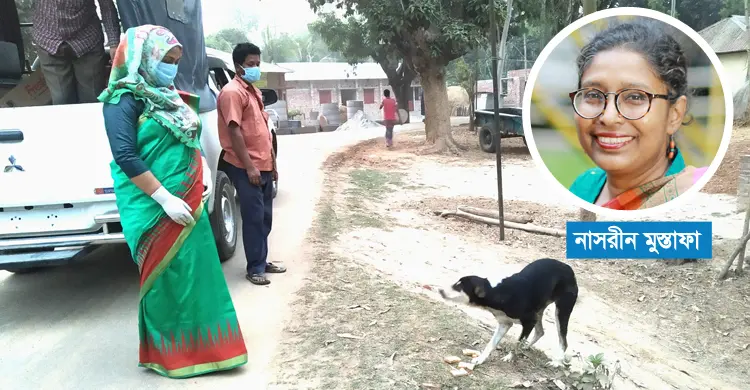
Just because a few inhumans want dogs killed, we cannot forget the people who stand beside animals and birds in this crisis. That is when a word came to mind: coincidence. An English word, it has become Bengali too. Its Bengali equivalent, "kakataliya", does not come to mind even on hearing crows caw. Today it did. The event that prompted the rhyme reminded me of another I had seen a few months earlier, and the word burst out: a coincidence indeed! The daily Jaijaidin had run the news with a photo just after the Covid-19 lockdown began. I checked the date with Google's help: 11 April. A woman in a sari, wearing a mask, stands in front of a hungry dog.
The dog's posture made it look hungry, and I could clearly hear its barking. I felt what it meant. It was saying: I'm hungry. What is this lockdown business you're doing? Hotels shut, shops shut, people not coming out on the streets. We live by eating the scraps you throw. Now there is no food, but the hunger is still there. You are taking food to the homes of people who lost their work. Have you kept track of us? A woman's voice comes from behind the mask. She says she does keep track of the plight of dogs and cats, so just as she is taking food door to door to people, she is feeding dogs and cats too. That is why she has come to it. The dog whimpers softly. It means: thank you.
The plate of food set before it brings tears to its eyes. It wanted to look at her once more, but its wet eyes would not let it, and its hunger did not let it try. When it finished eating, she was gone. But when it met her again, it knew her at once. It told its companions: see! This is what a human is like. Not because she looks like a human; her heart is exactly like a human's, so her deeds are too.
The officer who fed the hungry
The name of that person who acted like a human is Wahida Khanam. As Upazila Nirbahi Officer of Ghoraghat upazila, she stood by the people of the upazila like one of their own to see them through the pandemic. People of all classes and professions across the country stood by others at this time, but very few could think of the helplessness of animals. She is one of them.
Having come through so many days, I realise I am still alive. So that April news hits me all the harder when I hear that a government officer is fighting for her life: her skull caved in by hammer blows. Attackers entered through the ventilator while she slept at night in her official residence, intending to kill her; killing was their only aim. Her father was also seriously injured, and her three-year-old child was asleep in the bed.
The attackers, entering with hammers like Thor of Norse mythology, wanted to kill the person who, in the front line during this pandemic, was fighting to keep not only people but animals alive. She carried on this fight not just with government aid but with her own money, and earned people's love in return. News of her work standing by ordinary people even before the pandemic is still floating around on newspapers' online pages. Since 3 September, it has been joined by news of Wahida Khanam fighting for her life.
What the struggle of women officers in the field is like cannot be understood without seeing it up close. Early in their careers, because their husbands are not posted to the same place, they often manage small children almost alone, handle cooking and the household, and serve the public, yet women rarely speak of the hardship. Because then they will hear: why do you go out to work? A woman's job is to run the home, and so on. Male officers have hardships too, but for women it is literally a war. If the slightest fault is found in a woman's work, she faces dirty, obscene social attacks simply for being a woman, which does not happen to men. Despite all this, Bangladesh has set an example in women's empowerment. Begum Rokeya would truly have been happy to know how widespread this struggle of women is.
A call for justice
Wahida Khanam was fighting, and she has been attacked. Some time ago Dr Rakib was attacked and tragically killed, and engineer Delowar was brutally murdered. Officers being attacked while doing their professional duty is not at all acceptable. And attacks on women are even more widespread. Society's teaching regards women as weak; is she not being seen as an easy target?
Whatever the reason for the attack, let the investigation bring out the truth. Let the culprits receive exemplary punishment, so that the warriors who have taken up the fight to look after the country's people regain their courage, and society gets a strong message: wrongdoing will not go unpunished. May Upazila Nirbahi Officer Wahida Khanam return to the stage of life. You were creating so many examples of what a human should be, and so much of your work remains. You may have to spend the rest of your life in another battle, with your body coping with terrible injuries. The shock to your child, who was asleep in the bed and miraculously survived that terrible night, will shake you like an earthquake too. All this is true. But it is also true that everyone's love and prayers will surround you and give you at least some strength in this fight. You must win the war to drive out the inhumans and make the world fit for humans, sister!
The writer is a fiction writer.
Source: Jagonews24. First published in Bengali on The Agro News.

Comments
(0)