
By Niamur Rashid Shihab
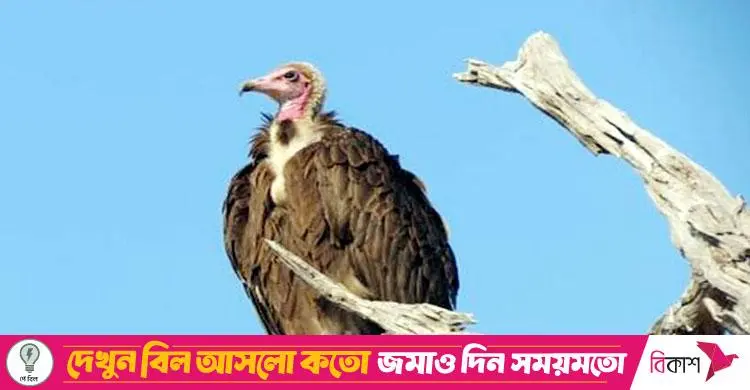
The once-familiar vulture has disappeared from nature. Vultures were once seen everywhere, but through natural disasters and a range of other causes, the bird known as nature's sweeper is now nearly extinct.
Wildlife and bird experts say that unless the species is protected, vultures will vanish from nature within a few years, and schoolchildren will have to be shown them in pictures in books. The slender-billed vulture is still somehow surviving in its struggle with nature.
Why vultures matter
Vultures reduce pollution by eating dead animals and birds, and they protect the environment from the spread of germs of anthrax and other diseases. That is why the vulture is called "nature's sweeper". Although there are 23 species of vulture in the world, only seven are seen in Bangladesh, and even these are now nearly extinct.
In the 1980s, flocks of vultures roamed the river chars across large areas of the south, including Patuakhali district and Galachipa upazila. At various times in 1971, grey vultures perched on bodies floating down the rivers, and vultures circled over the cattle herds, casting shadows.
The vulture is neither an ill omen nor fierce. It is not a hunter like the kite, eagle or hawk, but a great friend of our environment, keeping its balance by eating dead animals. A vulture never attacks a living person.
The bird has very keen eyesight and nested in banyan, koroi, shimul and debdaru trees and bamboo clumps. Its sight is so sharp that it can see food on the ground or on water from a great height. It lays 15 to 20 eggs at a time, and the chicks hatch after three weeks of incubation. Its normal lifespan is 25 years, and each bird stands three to four feet tall. But natural disasters are steadily reducing their numbers: since the 1970s, vulture numbers have fallen by about 98 per cent.
The diclofenac threat
According to experts, the meat of dead animals does the vulture no harm. But if a vulture eats the meat of a dead animal that was given diclofenac, its kidneys fail and it dies within 2-3 days. For this reason, 97 per cent of the subcontinent's vultures have died in the last three decades.
Vultures are now nearly extinct, which is a major threat to our environment. They must be saved from extinction. If no steps are taken now to protect the environment, nature's sweeper will soon be gone.
The writer is a feature writer.
Source: Jagonews24. First published in Bengali on The Agro News.



Comments
(0)