
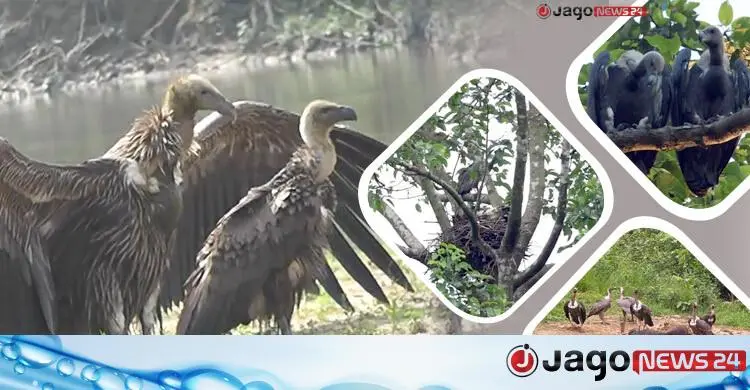
Once, a glance at any carcass dump would reveal vultures. Because they live on dead animals, they are called "nature's sweepers". But their numbers keep falling, and the bird is now close to disappearing.
Inquiries show that in five years the number of vultures in Habiganj alone has fallen by half. In 2021 there were 200 vultures across the country, more than 100 of them in Habiganj. Official records now show only 60, and in reality there are thought to be no more than 40. People involved say toxic drugs given to animals are the sole reason for the decline.
There was a time when vultures roamed freely in village and town alike. Whenever a dead animal was found, flocks circled in the sky, and people could tell from them that a carcass lay nearby. The bird's contribution to keeping nature in balance is immense.
Those involved say that as the bird disappears, nature's balance is being lost. Although the government has taken various steps to protect vultures, they have had little effect. However, staff of the International Union for Conservation of Nature (IUCN), which works on vulture conservation, hope that if government efforts continue, results will come within a few years.
Poisoned in Moulvibazar
Sultan Ahmed, an IUCN programme assistant, oversees the organisation's vulture field activities with a team of four. According to him, vultures now survive in only two places in the country: about 200 in the Sundarbans and 50 in the Rema-Kalenga forest in Habiganj.
"A few years ago there were about 100 vultures in Rema-Kalenga. But in 2024 a number of them went to Moulvibazar, where unfortunately they died of food poisoning. Now the government is giving them safe food and a separate budget has been set aside. We hope vulture numbers may gradually rise," he told Jagonews.
"A vulture never takes a second mate. If a male or female dies, the other does not pair again, so their breeding stops. Because a good number of vultures died in Moulvibazar, breeding has fallen," he said.
Sajen Munda, a village police member who looks after the vultures in Rema-Kalenga, told Jagonews: "There are 25 of us. Our job is to look after the vultures." He said the official register shows 60 vultures there now, against more than 100 in 2024. This year 40-45 vultures went to a hill in Moulvibazar, where a goat had died. A fox and a dog ate it and also died of poisoning, and the vultures died after eating those two carcasses. Since then, vulture numbers have not recovered much.
"Here, under a government initiative, two cows a month are given as food for the vultures. We slaughter them and leave them there. In the Sundarbans too, food is being supplied under a government initiative to conserve vultures," Sajen Munda said.
Former union parishad member Abdus Sahid told Jagonews: "Flocks of vultures used to be seen in the trees. Now they are rarely seen, and they have to be conserved." He believes poisoning of livestock alone has caused this. He said there would be no more than 50 vultures in Rema-Kalenga now, that they do not get enough food, and that vultures are dwindling for lack of food.
IUCN figures and hope
IUCN data show that vulture numbers rose to 246 in 2023-2024. But in 2024 at least 40 vultures, including 10 females, went to a hill in Moulvibazar. The toxic drugs ketoprofen and diclofenac given to a goat were identified as the cause of the vultures' deaths by poisoning.
The hopeful news is that since the 2024-25 and 2025-26 fiscal years, the government has supplied safe food for vultures and allocated funds for their conservation, raising the prospect that numbers will grow over time.
However, pesticides are used in many places to kill foxes, and the organisation has advised against using any pesticide for that purpose.
What experts suggest
Dr Salauddin Yusuf, a teacher in the Department of Anatomy and Histology at Habiganj Agricultural University, told Jagonews: "As far as I know, IUCN and the Forest Department are working on vultures here, but there may be scope to do more. Many people complain that conservation at Rema-Kalenga is not being done well. Captive breeding and a release programme could be taken up here, or they could be bred in captivity in various zoos and released into the wild."
He added: "Educational institutions could do more research on vultures. A vulture habitat project could be set up, with a fixed feeding site. If dead animals are kept at a set place, vultures will gradually visit more. If we can do this, we can hope that one day vultures will return to our country's nature as before."
Divisional forest officer Md Abul Kalam told Jagonews: "The vulture is 'nature's sweeper'. By eating the remains of dead animals it keeps the environment clean and helps prevent the spread of diseases including anthrax. So for our own sake, keeping vultures alive is everyone's responsibility."
IUCN project assistant Shakib Ahmed told Jagonews: "Vultures save lives, so vultures must be saved. If vultures survive, nature will stay healthy."
Source: Jagonews24. First published in Bengali on The Agro News.
Comments
(0)