
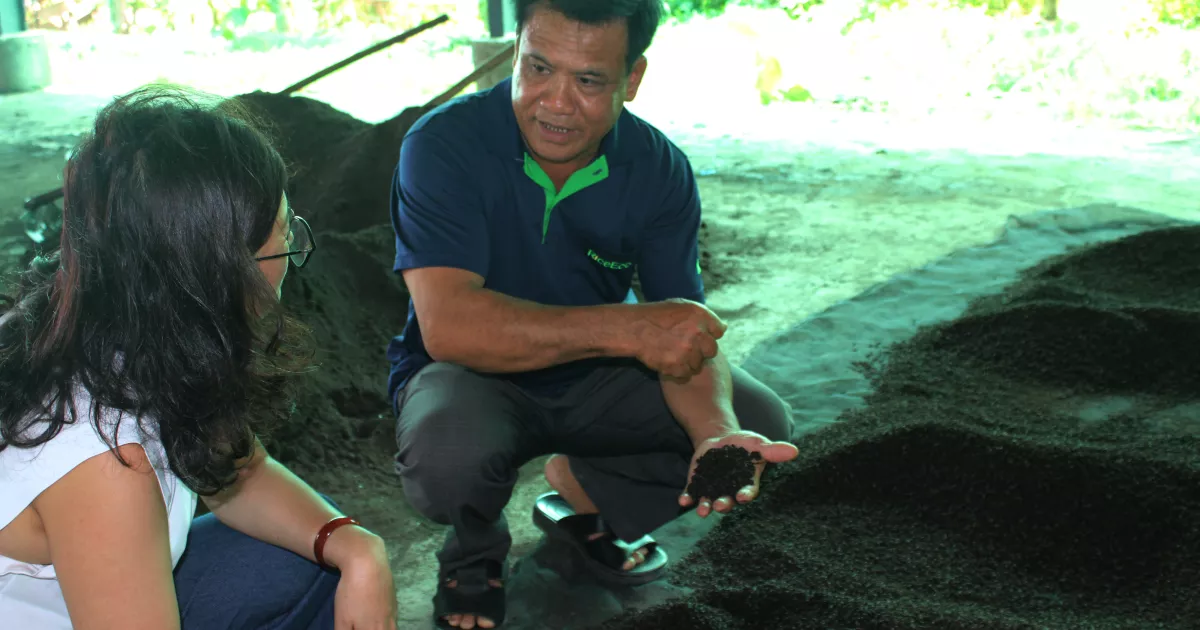
For years the end of every harvest at the Tien Thuan Agricultural and Service Cooperative in Can Tho was marked by smoke. There were few buyers for loose straw, little information about what else to do with it, and burning was quick. Farmers also worried that taking the straw off the field would hurt the soil, so it stayed a problem to be removed rather than a crop to be sold.
Nguyen Cao Khai, the cooperative's director, noticed what the routine cost. Beneficial insects grew scarce in the rice area and the field crabs disappeared; chemical-intensive production raised its own worries about farmers' health. But changing a practice held for years takes more than instruction. It takes evidence a farmer can see on their own land.
That evidence came through the International Rice Research Institute (IRRI) and its RiceEco project — rice straw-based circular economy work funded by the Mekong-Republic of Korea Cooperation Fund and the Mekong Institute, running in Vietnam and Cambodia. IRRI brought in off-field technologies for straw collection, mushroom cultivation and mechanised composting, plus in-field mechanised straw incorporation with microbes that break the residue down quickly. In June 2024 IRRI and Can Tho's agriculture authorities launched the circular agriculture model at the cooperative and handed over a self-propelled organic fertiliser turner.
The change can be measured in floor space. Before RiceEco the cooperative had no straw-processing machinery and about 240 square metres for production. It now has roughly 1,000 square metres for composting, 540 for storage and access to another 4,000 for mushroom production. By September 2025 it was producing 12 to 15 tonnes of organic fertiliser a month; a mushroom cycle using 600 to 700 rolls of straw yields about 900 to 1,050 kilograms in 40 to 42 days. IRRI estimates the circular practices add USD 50 to 70 a hectare against burning the straw or selling the loose material for about USD 25.
The work spread outward. Collecting and handling straw for mushrooms created jobs in the village, particularly for women. Straw that used to burn now moves through a local chain — collection, transport, storage, cultivation, composting — which gives families a second income and gives the cooperative the labour it needs to grow.
Khai took IRRI's demonstration method and used it himself. He rented land to show the techniques, worked through advanced farmers as local examples, and encouraged households to compare a pilot plot against a conventionally managed field. To take the fear out of it he offered guarantee money for field trials; none of the participating farmers had to claim it. He is invited to speak at meetings more than 20 times a year. By his own estimate only 30 to 40 per cent of farmers around him have taken up practices such as lower seeding rates through mechanised direct seeding — authorities can announce a low-emission target, he says, but farmers still need a working example close to home.
Scaling the straw business is still hard, because collection, transport and processing all need costly machines. Support from Thien Tam Capital Investment after RiceEco ended has brought a straw baler, a drone, a decomposing machine and a pellet maker, but Khai argues that five- to seven-year financing is what a cooperative needs if it is to mechanise and serve a much larger area. An electricity company has asked about generating power from the straw. RiceEco fed into Vietnam's 2023 national technical guideline on sustainable, circular, low-emission straw management for the Mekong Delta, and reported reaching 5,084 farmers and stakeholders across Vietnam and Cambodia.
Source: CGIAR

Comments
(0)