
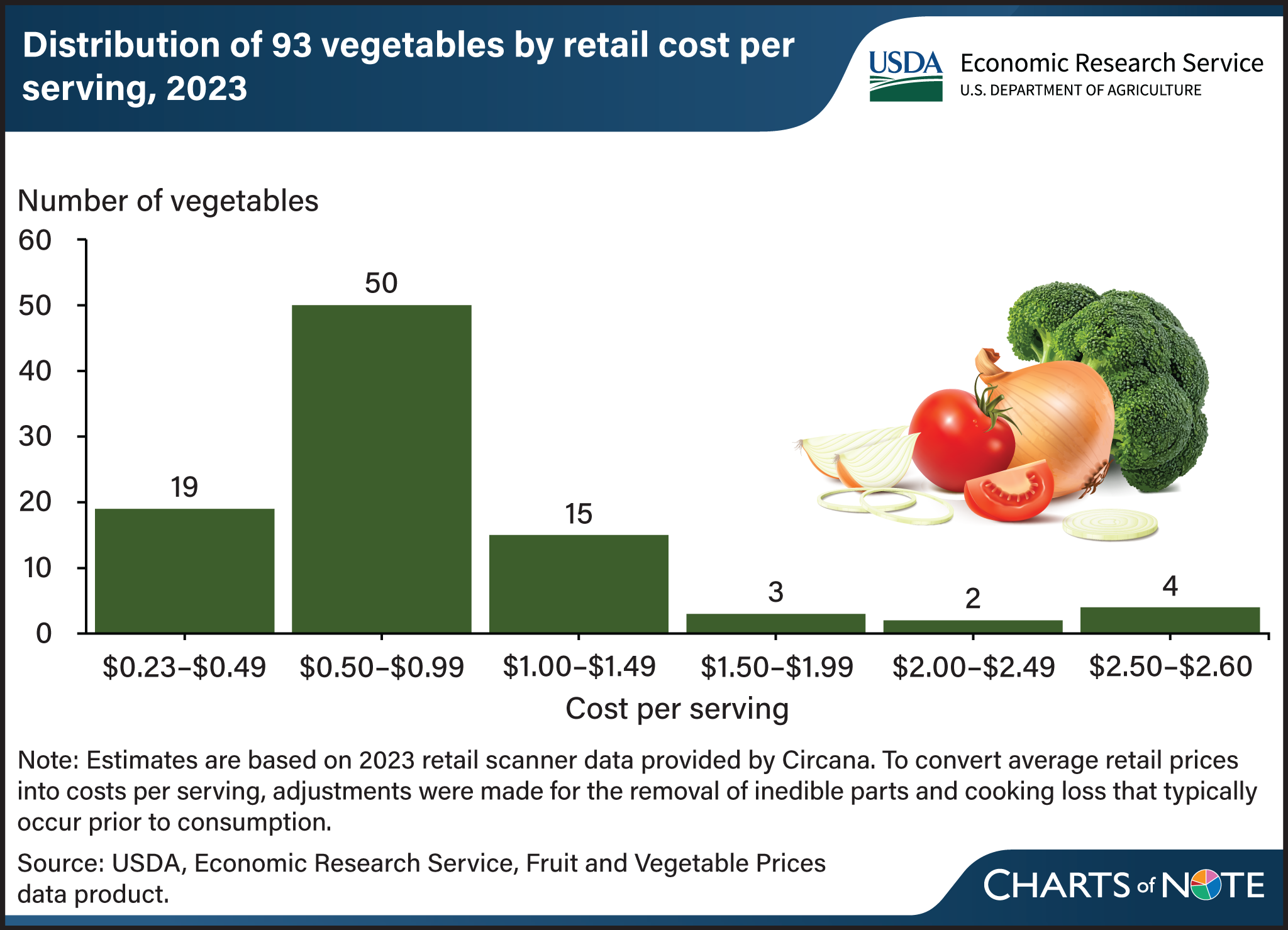
Sixty-nine of 93 fresh and processed vegetable products sold in the United States cost consumers less than $1 per serving in 2023, according to a new Chart of Note from USDA's Economic Research Service (ERS). The estimate is built on average retail prices and measured per serving, the edible portion that fits in a 1-cup measuring cup, or 2 cups for lettuce and other raw leafy greens, as defined in the Dietary Guidelines for Americans, 2025-2030.
At the cheap end, 19 products cost less than 50 cents a serving. They included white baking potatoes at 30 cents, fresh cucumbers eaten with the peel at 30 cents and fresh baby carrots at 40 cents.
Another 50 products fell between 50 and 99 cents a serving, among them fresh Roma and plum tomatoes at 51 cents and fresh green beans at 87 cents. The most expensive items in the sample were fresh okra and frozen asparagus, both at $2.60 a serving.
Price is not what keeps Americans from vegetables, the figures suggest. Federal guidance recommends 3 servings of vegetables a day for a person on a 2,000-calorie reference diet, but ERS estimated that the average consumer ate 1.5 servings of vegetables and legumes on a given day in 2017-18, half the recommendation.
For vegetable growers, the gap is also a measure of unmet demand: a population eating the recommended amount would buy roughly twice as much as it does now. The cheapest items on the list, potatoes, cucumbers, carrots and tomatoes, are also among the most widely grown field and greenhouse crops.
The chart, by ERS economists Hayden Stewart and Jeffrey Hyman, draws on the agency's Fruit and Vegetable Prices data product, last updated on 9 December 2025. The chart image published with this report is ERS's own.
Source: ers_usda


Comments
(0)