
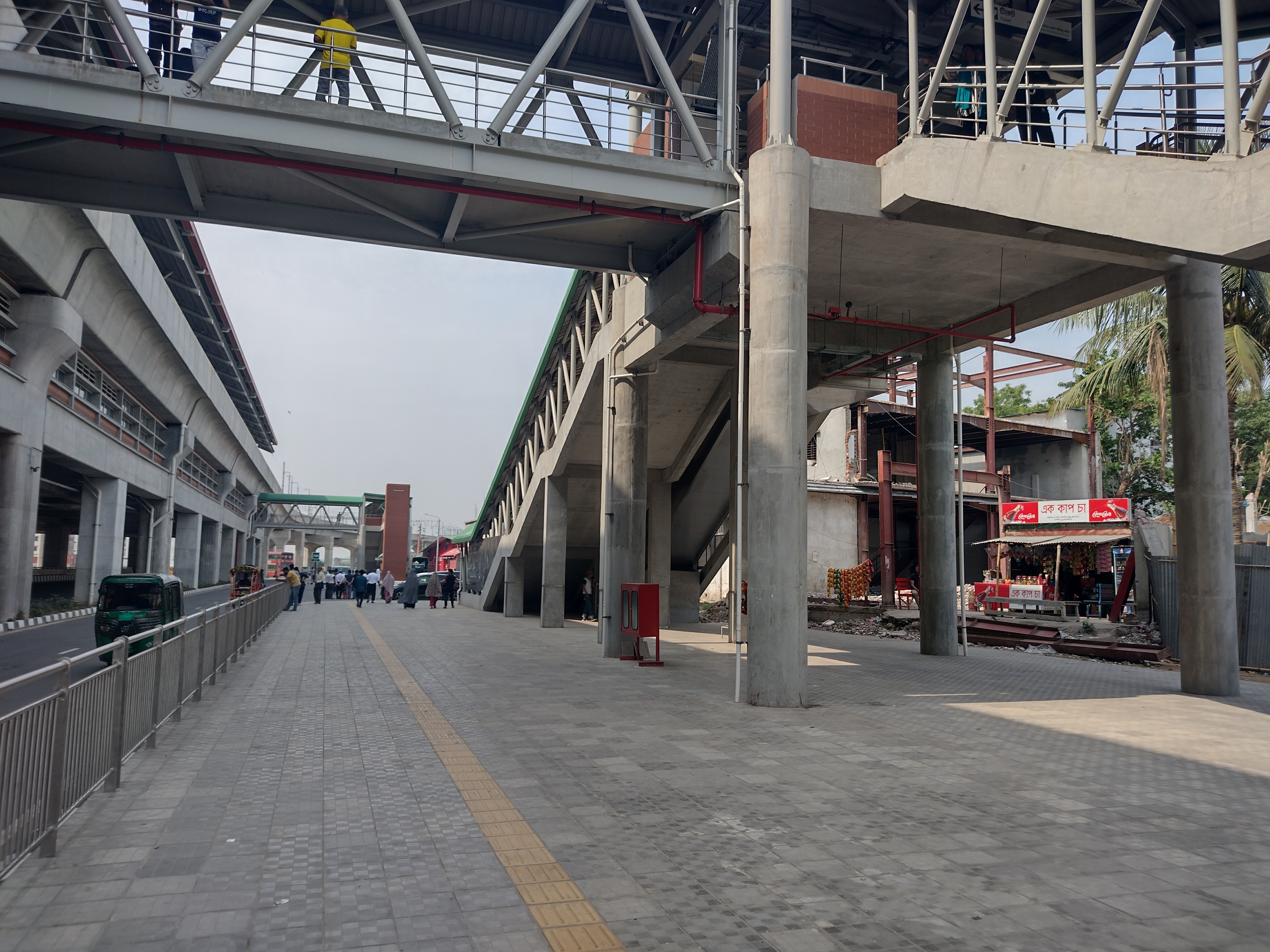
On Friday 29 May 2026, the day after Eid-ul-Adha, heaps of animal waste, dung and mud were still lying beside Uttara North metro station in Dhaka's Uttara. A cattle market that had grown up beside the station for Eid, which Jagonews24 described as illegal, had been removed, but the area had not been fully cleaned. Jagonews24 reported that afternoon that, a day after the market was cleared, pedestrians and metro passengers were still struggling through the stench and the mud. Bangladesh celebrated Eid-ul-Adha on Thursday 28 May that year.
Waste, dung and mud after the market was cleared
According to Jagonews24, those responsible had said the area would be cleaned as soon as the market was removed. On the spot, however, its reporter found that cleaners had started late. Some were spraying water, while elsewhere piles of waste lay beside the footpaths.
A caption in the report said that animal waste was still lying beside the station on Friday, the day after Eid, and that many trees there had been destroyed. Another of its photographs showed cow dung under the station. The report also carried a photograph supplied by Dhaka North City Corporation (DNCC), whose caption said the corporation ran a cleaning drive beside Uttara North metro station on Friday.
Many pedestrians and passengers voiced their irritation at having to make their way through the smell and the mud. Local residents and passengers called for the waste to be removed quickly and the whole area cleaned to ensure a healthy environment.
What pedestrians and residents alleged
Local people who spoke to Jagonews24 called the situation "anarchy" and voiced anger about the illegal cattle market and the damage to the environment. They alleged that the site was never a designated cattle market and that some greedy people, linked to politically influential figures, had set the market up there for money. The allegation was theirs; the report named no one.
Pedestrian Ruhul Amin told Jagonews24: "You have to hold your nose just to walk down the road. There is a terrible stench all around, and the mud makes it hard to get through."
Another pedestrian, Halimul, said: "This is complete anarchy. There was no permission to hold a cattle market here. Some greedy people linked to a political party did this to make money. It should be investigated and those responsible punished." He added that trees should be planted at once to restore the trees and green space the market had destroyed.
Residents also questioned the role of law enforcers. They alleged that such illegal activity would not be possible without the help of local influential groups and part of the administration. Resident Chowdhury Almas said: "This could not have happened without the cooperation of the police and local influential people. They were involved, so they too should be punished for this kind of activity."
Residents demanded a swift investigation, the identification and punishment of those responsible, and restoration of the damaged environment. The Jagonews24 report carried no response from the police or the city corporation. What the police and the corporation had said about the site in the days before Eid is set out below.
Police clearance under the station before Eid
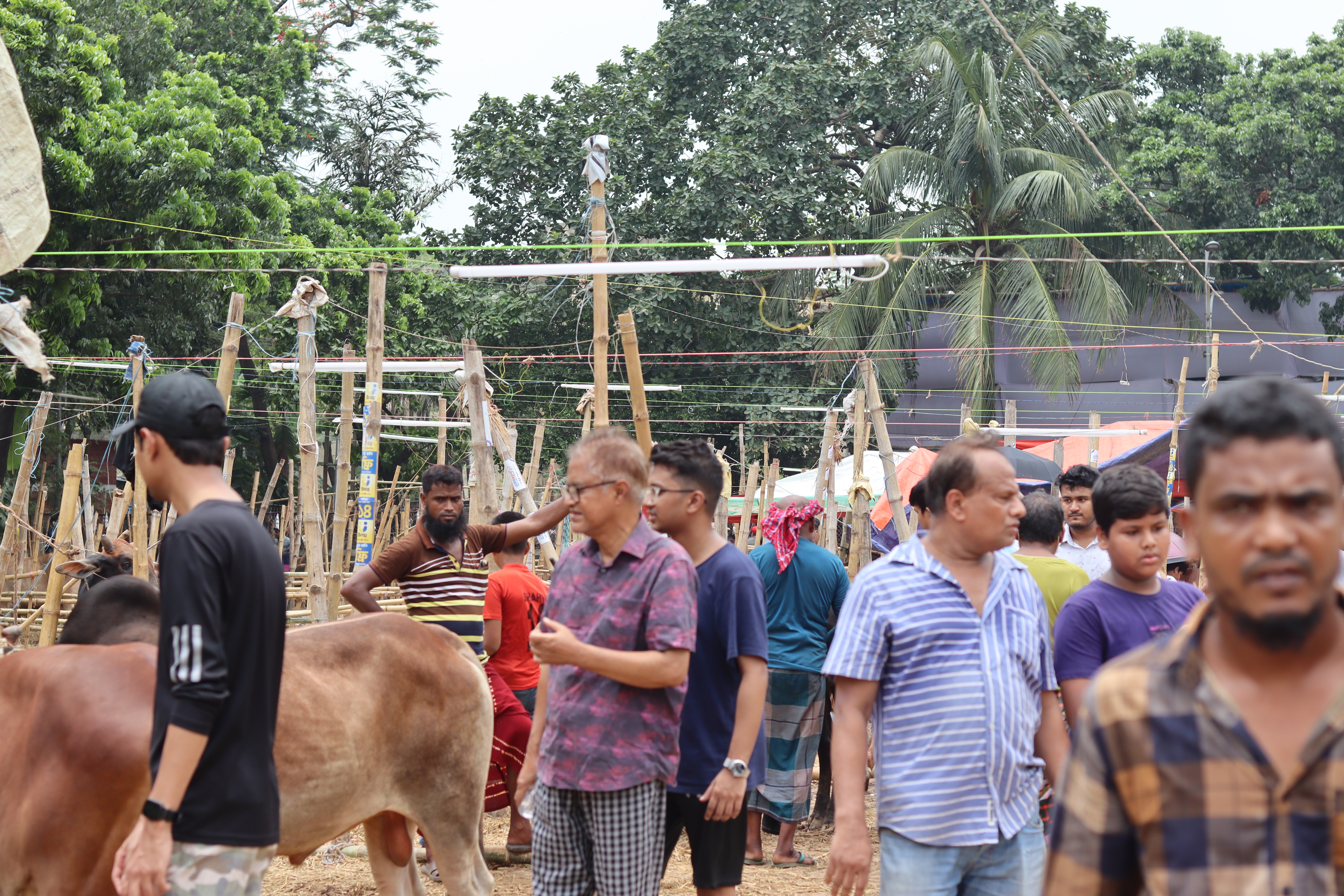
Two days before Eid, on the evening of Tuesday 26 May, N M Nasiruddin, deputy commissioner of the Dhaka Metropolitan Police (DMP) media and public relations division, sent a press release to the media. As reported that night by the Bengali edition of The Business Standard, the release said the capital's biggest sacrificial animal market that year was at Diabari in Uttara. With so many animals arriving, sellers had gone beyond its set boundary and tied animals on the main road and under the metro station, causing heavy traffic congestion and disrupting people's movement.
According to the police, Diabari, the largest market under Dhaka North City Corporation and the one with the highest lease value, had become very busy that year. Large numbers of sacrificial animals had been brought by truck and by river from across the country, and big cattle in particular were drawing buyers.
The DMP Uttara division cleared the animals from under the metro station and restored traffic by an alternative route. The market's leaseholder was called to the spot and warned. Deputy commissioner Nasiruddin said holding a market or keeping animals on the road was completely prohibited and that anyone defying the order would be fined by a mobile court.
The daily Desh Rupantor reported on the night of 27 May that passengers and locals had complained that animals tied under the station, parked trucks and temporary bamboo enclosures were obstructing movement and causing tailbacks. In many places the footpath had been taken over, forcing pedestrians to walk on the road at their own risk. One affected passenger told the paper that the situation had become very hard for regular metro users.
What the state minister and the DNCC administrator said
On Wednesday 27 May, Mir Shahe Alam, State Minister for Local Government, Rural Development and Co-operatives, visited the Diabari cattle market. According to the state news agency BSS, he said no space under or around the metro station had been leased for a market. In his account, some traders had sheltered under the station with their cattle during sudden heavy rain two days earlier, and the DNCC administrator had then come in person to move the animals off the road and into the designated market area.
The state minister said it was wrong to think that the government or the city corporation was indulging such unauthorised activity. He said a magistrate was on duty at the market at all times. He claimed that a three-day-old video had been spread to make the government controversial, when animals were in fact being bought and sold inside the market. No animals would be traded around the metro, he said, and nothing of the kind would be allowed in future.
BSS also reported a remark that bears directly on the waste found after Eid. The state minister said some places had become dirty because animals had come out onto the road, but cleaning had begun that morning and the agencies concerned were working together.
DNCC administrator Md Shafiqul Islam Khan said that during the rain some traders had stayed there with their cattle and were moved at once. On learning that they had returned, he went back to the spot at 1:30 am and took action. "We did not lease this place," he said. "We have asked for action against those who tried to operate there, and we have also spoken to the leaseholders about it." He added that cleaning had been under way since that morning.
So residents, police and the city corporation agreed that the land beside the station had not been leased for a market. Who had kept animals there, and whether anyone had used influence, was where residents' allegations and the authorities' account differed; reports published up to 29 May gave no result of any investigation.
DNCC's announced plan for sacrificial waste
At a meeting at the DNCC's Nagar Bhaban in Gulshan on the afternoon of 26 May, administrator Md Shafiqul Islam Khan announced that sacrificial waste would be removed within 12 hours on Eid-ul-Adha. According to The Business Standard, the corporation said it would deploy 16,000 cleaners and 750 waste trucks to meet that target.
The chief guest, State Minister Mir Shahe Alam, said the Prime Minister had given special instructions, through an inter-ministerial meeting, on cattle markets across the country, hide management, easing traffic and removing waste, and that in line with those instructions the city corporations had been told to remove sacrificial waste within 12 hours. He also said quick response teams and drainage teams were ready to deal with waterlogging during the monsoon.
According to the DNCC, its 16,000 workers would remove waste in the field, while the 750 trucks would carry it to the Amin Bazar landfill. To speed up unloading there, new link roads, platforms and trenches had been built, and a digital weighbridge was kept running to monitor every trip in real time.
The corporation said it had already handed out 1,630,000 polythene bags to residents, along with 3,600 sacks of bleaching powder, 1,348 cans of phenyl and 3,900 cans of Savlon. To raise awareness it was using loudspeaker announcements, digital billboards, 50,000 leaflets and mobile phone text messages, and mosque imams were raising cleanliness in their Friday sermons.
That plan was about sacrificial waste. The dung and mud left beside Uttara North station came from animals being kept there, on land the city corporation said it had not leased for a market. As of Jagonews24's report on the afternoon of 29 May, part of that waste was still lying there, and the DNCC's own photograph showed a cleaning drive under way that day.
Dhaka's cattle markets and the count of sacrificial animals
The Business Standard reported on 21 May that more than 3,600 cattle markets would be held across the country that year, 24 of them in the capital. Dhaka South City Corporation was preparing 11 temporary markets and Dhaka North City Corporation 12, in addition to the permanent market at Gabtoli. The two corporations said trading at these markets would run for five days.
One of the DNCC's 12 temporary markets was the Boubazar area next to Sectors 16 and 18 at Diabari in Uttara. The others on the list included empty land under the elevated expressway beside Khilkhet bazar, the Eastern Housing area of Mirpur Section 6, the Kalshi sand field in Mirpur, the area beside Dhaka Polytechnic Institute, empty land beside the Merul Badda kitchen market, East Hazipara, the area along the 40-foot road at Bosila in Mohammadpur, Bhatulia, Kanchkura, Paschimpara near the Mastul checkpoint, and the area beside the Sutivola canal in Bhatara.
Dhaka South City Corporation administrator Abdus Salam said at the time that no market would be allowed to spring up at random or on the road that year, and that no one had been given a lease outside the rules. He said special arrangements had been made at every market so that sacrificial waste would not be dumped anywhere. The same report noted a government ban on cattle markets in border areas.
Citing the Department of Livestock Services, The Business Standard reported that 12,333,840 animals were ready for sacrifice in Bangladesh in 2026, against an estimated demand of 10,106,334, leaving a surplus of about 2.2 million animals. A report on 25 May gave the same figures from the Ministry of Fisheries and Livestock.
Visiting the markets at Tejgaon, Kamalapur, Postogola and Bhatara on 24 May, three days before Eid, a Business Standard reporter found few buyers in the intense heat; farmers were pouring water over their animals from pipes and fanning them with palm-leaf fans and rechargeable fans to protect them from the heat. By sellers' asking prices, a cow that would yield two to two and a half maunds of meat was offered at Tk 120,000 to 130,000, and one of more than six maunds at over Tk 300,000. Farmers blamed rising prices of feed such as bran, oil cake and straw. The weather then turned: the state minister said on 27 May that sudden heavy rain had fallen two days earlier, and that it was during this rain that some traders took their animals under the station.
Diabari and Uttara
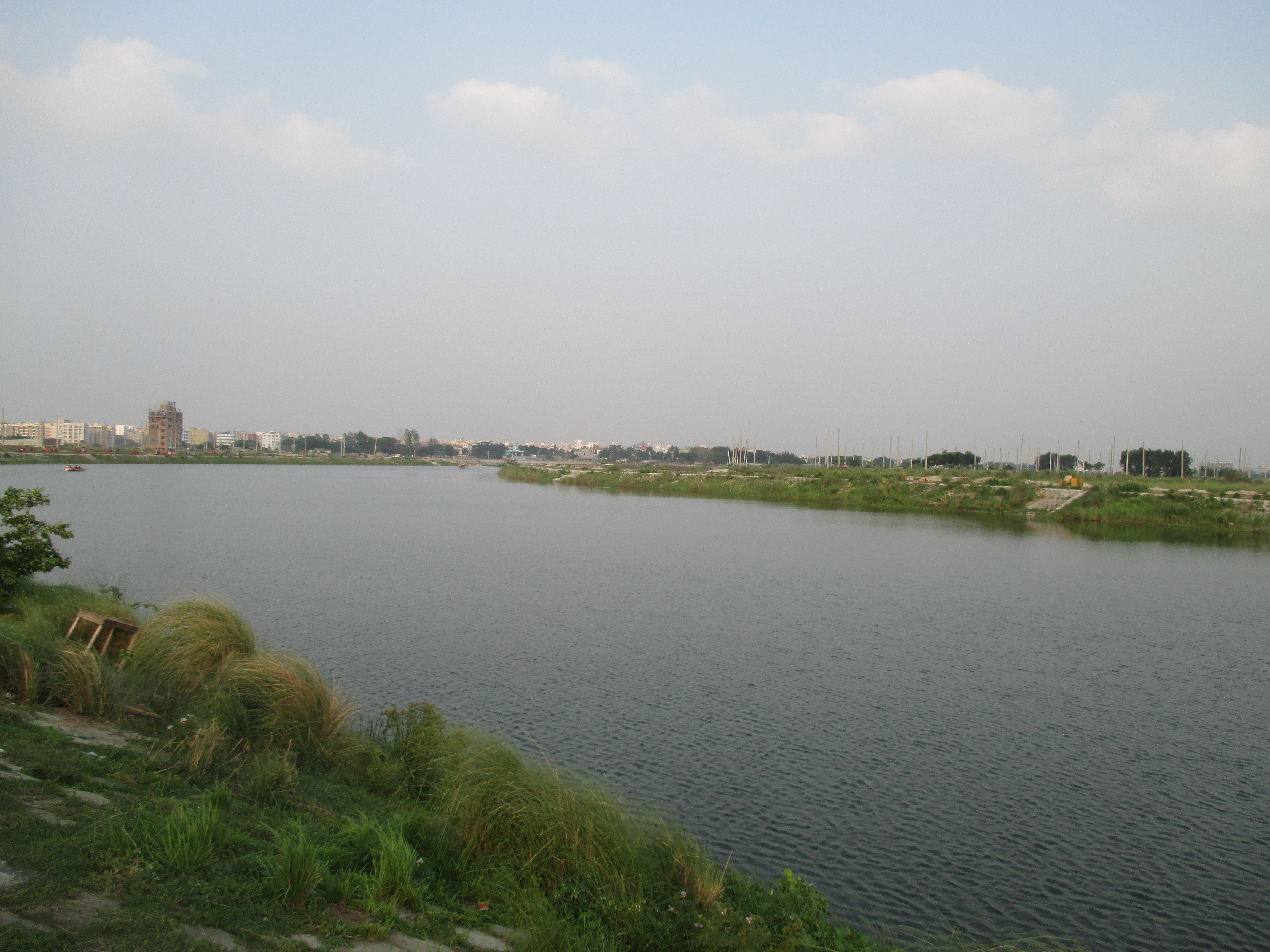
Diabari is an area of Uttara in Dhaka made up of the flat land of Uttara's Sectors 15 and 16. According to Wikipedia, its rural feel within the city has made it popular with visitors, many of whom come to see the kash (kans grass) flowers. A variety of birds can be seen there, though their numbers are said to be falling because of human activity. It is also known for paddle boats and kayaking.
Uttara itself is a planned residential area in the north of Dhaka, on the road to Gazipur and next to Hazrat Shahjalal International Airport. To relieve pressure on Dhaka, the Dhaka Improvement Trust (now RAJUK) surveyed the land between Tongi and what was then Kurmitola airport in 1965 for a satellite town. The foundation stone was laid on 25 June 1967. First called "North Satellite Town", the project was renamed "Uttara Residential Model Town" in 1980.
Much of Uttara's land was once low-lying wetland. After the 1988 floods the Dhaka embankment was built and Uttara's wetlands began to be filled. In 1992 RAJUK began a second phase extending Uttara westward, completed in 1998. A third-phase plan, finalised in 2009, added four more sectors on 2,008 acres west of the second phase. Diabari's open fields and water bodies lie in this extended part.
Uttara North station and MRT Line 6
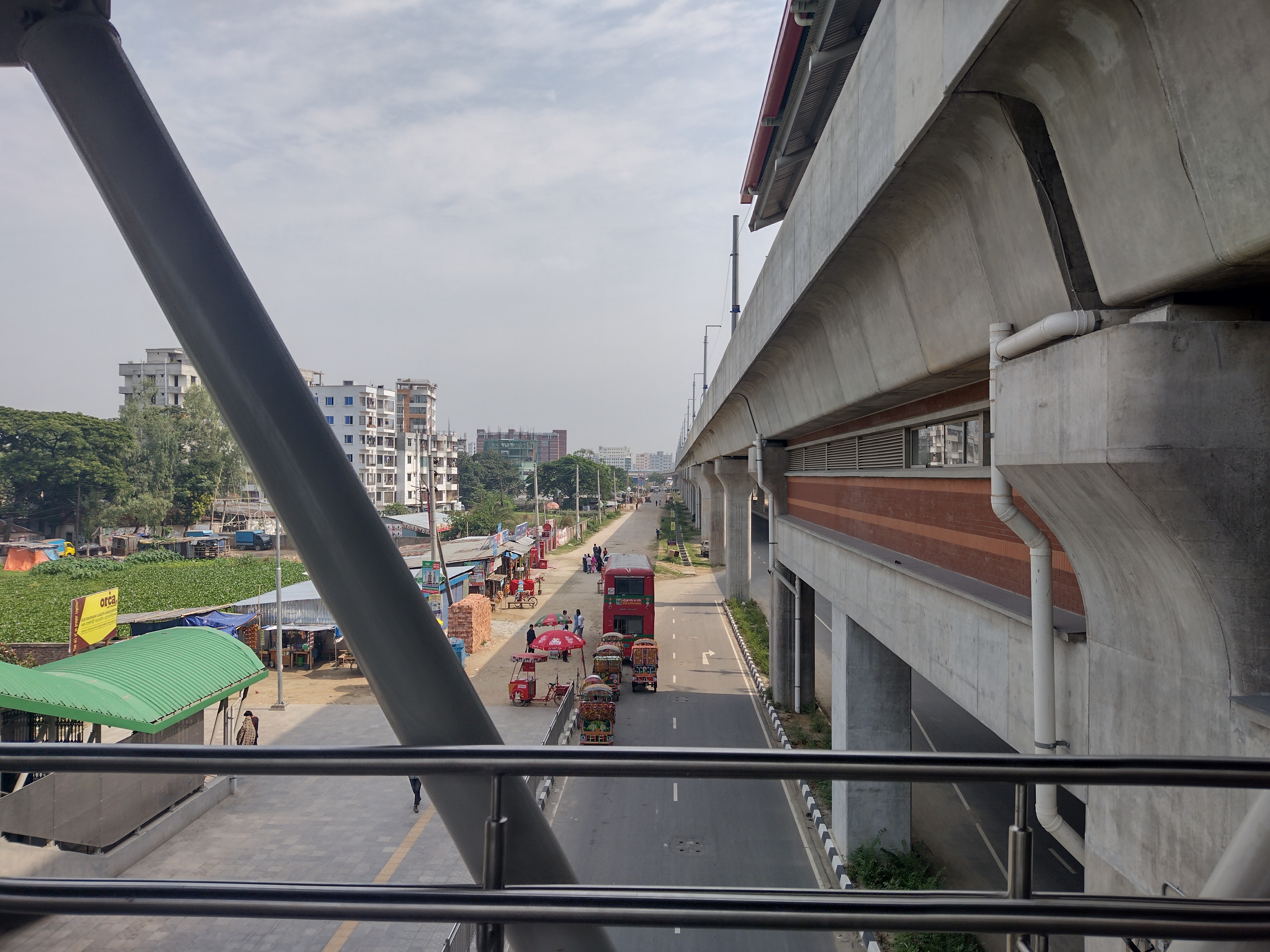
Uttara North is an elevated station on MRT Line 6 of the Dhaka Metro Rail and the northern end of the line. It was built under "Package CP-03", awarded to Italian-Thai Development Public Company Limited; the contract was signed on 3 May 2017 and construction began on 2 August that year. The Uttara to Agargaon section was inaugurated on 28 December 2022 and opened to passengers the next day.
Despite its number, MRT Line 6 is Bangladesh's first metro line, and it runs entirely on an elevated track. After the Agargaon to Motijheel section was inaugurated in November 2023, all 16 stations from Uttara North to Motijheel were in service by 31 December 2023. The line is operated by Dhaka Mass Transit Company Limited (DMTCL), and its construction was financed by the Japan International Cooperation Agency (JICA).
The line's depot is at Diabari. It has 52 structures, including workshops, washing sheds and storage, and can hold 18 trains. Trains reach it by running north from Uttara North station through a 300-metre workshop, and an operation control centre at the depot directs train movements. The first trial run, on 29 August 2021, went from Diabari depot to Mirpur 11.
Each station has a ground level and two upper levels. Passengers climb by stairs or lift to the concourse, with its ticket counters, waiting room and staff offices, then pass through automatic fare collection and take an escalator or lift to the platforms on the second level. The way into the station therefore begins on the road and footpath below. Bangladesh Road Transport Corporation (BRTC) runs a shuttle bus from Uttara North to House Building, and a bus service from Tongi to the station began on 9 May 2024. That is why animals kept under the station, and the waste they left, bore so directly on passengers.
Dhaka North City Corporation
Dhaka North City Corporation is the local government body for the northern part of the capital. On 29 November 2011, Parliament passed the Local Government (City Corporation) Amendment Bill, dissolving the undivided Dhaka City Corporation and creating two corporations, Dhaka North and Dhaka South. The corporation's functions, powers and responsibilities are governed by the Local Government (City Corporation) Act, 2009; alongside urban planning and health services, waste management is among its duties.
On 9 May 2016 the government approved adding eight unions to the DNCC: Beraid, Badda, Vatara, Satarkul, Harirampur, Uttarkhan, Dakshinkhan and Dumni, bringing its area to 197 square kilometres. The DNCC is divided into 54 wards and 10 zones, and covers areas including the Uttara East and Uttara West police stations as well as Turag, Uttarkhan, Dakshinkhan, Biman Bandar, Khilkhet, Gulshan, Mirpur and Mohammadpur.
According to the 2022 census, 5,990,723 people lived in 1,636,924 households in the DNCC area, of whom 5,750,463 were Muslims. It was for this population that the corporation set itself the target of clearing sacrificial waste within 12 hours of Eid. In May 2026 the DNCC was headed by its administrator, Md Shafiqul Islam Khan.
Eid-ul-Adha and qurbani
Eid-ul-Adha is one of the two main festivals of Islam and falls on the 10th of Dhul Hijjah, the last month of the Islamic calendar. After the Eid prayer, Muslims who can afford it sacrifice halal livestock, in remembrance of Prophet Ibrahim's (Abraham's) readiness to sacrifice his son at God's command. The animals must meet set standards of age and quality. By custom the meat is divided into three parts: one for the family, one for relatives and friends, and one for the poor.
In Bangladesh the festival is also known as Korbanir Eid or Bakri Eid. From the start of Dhul Hijjah, temporary cattle markets begin to appear across the country. Estimates cited by Wikipedia put the number of animals sacrificed in Bangladesh each Eid-ul-Adha at about 13 million. In 2026, 24 markets in the capital held large numbers of animals for several days. That is why, before Eid, the government, police and city corporations each set out instructions and preparations for keeping markets within their boundaries and for clearing the waste from markets and sacrifices afterwards.
Photo: Mehediabedin / Wikimedia Commons (CC BY-SA 4.0)
Sources: Jagonews24, The Business Standard (Bangla), Bangladesh Sangbad Sangstha (BSS), Desh Rupantor, Wikipedia



Comments
(0)