
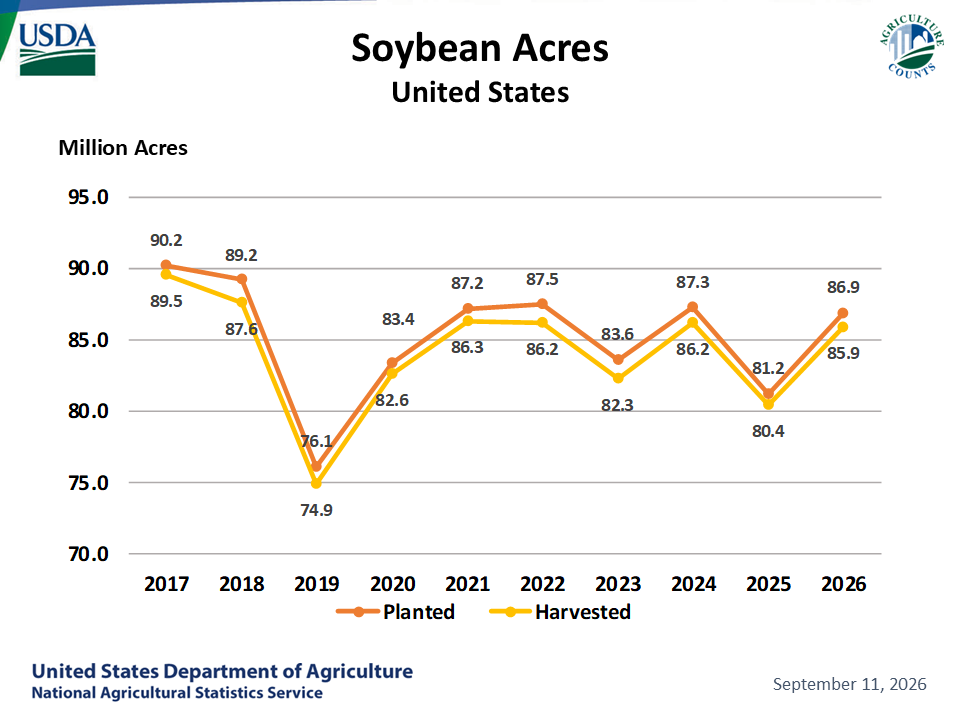
Farmers in the United States intend to plant 95.3 million acres of corn in 2026, 3% less than last year, and 84.7 million acres of soybean, 4% more, according to the Prospective Plantings report published on 31 March by the Department of Agriculture's National Agricultural Statistics Service (NASS).
The report is the first official, survey-based reading of American planting intentions, drawn from returns by nearly 74,000 farm operators in the first two weeks of March.
The retreat from corn is broad rather than local. Planting intentions are down in 37 of the 48 estimating states, with falls of 300,000 acres or more expected in Illinois, Iowa, Minnesota, Nebraska, North Dakota, South Dakota and Wisconsin. Against that, the corn area in Nevada and Washington would be the largest on record if realised, while Connecticut, Massachusetts, Pennsylvania and Rhode Island would post their smallest.
Soybean gains of 300,000 acres or more are expected in Arkansas, Iowa, Kansas, Mississippi, Nebraska, South Dakota and Wisconsin, with Wisconsin heading for a record. Wheat is expected to lose ground: all wheat area is put at 43.8 million acres, down 3%, with winter wheat at 32.4 million acres, other spring wheat at 9.42 million and durum at 1.95 million. All cotton is expected to total 9.64 million acres, up 4%.
NASS published its quarterly Grain Stocks report the same day. Corn in store on 1 March totalled 9.02 billion bushels, 11% more than a year earlier, with on-farm stocks up 21% while off-farm stocks fell 2%. Soybeans totalled 2.10 billion bushels, up 10%, and all wheat 1.30 billion bushels, up 5%.
Intentions are not a harvest, and the June Acreage report exists precisely because growers change their minds between March and planting. Even so, the March survey is the first firm number the world's grain and oilseed markets have to work with each year.
That is where the report reaches Bangladesh. A bigger American soybean area points to more crushing and, other things being equal, easier soybean oil and meal supply; a smaller corn area works the other way on feed maize.
Source: USDA National Agricultural Statistics Service



Comments
(0)