
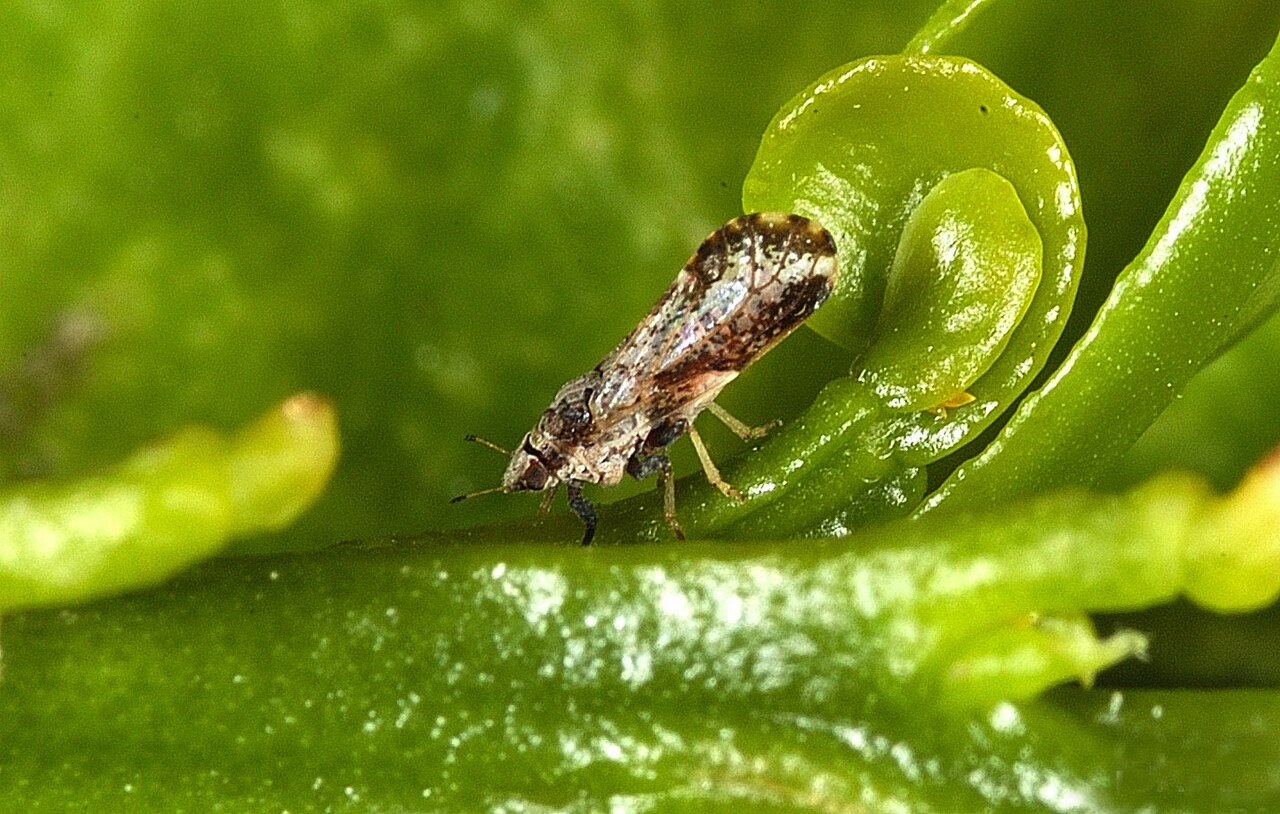
Researchers at São Paulo State University (Unesp) in Brazil have developed a bio-based nanoemulsion that reduced the bacterium behind citrus greening, Candidatus Liberibacter asiaticus, in infected orange seedlings. Citrus greening, or huanglongbing (HLB), is spread by the Asian citrus psyllid.
The formulation, V13, combines oregano essential oil, hexyl gallate and eugenol in droplets about 50 nanometres across. The bacterium lives in the plant's phloem, where antimicrobials struggle to reach it, and the nanoemulsion is meant to carry the active ingredients into plant tissue. The work, with N&P Pharmaceutical Technology Laboratory, was published in Frontiers in Agronomy on 7 October 2026.
Two greenhouse trials each used 20 Valencia orange seedlings on Swingle rootstock, infected through psyllids: 10 got V13 as a root drench of about 150 millilitres per seedling, seven times in each 60-day cycle, and 10 got water. Over 300 days, V13 cut bacterial levels by 1.29 log units in the first trial, with 70% of treated plants at or near the detection limit, and by 2.46 log units in the second, with 90% there. Responses varied from plant to plant.
The formulation stayed active for 120 days in storage. Tests found no acute toxicity in mealworm larvae at ten times the proposed rate and no significant effect on the survival of a stingless bee, Melipona scutellaris, and seedlings showed no visible damage, though growth was not measured.
The authors stress that this is a proof of concept under controlled conditions. Field trials in commercial orchards, scale-up, cost and behaviour in different soils are still to be studied, the bacterium was not eradicated, and psyllid control and integrated HLB management remain necessary. The six authors include Vitória Rodrigues Bergamo and Henrique Ferreira; the report was edited by Leonardo Gottems.
Photo: David Hall / Wikimedia Commons (Public domain)
Source: AgroPages

Comments
(0)