
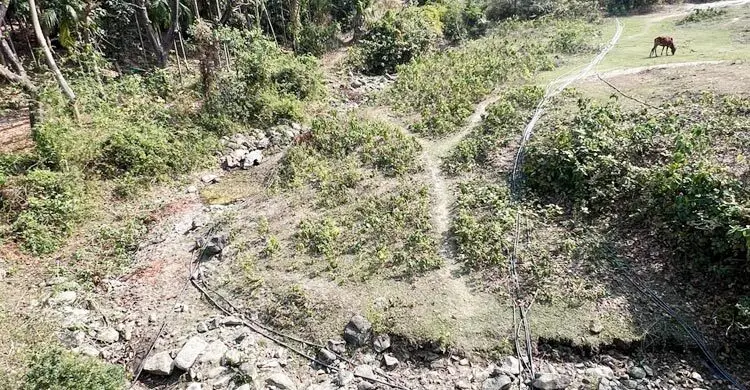
A decade ago the forests of Ukhiya and Teknaf were full of large trees of many species, and even in the dry season there was water in the forest streams, canals and reservoirs. But continuing deforestation, unplanned extraction of groundwater through deep and shallow tube wells, and lack of rain are steadily lowering the water table. As the streams and canals dry up, the shortage of drinkable water for wildlife is growing severe. With the forest thinning, wildlife habitat has shrunk at an alarming rate.
At a recent seminar of the non-government development organisation CODEC, Prof Dr Mosharraf Hossain of the Institute of Forestry and Environmental Sciences at the University of Chittagong described how severe the water crisis for wildlife has become with the disappearance of hill streams.
Research findings
He said the hill streams and natural water sources in Teknaf have dried up. Research into the affected wildlife and water sources found that Ukhiya-Teknaf has the Bay of Bengal on one side and the Naf river on the other, with hill forest in between. For fresh water there is no option but to rely on hill streams, groundwater and rain. But excessive extraction of groundwater is steadily lowering the water table and raising salinity, while lack of rain and deforestation keep drying up the forest streams and reservoirs. Wildlife is suffering a severe water shortage. Many animals have already died and many have moved elsewhere. Losing drinking water, food and habitat, elephants, snakes and various other animals and birds are coming out into settlements. Many local families have also moved from one village to another because of the water shortage.
Local people said the forests of the country's southern border district are constantly being encroached on, shrinking wildlife habitat. Deforestation is slowly reducing tree cover, environmental damage is destroying the ecosystem, and food for animals and birds is dwindling. Because of environmental impacts and shortages of habitat, food and water, wildlife is coming into settlements, where people treat the animals as enemies, catch them and beat them to death. Man-made disasters are driving many species of animals and birds towards extinction and robbing them of their homes. Steps are urgently needed to overcome this.
Local voices
Shafiul Alam of Bahar Chhara Shilkhali in Teknaf said that even two decades ago there was water in the forest streams and canals in the dry season. Now, let alone water, there is no trace of the streams. Indiscriminate tree felling is the cause.
Shahajahan, who works to protect wildlife in Shamlapur, Teknaf, said that because of continuing deforestation, pythons and various other animals come out into settlements at different times for lack of food and water. "We have rescued and released many animals," he said.
Dr Shital Kumar Nath, project director of Nature and Life at CODEC, a non-government organisation working with wildlife, said coordinated action was urgently needed to end the water crisis in Teknaf-Ukhiya. The crisis is growing worse not only for wildlife but also for local people. Hill cutting must be stopped, and steps taken for afforestation and rainwater retention.
Official response
Mostafizur Rahman, executive engineer of the Department of Public Health Engineering (DPHE) in Cox's Bazar, said the demand for groundwater for drinking and other use had risen as more concrete and semi-concrete buildings went up, creating a growing shortage of safe drinking water. To tackle this, the DPHE is implementing a rainwater harvesting project, with priority to Rohingya-populated Ukhiya and Teknaf. A proposal has already been made to lease 600 acres in Palongkhali, Ukhiya. But reviving canals and streams to conserve water naturally inside the forest is essential, he said.
Md Sarwar Alam, divisional forest officer (DFO) of Cox's Bazar South Forest Division, said about 8,000 hectares of forest land in Ukhiya-Teknaf have lost their biodiversity because of the Rohingya shelter. In addition, for lack of awareness, tree thieves indiscriminately cut trees from every part of the hills, top to bottom. With the trees beside them cut, the streams are all dying. Planned tree planting has begun to keep all parts of the hills alive, and it is continuing.
As recommended by the research, rapid planting has begun on land up to 15 feet on both sides of streams that used to flow. Unless local communities come forward alongside forest workers, it will be hard to protect nature and the forest.
Source: Jagonews24. First published in Bengali on The Agro News.
Comments
(0)