
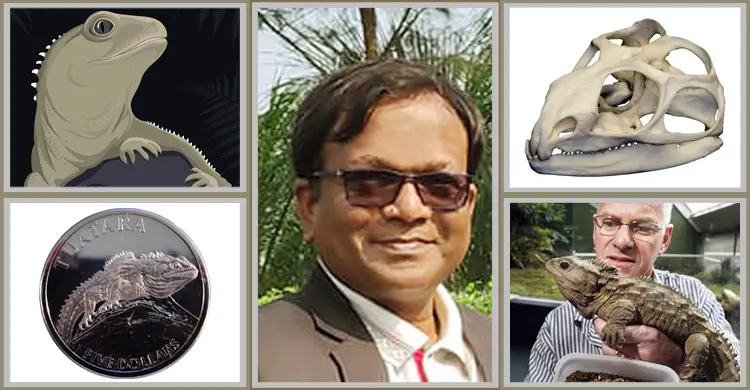
Dinosaurs belong to the Jurassic age. Many myths and science stories about them circulate among us, along with science fiction and films. These huge creatures once ruled the world at the dawn of creation. We have never seen a dinosaur; much of what we know comes only from anthropological research and fossils. But while we never had the chance to see a living dinosaur, scientists have found a strange creature from the age of dinosaurs: the tuatara.
The name tuatara comes from the language of New Zealand's Maori people and means "spines on the back". Scientists believe the tuatara is the last living member of a reptile family 200 million years old. It is the only animal to have survived the catastrophe about 60 million years ago that wiped out the dinosaurs and three-quarters of life on Earth. Of the creatures that lived in Earth's earliest times, only the tuatara survives. The four-limbed animal's habitat is now limited to just 30 remote islands, which the writer places in "North Ireland".
A third eye
The tuatara moves very slowly. Its backbone is like a fish's and its lungs like a frog's. Strangest of all, it is the only animal with a third eye on top of its head. Researchers have noted that this eye has its own lens and a parietal plug that works as a cornea. Linked to the brain through the nervous system, the third eye works constantly like a modern live camera. It can usually be seen on young tuatara about six months old, but as they grow it disappears among the many spines on the skull, is covered by skin and is no longer easily seen.
In 220 million years of evolution this long-lived animal has changed very little. Brian Gill, curator at the Auckland War Memorial Museum, calls it "a living fossil". Figures from New Zealand's Department of Conservation show its numbers falling every year, and because it breeds so slowly the decline is almost impossible to stop.
Tuatara usually come out at night and hide by day among roots or in burrows. They wait for prey, somewhat as a frog does. Their lungs are like an amphibian's and hold too little oxygen, so they cannot run down prey. The body is odd too: the head is a lump-like triangle, a little like a monitor lizard's. The brown skin hangs in folds at the throat, with white spots here and there. The tail is strange, tapering from base to tip and quite hard, with a row of spines along the top that runs along the back almost to the neck. Females have larger spines on the back than males.
Slow growth and slow breeding
A 150-year-old tuatara looks much the same as ever. They do not grow very large: a 40-year-old weighs about 450 grams, and they usually weigh at most a kilogram, or a little more. A tuatara can live for more than 150 years. Like fish, they are cold-blooded, and their metabolism rises with temperature. They are comfortable even at 15 degrees Celsius. Their skin is very soft and flabby.
Females breed every four years, and mating is a curious affair. A male ready to breed comes out of its burrow and waits. When a female comes near, he circles around her; if she is drawn to him, they mate. About seven months later the female lays six to ten eggs at once in a sunny spot, and the young hatch 11 to 16 months after laying. The tuatara's great enemy is the rat, which destroys its eggs.
Dr Daugherty of Victoria University of Wellington has spent about a decade researching how to hatch tuatara eggs, with the aim of keeping this slow-breeding species alive. He has chosen four islands where tuatara are close to being wiped out. Some tuatara taken from those islands are being bred at the Auckland and Hamilton zoos. Hatching brings another problem: each egg needs a different temperature. Research has shown, however, that most eggs hatch at between 18 and 22 degrees Celsius. Researchers want to collect more females to speed up breeding of the endangered animal.
A long-held confusion
Until the last century there was confusion among scientists about the tuatara. Many researchers thought it was just a species of monitor lizard, and until 1867 almost all of them believed so. The mistake was corrected by Dr Albert Carl Ludwig Gunther, curator and researcher at the British Museum in London, who compared it with the long-extinct Rhynchocephalia reptiles. In 1989, the article says, Dr Gunther discovered two species of tuatara. In his view, tuatara were spread across the whole world in the age of dinosaurs. About 80 million years ago New Zealand broke away from the southern landmass, and since then the tuatara has been confined to New Zealand. Its main decline there began about 100 years ago.
When Polynesians settled in various parts of New Zealand, large-scale farming began, and with it came rats and dogs. The tuatara began to lose ground. The wildlife conservation department has recently moved to protect it, and since 1990 has been trying to speed up its breeding through artificial breeding. Some "sanctuary islands" have been set aside where the animals can live undisturbed. Pictures of the tuatara still appear on New Zealand coins, telephones, cards and book covers.
Hazley, a nature-loving scientist and great admirer of the tuatara, has set up a "Tuatarium" gallery. He began researching tuatara 27 years ago and built the Tuatarium of clear glass, where the animals enjoy all the benefits of natural conditions. He keeps tuatara with various names. One of them, Henry, is about 111 years old and has fathered young at that age. Hazley loves the animals like everyday friends.
The tuatara has survived as a silent witness since the beginning of creation. May its generations live on for thousands of years alongside all the world's creatures; otherwise, like the dinosaur, it may become an unbelievable tale for future generations.
The writer, Sheikh Anwar, is a science writer, researcher and MPhil scholar at Dhaka University.
Source: Jagonews24. First published in Bengali on The Agro News.

Comments
(0)