
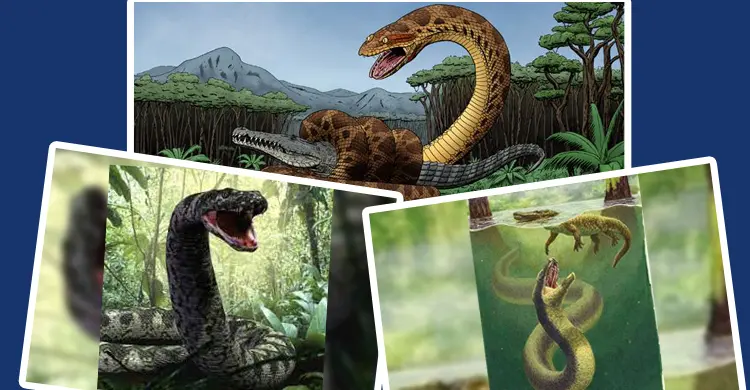
The very mention of snakes makes many people's skin crawl, and even their stories frighten some. Thinking of the huge anacondas seen in films is enough to make anyone's throat go dry, and many people believe the anaconda is the world's largest snake. But a far bigger snake once ruled the Earth. Its name was "Titanoboa cheronosis".
This snake roamed the forests of South America. In the past there was no shortage of dense jungle in many parts of the world, and many believe this huge snake also lived in places beyond South America. Titanoboa has even been described as having ruled by terror.
Each Titanoboa weighed more than a tonne and was proportionally long, at 50 feet. The whole snake would surely have matched the height of a tall building today.
A fossil from a Colombian mine
This fearsome reptile is known to have existed in prehistoric times, roaming the Earth about 58 million years ago. Its fossil was found in a huge mine in northern Colombia. The snake was so large that it could swallow a whole crocodile in moments, and looking at it, no one could tell it had a crocodile in its belly.
Until a few years ago, scientists had no idea at all that such a huge snake had existed. Only after its fossil was found did they begin to learn about Titanoboa.
Even the largest snake alive today is much smaller than Titanoboa; some say today's biggest snake is less than half its size. The fossil was discovered by the scientist Carlos and his colleagues. "We never imagined we would find the fossil of such a large animal from so many years ago. It is a great success for us," they said.
Not venomous, but immensely strong
Scientists believe Titanoboa may be an ancestor of the boa constrictor, a python-like snake of South America, because carbon dating of the fossil showed considerable similarities with these animals. Interestingly, despite its monstrous size, the snake was not venomous. It was immensely strong: once it seized an animal, it crushed it in moments. Its squeezing force is said to have been equal to about 400 pounds per square inch.
Snakes generally cannot regulate their body temperature well and depend on outside heat to survive. The scientist Bloch said dinosaurs died out about 60 million years ago, after which temperatures at the equator were quite high. That, he said, is why Titanoboa grew so large, and it is the secret of the reptile's size. The Earth is now warming again. Will Titanoboa be seen again?
The writer is a student and journalist.
Source: Jagonews24. First published in Bengali on The Agro News.
Comments
(0)