
Every year people along the Teesta battle floods, river erosion and drought. This year too, after several rounds of flooding, one last flood dashed farmers' hopes. The sudden flood of 20 October caused extensive crop damage in five upazilas along the Teesta.
Along with erosion, sand buried standing crops, and in places erosion swept away farmland and crops. Agriculture and the rural economy take one blow after another. Even so, farmers who lost everything to the Teesta are trying to get back on their feet.
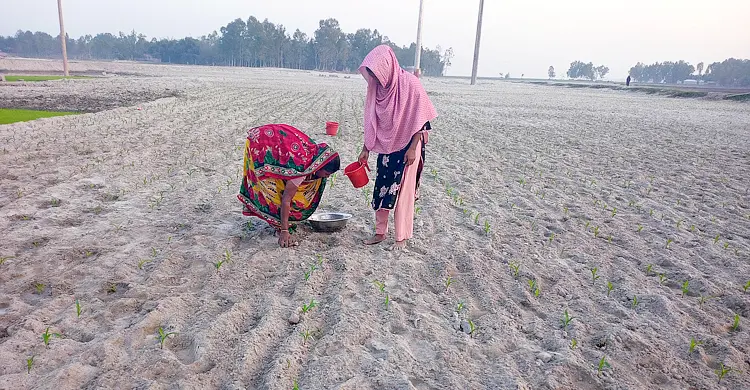
By the end of December the Teesta had dried up, and vast sandbanks have emerged in the bed of the dead river. The sandy riverbed is beginning to turn green, and farmers have started sowing crops there. Though worried, they are busy trying to recover their losses with fresh energy.
Crops under sand
The government has brought about 28,000 affected farmers in the five Teesta upazilas under an incentive programme this time. In this year's flood in the five upazilas, transplanted aman on 2,995 hectares, maize on 100 hectares, green chilli, potato and onion on 90 hectares, and groundnut, pumpkin and pulses on 100 hectares were submerged. Crops on 2,045 hectares were completely destroyed.
Visits to Rajpur in Lalmonirhat Sadar upazila; Char Gobardhan, Balapara and Kutirpar in Aditmari upazila; Kakina, Char Bairati, Bhotmari and Shoilmari in Kaliganj upazila; Dauabari, Gaddimari, Patikapara, Haldibari, Sindurna and Saniajan in Hatibandha upazila; the Teesta char of Dahagram in Patgram upazila and other affected areas found the scars of the sudden flood exposed as the water receded. Wrecked houses still lie around, and farmers' fields are buried under Teesta sand. Farmers are trying to clear the sand with sickles and spades, then sowing new crops. In places they are planting winter vegetables, sweet pumpkin, maize, onion, potato and other new crops, and various crops have begun to sprout on the Teesta chars.
Farmers' voices
Rahima Bewa, busy tending her vegetable plot, said: "One flood swept everything away. Now I am planting potato, onion, pumpkin and maize on the char again. After the potatoes are lifted I will plant groundnut. Our hardship lasts 12 months. With floods and drought we have to struggle to bring the crop home. If we don't farm, what will we eat? Poor people like us have no other way."
Farmers of Char Bairati, Bhotmari and Shoilmari in Kaliganj upazila said the damage from the untimely sudden flood was several times greater. Their rice, potatoes, vegetables, groundnuts and other crops were badly damaged, leaving them in financial trouble and many families in debt. Still, they have started farming again. The sandbanks are now a blessing for them: golden crops will grow in this sandy char soil and turn the fortunes of people hit by Covid and floods, they said.
Bhotmari farmer Mozammel Haque said: "Good seed is hard to find; seed is the problem now. Still, I have planted maize on two acres. The price of fertiliser is rising now. If the government controls it, it will be easier for us to farm. All the farming you see on the char now is being done by needy people. We have to run our households by selling this crop."
Anwar Hossain of Sindurna char said: "I prepared 10 bighas of land for maize, and in one day the flood finished everything. When I went to look, sand had piled up knee-deep on the land. Now I am in despair."
Teesta farmer Jamal Hossain said: "We have one demand: we want an embankment on the Teesta. If the government does not tame the Teesta, such losses will keep happening."
Saiful Islam of the same area said: "All our farmland went under water. The potato, vegetable and pumpkin fields rotted. We suffered heavy losses in the untimely flood, but nobody looks at us. The agriculture office came and took down our names."
Officials on support
Hatibandha upazila agriculture officer Omar Faruk said crops on the chars had done well this time thanks to favourable weather, but farmers were hit by the sudden flood, as floods do not usually come at this time. Farmers are now trying to recover, and the agriculture department is giving them various advice.
Shamim Ashraf, deputy director of the DAE in Lalmonirhat, said 28,000 farmers in Lalmonirhat are being given incentives for any one of six crops in the rabi season, of whom about 16,000 in the five flood-hit upazilas will be covered. Farmers are given fertiliser and seed support for various crops under it.
Source: Jagonews24. First published in Bengali on The Agro News.


Comments
(0)