
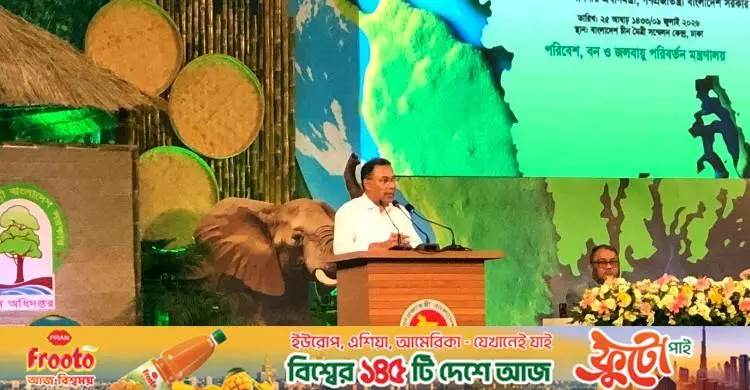
Stressing care for creation in line with the guidance of the Holy Quran, Prime Minister Tarique Rahman has said the relationship between human society and ecosystems is deep and inseparable. Environmental protection and tree planting must therefore become a social movement rather than a mere formality, he said, and he urged people to celebrate the birth of every child by planting a tree.
He was speaking on 9 July at the Bangladesh-China Friendship Conference Centre in Dhaka at the opening of the World Environment Day and Environment Fair 2026 and the National Tree Plantation Campaign and Tree Fair 2026.
Under the theme "Brikkharopone sajai desh, sabar age Bangladesh" (Let us adorn the country with trees, Bangladesh before all), the Prime Minister formally opened both events. He presented the National Environment Award 2025, the National Award for Wildlife Conservation 2026 and the National Award for Tree Plantation 2025, and handed out dividend cheques to beneficiaries of social forestry.
Care for creation
Opening his speech with a verse of the Holy Quran, the Prime Minister said: "He is the One who created for you all that is on the earth." Rivers and canals, trees, insects, wild and domestic animals and everything in the environment are beneficial to people, he said, but to benefit from them, caring for them is people's responsibility.
With the advance of science it has been proved that the relationship between human society and ecosystems is deep and inseparable, he said, and the safe growth of human society is bound up with the safe nurturing and development of ecosystems. Holding the environment and tree fairs is therefore a safe investment in the healthy growth of present and future generations, and he congratulated everyone involved.
Environmental protection and tree planting must become a daily habit rather than an annual ritual, the Prime Minister said; only then can a healthy settlement be built. Addressing students and young people, he said thoughtful students and committed youth can take the lead in building a "green settlement".
Greening is essential for future generations to live well, he said, and he called on people to celebrate each birth by planting a tree, so that a tree grows up alongside every newborn and the social movement for greening moves forward.
25 crore trees in five years
The government has launched initiatives including green volunteerism in educational institutions, a Climate Youth Fellowship and an Environment Start-up Fund, he said, expressing hope that their successful implementation would build a safe, healthy and green Bangladesh for present and future generations.
The current government has taken up a programme to plant 25 crore trees in the next five years, the Prime Minister said. But planting alone is not enough: which species should be planted in which environment, soil and climate must be decided on the basis of research. How suitable fast-growing trees such as eucalyptus and akashmoni (acacia) are for the environment is also a matter for research, he said. He urged priority for native medicinal, orchid, bamboo, timber, fruit, cash-crop and endangered species in new planting.
The purpose of afforestation is not just planting trees, he said, but creating an environment where birds, animals and insects find safe habitat and the food they need. The government's aim is to maintain an ecosystem in which plants, animals, soil, water and air coexist naturally.
Planting new trees is urgent, the Prime Minister said, but making sure planted trees grow safely is even more urgent. He also stressed conserving existing trees that have become part of local ecosystems and protecting biodiversity, and said the government takes a hard line against deforestation, hill cutting, mangrove destruction and the killing of wildlife.
Rivers, waste and biodiversity
Protecting soil, rivers, forests, biodiversity and natural resources is essential in human society's own interest, he said. Without protecting rivers, agriculture, food security and water security cannot be ensured. He urged development and prosperity in harmony with nature rather than seeing development and environment as rivals. To this end the government wants to develop rooftop gardening, urban forestry, GIS-based tree planting, greening of riverbanks and both sides of canals, and eco-tourism as new sectors of the economy.
Noting that the impact of climate change is now an everyday reality, the Prime Minister said cyclones, floods, drought, heatwaves, river erosion and salinity have challenged agriculture, health, the economy and public life. In this reality, the government regards the environment as one of the foundations of national development.
The government has begun a programme to dig and re-excavate 20,000 km of rivers and canals across the country, he said. This will not only ensure year-round irrigation for farmers but also play an effective role in tackling the impact of climate change. He also stressed the need for a radical change in waste management in the capital and all cities, ports and suburbs.
The government has begun work to reduce plastic waste, the Prime Minister said, with initiatives for organic fertiliser production, recycling, waste-to-energy and a "reduce, reuse, recycle (3R)" policy. He urged people to dispose of waste at designated places rather than anywhere.
Population growth, climate change, unplanned urbanisation, the filling of rivers and wetlands, and deforestation have put biodiversity under threat, he said. Unless the safety of wild animals, pets and birds is ensured through ecosystem conservation, the safety of human society cannot be ensured either. He urged people not to be cruel to wildlife and not to treat dogs and cats inhumanely.
At the end of his speech the Prime Minister congratulated the winners of the national tree plantation and wildlife conservation awards and the recipients of social forestry dividends. He closed with the hope: "Let the country be a safe home for all animals and all life."
Saplings planted and fair visited
After the event the Prime Minister planted one sapling each of olive, jarul and neem on the grounds of the Bangladesh-China Friendship Conference Centre, then visited stalls at the tree fair and environment fair at the old trade fair ground. He was accompanied by Abdul Awal Mintoo, Minister for Environment, Forest and Climate Change; State Minister Sheikh Faridul Islam; and the Prime Minister's special assistant Dr Saimum Parvez.
The event was told that Ziaur Rahman made tree planting a state movement by framing the National Forest Policy in 1979, and that Khaleda Zia later launched the national tree fair and participatory social forestry in 1994. In that continuity, the current government is working to build a sustainable Bangladesh combining technology and nature.
Alongside the environment fair and month-long national tree fair in Dhaka, three-day tree fairs have been organised in seven divisional headquarters, 56 district headquarters and 29 upazilas. A special cell has been formed under the Prime Minister's Office to implement the programme to plant 25 crore trees in five years. Afforestation under the programme will be monitored with GIS, remote sensing, a National Tree Database and drones. The targets are to create more than 3.5 lakh new green jobs and 10,000 new nursery entrepreneurs. It is not just a government programme but a national movement, the event was told.
Source: Jagonews24. First published in Bengali on The Agro News.
Comments
(0)