
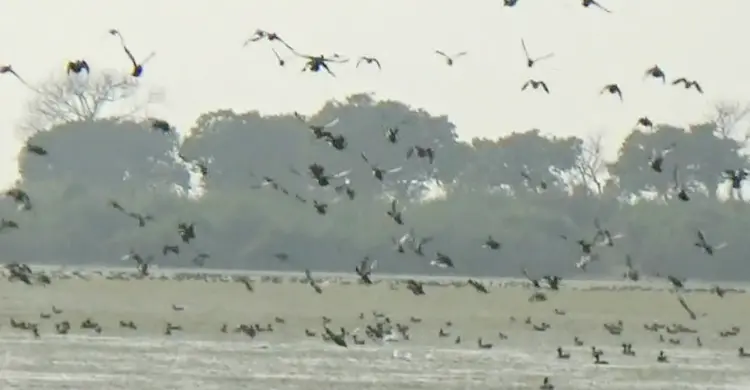
Fewer migratory birds have come this year to Tanguar Haor, the largest and most biodiverse wetland in the country's north-east and one of the world's Ramsar sites. Only a few years ago the haor rang with the calls and wingbeats of migratory birds. This year, although biting winter winds are blowing across the haor at the foot of the Meghalaya hills, the crowds of birds are thin.
People living around the haor say fewer birds have been coming for several years, and this year the fall is steeper. They blame the rampage of bird and fish hunters.
The wetland
Tanguar Haor lies in Tahirpur and Dharmapasha upazilas, about 50 km from Sunamganj district town. Made up of chhoykuri beels and noykuri kandas, it is 11 km long and 7 km wide, and it takes a different form in winter, summer and the monsoon.
In the monsoon it merges with other haors and looks like a sea. In the dry season the whole haor turns into 50 to 60 separate or linked beels. Eleven groves and countless scattered hijal and koroch trees, reeds, dudhilota, blue water lilies, water chestnut, shola, helencha, bontulsi and more than a hundred plant species make it a beautiful sight.
Migratory birds begin gathering in the haor from October. Local cormorants, kalem, native mete ducks, whistling ducks and egrets are joined by more than a lakh migratory birds that stop over in winter, and some stay the whole season.
Migratory birds reach Tanguar Haor, the country's largest water body, in November and December from Siberia, Mongolia, the Himalayas, North Asia, Nepal and other cold countries. Among them, lenja, patihans, butihans, baikal, nilshir, cormorants, patari, dolpipi, rangamuri and pantamukhi stay until February or March.
Hunters in every village
Residents said each of the 88 villages around Tanguar Haor has 8 to 10 bird hunters, and 700 to 800 people now make a living by hunting and selling birds. Fish poachers add to the trouble.
Ripon Mia, who lives by the haor, told Jago News that hunters from every village around it and from outside go into the haor every day. There are professional hunters in Tahirpur Sadar and Ratanshri village, who attack the birds in various ways with traps and nets. Fewer birds are also coming because trees have been lost, he said.
Resident Md Sajinur Mia told Jago News that many have taken up bird hunting as a profession. One bird sells for Tk 800 to Tk 2,000, so many run the business despite the risk, and when they get the chance hunters smuggle birds across the border.
Tahirpur resident Nahid Ahmed said the haor's woodland cannot be restored unless the use of firewood by people living around it is controlled. He proposed distributing gas cylinders and stoves free of charge, saying that protecting the woodland would protect aquatic animals and much other biodiversity.
Sunamganj Deputy Commissioner Md Jahangir Hossain told Jago News that the magistrates in charge and others concerned have been instructed by the district administration to monitor the haor closely so that no one can hunt migratory birds. Anyone who hunts birds will be brought to book, he said.
Source: Jagonews24. First published in Bengali on The Agro News.

Comments
(0)